

***Please take out a membership to support the light of truth.***
Funny to wake up to Marco Rubio’s threats to the International Criminal Court in The Hague, just after I wrote about my visit there.
The ICC is a fact-based sanctuary, a threat to criminal leaders engaged in genocide, crimes against humanity, war crimes, and the crime of aggression. Sitting leaders can be prosecuted. Rubio is an accessory to the murder of truth, and will likely be standing by Trump as he lies to the American public on Thursday night about Venezuela tampering with the 2020 election, confusing Venezuela with Russia in 2016 and hoping no one notices.
Over the weekend, I shared with you my Hot Type column on the next phase in the assault on truth, focusing on multiple reports that indicate Russians are advancing beyond the spreading of disinformation to methodically targeting, poisoning and subverting all trustworthy sources of truth.

I open with my trip to the ICC, because I want you to feel centered and focused on the fact that there are places in this world where international law still functions, despite attacks by fascist regimes. Here is a report I wrote in May about the ground being laid for a Special Tribunal for Russian war crimes.
In my most recent column from June 11, I cite multiple deep dive reports on Russian manipulation of Wikipedia and other reliable and trusted sources.
Who Will Write Our History?
In advance of writing that report, I reached out to intellectual historian Dr. Marci Shore for examples from history on how truth was preserved.
She responded: “The historical examples are all pre-digital, pre-internet. We’re in a different world now. The thing to do used to be to bury archives —the famous example is Emmanuel Ringelblum and the Oneg Shabbat archives.”
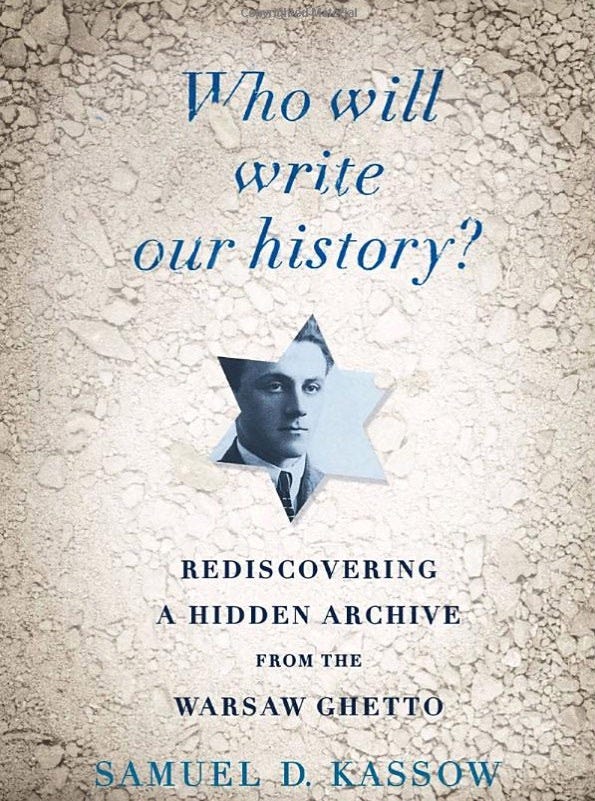
In the book Who Will Write Our History by Samuel Kassow, we learn the story of Ringelblum, a historian “who had the prescience to create and encourage the keeping of an archive in the Warsaw ghetto during the Holocaust.”
According to the book’s description:
“His story cannot be told without reference to the archive itself, which Ringelblum called “Oyneg Shabes” (the joy of Sabbath), primarily because its management committee met secretly to discuss the archive on Saturdays, the Jewish Sabbath. In the Warsaw ghetto, where the archive was assembled and ultimately buried in the ground to protect it from the destruction of the ghetto by the Nazis, this was no mean feat – the archive was born at a time when it was difficult enough for individuals to keep body and soul together, never mind dedicating themselves to a project – more like a mission – that was much bigger than they were…
Nineteen-year-old David Graber, one of the boys who helped to bury the archive at the beginning of August, 1942, at the height of the murderous frenzy that would result in the deaths of almost 300,000 of the ghetto occupants at the hands of the Nazis in Treblinka, scribbled a ‘last will’ that was found with the archive:
‘What we were unable to cry and shriek out to the world we buried in the ground….I would love to see the moment in which the great treasure will be dug up and scream the truth at the world. So the world may know all…May the treasure fall into good hands, may it last into better times, may it alarm and alert the world to what happened…in the twentieth century….We may now die in peace. We fulfilled our mission. May history attest for us.’
The Oyneg Shabes archive itself grew out of the self-help organizations in the ghetto – particularly the “Aleynhilf” (literally, “self-help”), and the house committees – organizations which themselves point up the struggle of the individual within the community, and the community itself, to survive in the Warsaw ghetto.
Shore highlights a woman named Nadezhda Mandelshtam, who “memorized her husband Osip’s poetry — the only safe place was in her head.”
That revelation is something Aleksandr Solzhenitsyn also shared in his book, The Gulag Archipelago about the Soviet forced labor prison camps.

Documenting Ukraine
Shore also recommended we learn about the Documenting Ukraine project, which is working on a digital archive.
Ukrainian historian “Roman Tymoshevskyi has been doing a lot of the work to organize the actual archive part,” she said.
A project of the Vienna-based Institut für die Wissenschaften vom Menschen (IWM) Institute for Human Sciences, Documenting Ukraine objectives include:
Launched in March 2022, Documenting Ukraine seeks to contribute to creating a record of the Russo-Ukrainian War, capturing the human experience of that war, and making it accessible and comprehensible to the broader world.
Through Documenting Ukraine, the IWM supports scholars, journalists, public intellectuals, artists, and archivists based in Ukraine as they work on documentation projects that establish and preserve a factual record—whether through reporting, gathering published source material, or collecting oral testimony—or that bring meaning to events through intellectual reflection and artistic interpretation. Ultimately, the materials collected and produced through these projects will be housed in a complex, transdisciplinary archive.
This is a project that centers Ukrainian intellectual work: the projects are conceived, developed, and carried out by Ukrainians, and Documenting Ukraine grantees retain full intellectual property rights to any work they produce. The same thinking underpins the archive that will result from the project: any materials contributed by people we are supporting are an important part of Ukraine’s intellectual heritage.Documenting Ukraine is part of IWM’s Ukraine and the World program headed by Lesia Ukraїnka Permanent Fellow Prof. Timothy Snyder.
In light of how Russia has tried to erase Ukrainian history on and off for centuries, this project headed by Shore’s husband seems particularly important.
Here are reports from my interviews with Ukrainian historian Tetiana Boriak, who explains the last century of Soviet imperialism and its impacts on Ukraine, including the Executed Renaissance.


The Reckoning Project
Shore also directed us to The Reckoning Project, which has been documenting war crimes in Ukraine, Palestine, and Sudan.
Its mission statement:
“When war crimes go unpunished, violence always returns. The Reckoning Project exists to end that cycle–closing the gap between atrocity and accountability to build a safer, more just world.”
In Ukraine, The Reckoning Project “trains local researchers to gather and document war crimes with precision and care for every witness. Each testimony is rigorously verified and transformed into powerful tools for justice — from legal submissions to media investigations. By bringing truth to both courtrooms and global audiences, we amplify survivor voices and expose Kremlin disinformation.”
The Case of Yuri Dmitriev
In addition, Shore leads us to the case of “Yuri Dmitriev from Memorial, which is unfortunately a good example of how Russia deals with attempts to collect truth.”
In a report on Dmitriev from Eurozine, Irina Galkova writes about “memory as source of personal and collective resistance.”
She wrote:
In 2016, Yuri Dmitriev – the head of the Karelian branch of the Memorial Society – was arrested on an anonymous denunciation, facing false charges that ruined his family’s life and, for himself, have resulted in years of imprisonment.
For more than thirty years – half of his life – Dmitriev has been studying the traces of the Stalinist regime’s crimes in Karelia. Part of his work is spent in archives, the other part in the field in search of secret burial sites. His main topic is the executions during the Great Terror from 1937–38. The truth about them has not been fully disclosed: many sites have not been found and archival documents remain classified. What we know is thanks to enthusiasts like Dmitriev.
The work of restoring the memory of murdered people has never been easy, and in recent years it has become dangerous too. Almost simultaneously with the final verdict in Dmitriev’s case, two central Memorial organizations in Moscow were liquidated, one of which I worked for… He made me think in a deeper and more serious way about the case I was studying. Through him I came to realize that the history of repressions is not just a topic of research, but a source of enormous pain, compressed in the memory of several generations, undisclosed, unprocessed and unmourned.
Touching this pain makes the historian a participant in it. One must make a choice to accept it as one’s own or to distance oneself. In Yuri’s case, it was comprehension of other people’s pain and unwillingness to disassociate himself that led him to become a historian.
Her reflections of present and past — including her visit to him in prison — are sobering, and I encourage you to read the entire article.
We can see the from history the lengths that people will go to to ensure truth is preserved. Burying truth in the ground, as people did in Warsaw, or gathering evidence of war crimes as people are doing now, just some ways to ensure truth is archived from those who build themselves a world of lies in order to evade consequences.
Dr Marci Shore is an American Professor of Intellectual History at the University of Toronto. She left her position at Yale University in the US – with her husband, the historian Timothy Snyder – in August 2024. She is an expert in European history and the author of The Ukrainian Night, and Caviar and Ashes.
****
Thank you again to those of you who support this work.
****
****
Bette Dangerous is a reader-funded magazine. Thank you to all monthly, annual, and founding members.
I expose the corruption of billionaire fascists, while relying on memberships to keep the light on.
Thank you in advance for considering the following:
Share my reporting with allies
Buying my ebooks
A private link to an annual membership discount for older adults, those on fixed incomes or drawing disability, as well as activists and members of the media is available upon request at bettedangerous/gmail. 🥹
More info about Bette Dangerous - This magazine is written by Heidi Siegmund Cuda, an Emmy-award winning investigative reporter/producer, author, and veteran music and nightlife columnist. She is the cohost of RADICALIZED Truth Survives, an investigative show about disinformation and is part of the Byline Media team. Thank you for your support of independent investigative journalism.
🤍
Begin each day with a grateful heart.
🤍
Thank you for your wonderful people and your beautiful heart xxxx