

***Please take out a membership to support the light of truth.***
“One word of truth shall outweigh the whole world.”—Aleksandr Solzhenitsyn
I was changing a suet feeder last week, my mind ruminating on a passage I’d just finished reading in The Gulag Archipelago. In an explosion of rage-absurdity, the book’s author explained why the Soviet forced labor prison camps were unprofitable — malnourished prisoners working 10 to 14-hour days, walking four miles to and from job sites in sub zero weather, aren’t models of efficiency.
“All they were on the lookout for was ways to spoil their footgear—and not go out to work; how to wreck a crane, to buckle a wheel, to break a spade, to sink a pail—anything for a pretext to sit down and smoke. All that the camp inmates made for their own dear state was openly and blatantly botched.”
But it was the following passage that I couldn’t shake:
“In the fifties they brought a new Swedish turbine to Steplag (special camp No. 4). It came in a frame made of logs like a hut. It was winter, and it was cold, and so the cursed zeks crawled into this frame between the beams and the turbine and started a bonfire to get warm. The silver soldering on the blades melted—and they threw the turbine out. It cost 3,700,000 rubles.”
I kept picturing prisoners trying to stay warm, huddled in this makeshift log hut, and as I’m thinking about that profound image, I open the suet feeder, and there at the top curled up in the lid, are four snails huddled in a row — improvising their own shelter.
I don’t know if it was Aleksandr Solzhenitsyn whispering from the grave to keep reading his words, to keep plowing on no matter how painful, but it felt like a moment of serendipity, and so I forged ahead.
Authoritarians have an advantage because too few people read books. To know history is to gain armor against lies. I will forever be grateful for the tutelage of Ukrainian historian Tetiana Boriak, who spent many hours offering the Bette Dangerous community free history lessons on Russian imperialism.

Once I began reading The Gulag Archipelago — a three-volume work that describes life in Soviet prison labor camps in grave detail, I felt a solemn duty to report Solzhenitsyn’s words back to you.
Slavery occurred in the Soviet Union throughout the 20th Century and no one talks about it. But Solzhenitsyn words remain, and it’s time to remind the world of the truth, and pull all Russian propaganda out by its poisonous roots and set it on fire for eternity.
“Lies can prevail against much in this world, but never against art.”—Aleksandr Solzhenitsyn, accepting his Nobel Prize for Literature
The author was born in 1918 and grew up in the port city of Rostov-on-Don. He graduated in physics and math from Rostov University. He also studied literature by correspondence course at the Moscow Institute of Philosophy, Literature, and History. He was an artillery officer in World War II, earning the rank of captain and awarded multiple medals of valor. In 1945, after making derogatory remarks in letters to a childhood friend about Stalin for “betraying the cause of the Revolution”, as well as for his treachery and cruelty, Solzhenitsyn was arrested and sentenced to eight years in forced labor prison camps, followed by internal exile. In 1957, he was allowed to teach in Ryazan and Moscow, where he wrote the novella One Day in the Life of Ivan Denisovich, which describes a single day in a forced labor camp. Soviet leader Nikita Khrushchev personally authorized its publication in the journal, Novy Mir, in 1962, during a period of de-Stalinization. In 1956, Khrushchev had publicly denounced Stalin’s atrocities and cult of personality, resulting in a brief period of relaxed censorship.
“The past, no matter what it was like, never becomes a matter of indifference to the present.”—Novy Mir editor Aleksandr Tvardovsky, in his intro to One Day.
Khrushchev was warned not to allow the publication of One Day. Two decades after its release, Solzhenitsyn said “the 1962 publication of my tale in the Soviet Union is akin to a phenomenon defying physical laws, something like objects falling upwards.” It was a literary earthquake, with people crowding newsstands and ultimately, millions of copies sold.
“I’ll never forget a man who was unable to recall the journal’s name and was asking for ‘the one, you know, where the whole truth is printed.’”—Academician Sergei Averintsev
The unknown writer had submitted his manuscript using as a working title the prisoner’s badge number — the dehumanizing way prisoners were referred to. He also had a poet’s way with words — laconic, unforced — as he described the grim cruelty of daily existence in the camp. This would prove problematic for Khrushchev.
Not only did Solzhenitsyn receive hundreds of letters from former prisoners sharing their own experiences, which would provide the foundation for Gulag, but One Day was translated into dozens of languages.
He had stripped the Soviets of their masks, and the world could see the savage inhumanity that had been there from the very beginning.
Khrushchev’s so-called thaw was short-lived. By the mid-’60s, every copy of One Day was pulled from libraries, and by 1974, the Central Administration for the Protection of State Secrets in the Press (insert screwface emoji here) banned all of Solzhenitsyn’s works. But that was four years after he’d won the Nobel Prize for Literature. And one year after the publication of The Gulag Archipelago, which sped up the collapse of empire.
No longer could French or German intellectuals ignore the totalitarian component of Communist-Totalitarianism. The Soviets built a system of slavery and lies, and with the publication of Gulag, Solzhenitsyn made it impossible to defend that system. Lenin had endorsed it and Stalin expanded it, but it was always part of the Soviet Union. As Solzhenitsyn says, Hitler was Stalin’s disciple, building his camps on Stalin’s model.
No one knows how many millions of people died in the camps — the numbers vary wildly because the Soviets covered it up — but Solzhenitsyn describes the vast number of forced labor prison camps as an archipelago, like an island chain, hiding in plain sight. He dismisses the literature that was written during the era he covers, from the 1910s until 1956, because it doesn’t include references to the prison camps.
The word gulag comes from an acronym of the Soviet government agency that supervised the network of labor camps. Solzhenitsyn used the word archipelago as metaphor — camps scattered through the sea of the society.
Often people were arrested on minor or made-up charges, tortured, starved, and held in camps for decades, where many of those unknown millions were worked to death. After Solzhenitsyn received his eight year sentence, it became common to receive a tenner or 25 years.
In One Day, he describes a teenager who received a 25-year-sentence for offering food and milk to starving men, who turned out to be Ukrainian nationalists. When you read the literary non-fiction of Gulag, you learn how the young people who are arrested become feral in the camps, and how they worship the thieves. In this context, it’s not surprising that thieves now run the country.
“The time may come when we date the beginning of the collapse of the Soviet system from the appearance of Gulag.”—Frankfurter Allgemeine
Gulag’s detailed accounts of human rights abuses by Soviet officials, blew up decades of carefully constructed propaganda.
If a government a century ago was using violence, lies, and fear to exploit their citizens, they will try it again.
This is why I feel the urgency to bring you his words in a report, as I did before the 2024 US election, when I brought you the words of Bella Fromm. I only wish people would have heeded the warnings so clearly sounding from the past.

The Gulag Archipelago was first published in Paris as Arkhipelag GULag in three volumes (1973–75). This report is based on an edition published originally in 1985, which compiled all three volumes together, and my copy was printed by Penguin Random House UK in 2024. The translators are Thomas P. Whitney and Harry Willetts. It was abridged and introduced by Edward E. Ericson, Jr., who saw its publication “as the first crack in the Berlin Wall.”
While the book covers Solzhenitsyn’s own eight years in Soviet prison camps, it also includes 227 fellow prisoners’ stories — some that he’d committed to memory, as well as stories from the letters he received — and any historical sources he could find.
The first two volumes describe the arrest, conviction, transport, and imprisonment of the Gulag’s victims from 1918 to the mid-’50s. Solzhenitsyn is a unique combination of poet, pragmatist, humorist, philosopher, and keen-eyed observer. He is an overuser of exclamation points — admittedly, I have an allergy to the excitable bang — and it took some time to get past the constant interjection (sometimes three in a sentence!).
It felt trivial to complain, like, there but for the grace of god, etc… so I surrendered to its excess and by the third volume, where he describes attempted escapes and camp insurrections, he eased off on the punctuating point altogether. Or maybe I'd become immune, so captivating were the stories of heroism in the darkest of circumstances I no longer cared.
Solzhenitsyn, who was arrested and exiled from the Soviet Union in February 1974, dedicates the book “to all those who did not live to tell it” and even today, proceeds from its sale go to the fund he set up, the Russian Social Fund for Persecuted Persons and Their Families.
The book was written in secret, and in draft form, it never existed in its entirety anywhere, he was constantly smuggling pages, and hiding his writings where he could.
As I was reading it, it reminded me in some ways of the book Auschwitz: A Doctor's Eyewitness Account, the memoir of Dr. Miklós Nyiszli, the Hungarian Jewish physician who made a deal for his family to survive the Holocaust as he was forced to act as a forensic pathologist and performing medical experiments for Dr. Josef Mengele. It wasn’t because of the content, although cruelty and violence always offer parallels, but because both men can describe scenes of unfathomable evil with calm, but each would explode periodically with rage.
You can sense the agony dripping from Solzhenitsyn’s pen when he describes in detail what happened to the bodies of prisoners, the different scientific phases of starvation, particularly when he describes how women were treated. Upon arrival, they were “examined like merchandise.” He describes how “attractiveness was a curse” — how savagely they were treated.
I still can’t shake the fact they never had a chance to get really clean — warm water was rare, and he describes how people bathed only every ten days. And of course, along with frequent sexual assaults, there was the starvation.
He writes of the women enslaved in labor camps:
“The body becomes worn out at that kind of work, and everything that is feminine in a woman, whether it be constant or whether it be monthly, ceases to be. If she manages to last to the next ‘commissioning,’ the person who undresses before the physicians will be not at all like the one whom the trusties smacked their lips over in the bath corridor: she has become ageless; her shoulders stick out at sharp angles, her breasts hang down in little dried-out sacs; superfluous folds of skin form wrinkles on her flat buttocks; there is so little flesh above her knees that a big enough gap has opened up for a sheep’s head to stick through or even a soccer ball; her voice has become hoarse and rough and her face is tanned by pellagra.”
He described pellagra: “If your face grows dark and your skin begins to peel and your entire organism is racked by diarrhea, this is pellagra.”
The jailers were terribly inconvenienced by the magnitude of corpses, and the deceased were often defiled by bayonets and with mallets, before “the big toe of the corpse’s right foot with his prison file number. Corpses were tossed into pits in their underwear until a new regulation ruled that they should be buried naked — clothing shouldn’t be wasted on the dead. Stalin knew how to economise.”
“Unlimited power in the hands of limited people always leads to cruelty.”—Aleksandr Solzhenitsyn, The Gulag Archipelago
As I wrote in my initial preview of Gulag, Jailer in Chief, the “tsars of the Archipelago” had to be cruel and merciless. Anyone who exhibited any spiritual training or a ‘minimally circumspect conscience’ — even a speck of kindness — were eliminated.

The jailers had to be “constantly a weapon of violence, a constant participant in evil,” as they tried to turn people into slaves, systemically and sadistically. The aim was to demoralize and dehumanize the occupants, who while being starved and worked to death, were also being starved of any humanity.
The reading of the volumes of this book are so unbearably grim, so relentlessly cruel, I want to tell you that it has a fairytale ending, and that the people rise above and the Soviets repented of their evil, and that monuments begging forgiveness were built to those enslaved and that Lenin and Stalin’s names were forever tarnished, associated with the level of atrocities that one associates Hitler and the Nazi leaders with, but that is not the story.
There are moments where the prisoners triumph briefly — a three-day hunger strike results in jailers begging the prisoners to eat on day two, and they hold out for another day — and there are some incredible acts of defiance and escape. There are stories of people who refuse to become informants, who refuse to give up their humanity — even if it’s simply in the secret life of thought.
But overall, this is an inside account of horror events of the twentieth century for which there has been no accountability. The Russians celebrate the defeat of the Nazis, while refusing to liberate their own history.
I have hundreds of highlighted pages, and I find it difficult to go back and revisit — there is too much evil on those pages.
But I return out of duty. I am writing this having not slept all night, because I know we will be faced with another day of soul manipulation, of liars on camera, and reality being buried under propaganda rubble, and I can’t put it off. News delayed is news denied, and his words call out to us today.
“If freedom still does not dawn on my country for a long time to come, then the very reading and handing on of this book will be very dangerous, so that I am bound to salute future readers as well—on behalf of those who have perished.”—Aleksandr Solzhenitsyn, Author’s Note
I met a friend in Paris, who saw I was reading Gulag.
He tells me his father is in a Russian prison.
I say, “That means he must be an honest, decent man.” I learned that from Solzhenitsyn, who relays how a 14-year-old said: “Every honest man is sure to go to prison.” His father was in prison, and he was certain he would be forced to go to, and he was.
My friend tells me police found evidence on his father’s phone of support for Ukraine. For that, he received a seven-year sentence.
“The majority sit quietly and dare to hope.”—A.S.
As I read his words, I see that the jailers are sometimes prisoners, too. They may be allowed outside the barbed wire, but they are not free men.
Pages and pages and pages of pages of torture techniques — “not by one scoundrel, alone in one secret place only, but by the tens of thousands of specially trained beasts standing over millions of defenseless victims” and how it was all being “practiced in the flowering of the twentieth century in a society based on socialist principles” with a “revolver on the desk.”
“How medieval! How primitive!”
“In keeping silent about evil, in burying it so deep within us that no sign of it appears on the surface, we are implanting it, and it will rise up a thousandfold in the future.”—A.S.
He is writing in a previous century, the events of a previous century, so why do his words cry out with urgency?
Like, this line: “Things repeated on the radio day after day drill holes in our brains.”
As he writes of the “permanent twilight in the cells,” I keep thinking about an interview I just did with a survivor of Russian captivity. To survive is to win, she said. That Solzhenitsyn survived is one of our best weapons in this moment. It’s not too late for his words to bring Russia back to its knees.
“It is a rare zek who has not known from three to five transit prisons and camps; many remember a dozen or so, and the sons of Gulag can count up to fifty of them without the slightest difficulty. However, in memory they get all mixed up together because they are so similar: in case files the illiteracy of their convoys, in their inept roll calls based on; the long waiting under the beating sun or autumn drizzle; the still longer body searches that involve undressing completely; their haircuts with unsanitary clippers; their cold, slippery baths; their foul-smelling toilets; their damp and moldy corridors; their perpetually crowded, nearly always dark, wet cells; the warmth of human flesh flanking you on the floor or on the board bunks; the bumpy ridges of bunk heads knocked together from boards; the wet, almost liquid, bread; the gruel cooked from what seems to be silage…
“Shut your eyes, reader. Do you hear the thundering of wheels? Those are the Stolypin cars rolling on and on. Those are the red cows rolling. Every minute of the day. And every day of the year. And you can hear the water gurgling—those are prisoners’ barges moving on and on. And the motors of the Black Marias roar. They are arresting someone all the time, cramming him in somewhere, moving him about. And what is that hum you hear? The overcrowded cells of the transit prisons. And that cry? The complaints of those who have been plundered, raped, beaten to within an inch of their lives. We have reviewed and considered all the methods of delivering prisoners, and we have found that they are all . . . worse. We have examined the transit prisons, but we have not found any that were good. And even the last human hope that there is something better ahead, that it will be better in camp, is a false hope. In camp it will be . . . worse.”—A.S.
He writes about those invited to tour the camps, and how they created Potemkin scenes for the reporters, who then wrote about the greatness of forced labor prison camps, yes, these same camps where corpses were bayoneted and buried without underwear.
And I think, how much this sounds like today, this very day, when American and British born propagandists are telling the world how nice Russia is, how pretty and clean and churchy. The same Russia that assassinates reporters and dissidents, and refuses to come clean about its medieval actions in the twentieth century, as it savages Ukraine, again, as it savages the democratic world — the poison of its propaganda trees flowering death.
“This is the price man pays for entrusting his God-given soul to human dogma.”—A.S.
Bonfire of the Zeks
I opened with the image of the fire that melted the turbine, as people just tried to stay warm. The book is filled with images of survival, by every means possible. It is populated with not only political dissidents, the innocent who got picked up to fill quotas, thieves, and children — until the children, continuously outwitting and humiliating the guards, become too much of a liability and they stop putting them in camps. But it also populated by priests and nuns, who often share cells with sex workers. The workers get a three-year-sentence. The nuns get a tenner.
In “that savage world,” the prisoners began to savage the informants — the “stool pigeons.” Sometimes, the informants didn’t wake up, like the unfortunate character with a throat mishap found lying on his bunk in the opening scene of One Day.
And those who refused to become informants were often sent to penal colonies.
“The majority died there and naturally cannot speak about themselves,” he writes. “And the murderers from State Security are even less likely to speak of them.”
The Soul and the Barbed Wire
It’s in the Gulag, the thief sees his crimes as a mark of valor, and he dreams of bigger and better feats.
“The only place where one can steal on a big scale is from the state,” he writes.
I think of both Putin and Trump and their large-scale gluttonous thievery. They can steal on a big scale because they have the state, and both were stealing from the very beginning.

But the innocent, they “see with the eyes of truth” — Solzhenitsyn calls it their “secret weapon” against the Gulag. “Survive at any price” becomes a vow.
Here he paints another unforgettable scene:
“At the Samarka Camp in 1946 a group of intellectual had reached the very brink of death: They were worn down by hunger, cold, and work beyond their powers. And they were even deprived of sleep. They had nowhere to lie down. Dugout barracks had not yet been built. Did they go and steal? Or squeal? Or whimper about their ruined lives? No! Foreseeing the approach of death in days rather than weeks, here is how they spent their last sleepless leisure, sitting up against the wall: Timofeyev-Ressovsky gathered them into a ‘seminar,’ and they hastened to share with one another what one of them knew and the others did not—they delivered their last lectures to each other. Father Savely—spoke of ‘unshameful death,’ a priest academician—about patristics, one of the Uniate fathers—about something in the area of dogmatics and canonical writings, an electrical engineer—on the principles of the energetics of the future, and a Leningrad economist—on how the effort to create principles of Soviet economics had failed for lack of new ideas. Timofeyev-Ressovsky himself talked about the principles of microphysics. From one session to the next, participants were missing—were already in the morgue.”
He speaks on how only those who are liberated in their own soul can actually become liberators.
“What sort of a country it was that for whole decades dragged that Archipelago about inside itself?” he asks. “It was my fate to carry inside me a tumor the size of a large man’s fist. This tumor swelled and distorted my stomach, hindered my eating and sleeping, and I was always conscious of it (though it did not constitute even one-half of one percent of my body, whereas within the country as a whole the Archipelago constituted 8 percent). But the horrifying thing was not that this tumor pressed upon and displaced adjacent organs. What was most terrifying about it was that it exuded poisons and infected the whole body. And in this same way our whole country was infected by the poisons of the Archipelago. And whether it will ever be able to get rid of them someday, only God knows. Can we, dare we, describe the full loathsomeness of the state in which we lived (not so remote from that of today)? And if we do not show that loathsomeness then we at once have a lie.”
This is why he disregards the literature of the ‘30s - ‘50s. “Because without the full truth, it is not literature,” he states.
“Peace of mind is something our citizens have never known.”—A.S.
I go back and scan the photos in the book, his face as a young officer, and his face upon release from the Gulag chain. I see scorched sorrow. I see a warning from the grave. Do something before it’s too late for your country! For the world!
And yes, the exclamation points are mine, a gift from him.
As he describes the mutinies that occurred as his stretch wore on, he writes: “Like all embarrassing events in our history—which means three-quarters of what really happened—these mutinies have been neatly cut out.”
But they happened, and it began in earnest when they started to kill the stoolies.
“Make knives and cut stoolies’ throats—that was it,” he writes.
The tormentors took notice. Although they were still “stuck in the quagmire of slavery,” a shift had taken place, in part, because a “nauseating indifference” on how things played out led to an impromptu hunger strike that led to the beginning of the collapse of the “special camp” system.
“Everybody knew how easy it was to make knives, and easily they sunk home between the ribs.”
This created an “earthquake on their little island.”
From that tremor, Solzhenitsyn was expelled out of the camp and into internal exile.
The Devil Was Unclenching His Jaw
On his first night outside the barbed wire, he writes: “I cannot sleep! I walk and walk and walk in the moonlight. The donkeys sing their song. The camels sing. Every fiber in me sings: I am free! I am free!”
He takes a private lodging in a hen house, a happy man, only to wake up and find out that Stalin is dead.
He wants to howl with joy and “dance a wild jig! But alas, the rivers of history flow slowly. My face, trained to meet all occasions, assumed a frown of mournful attention.”
I pause and think about all the elderly Russians who lived in my West Hollywood neighborhood in the ‘90s. They never smiled, not once. I feel closer to understanding.
I read about how he adjusted to life without his “comrades in misfortune” in “special camps” that produced only “industrial goods and corpses.”
He thought for certain many historians would begin the heavy lift of documenting the labor camps, revealing them to the world, but it never happened. A few books survive, but mostly, “grief grew forgetful,” the mists of time cloud the memory.
But his work remains, and that’s what’s important.
In his final chapter, he writes repeatedly, presciently: “There Is No Law… There is no law.”
No exclamation points. Just the observation.
“The same treacherous secrecy, the same fog of injustice, still hangs in our air… there is no law.”
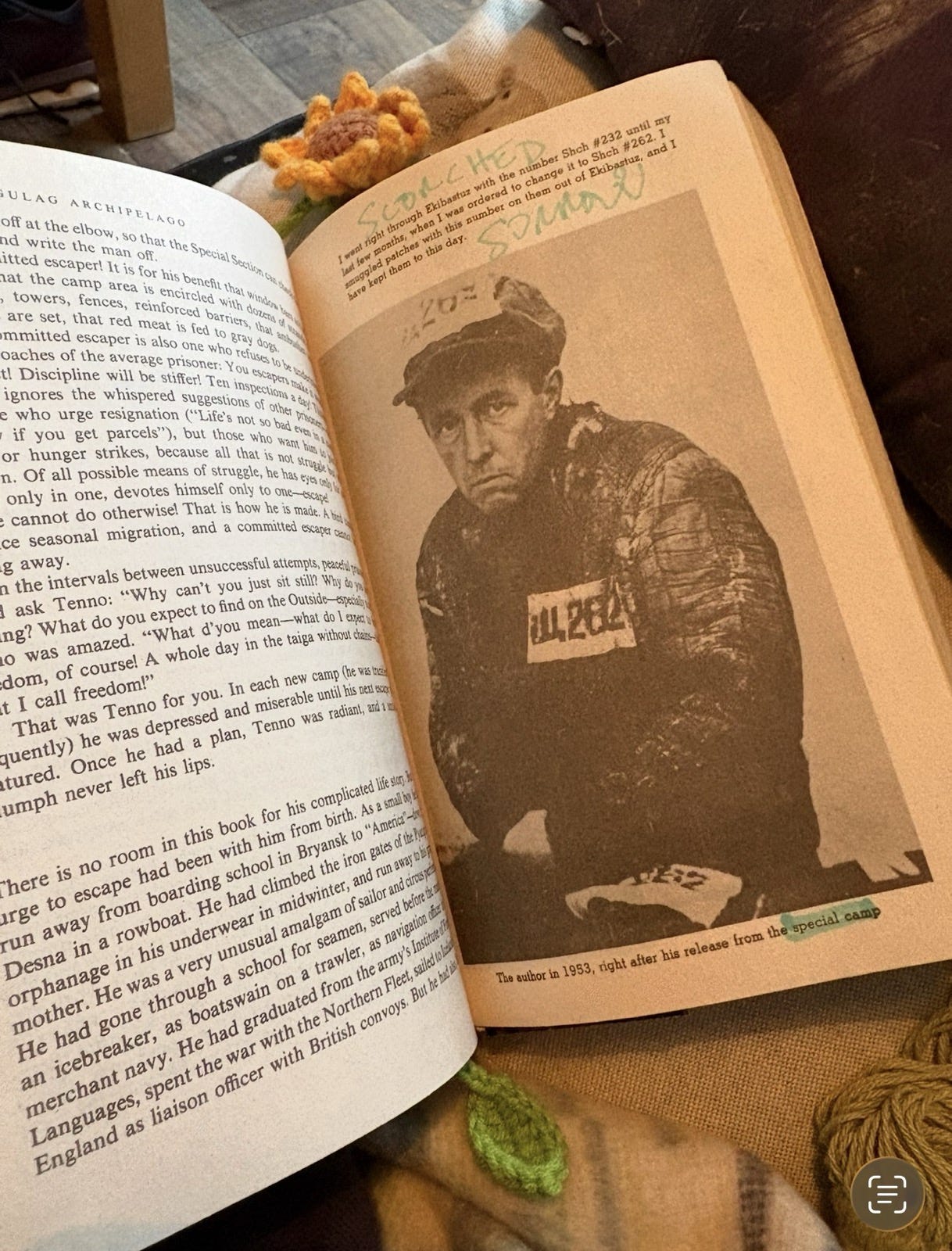
Due to the raids on his archives, he kept “traveling from place to place with these bits of paper” that became the foundation for Gulag, and he explained:
“The jerkiness of the book, its imperfections, are the true mark of persecuted literature. Take the book for what it is.”—written from a hiding place in 1967
In that same 1967 passage, from the Author’s Afterward he writes:
“I am finishing it in the year of a double anniversary… it is fifty years since the revolution which created the Gulag, and a hundred since the invention of barbed wire (1867). This second anniversary will no doubt pass unnoticed.”
****
****
Related:


****
Bette Dangerous is a reader-funded magazine. Thank you to all monthly, annual, and founding members.
I expose the corruption of billionaire fascists, while relying on memberships for support.
Thank you in advance for considering the following:
Share my reporting with allies
Buying my ebooks
A private link to an annual membership discount for older adults, those on fixed incomes or drawing disability, as well as activists and members of the media is available upon request at bettedangerous/gmail. 🥹
More info about Bette Dangerous - This magazine is written by Heidi Siegmund Cuda, an Emmy-award winning investigative reporter/producer, author, and veteran music and nightlife columnist. She is the cohost of RADICALIZED Truth Survives, an investigative show about disinformation and is part of the Byline Media team. Thank you for your support of independent investigative journalism.
🤍
Begin each day with a grateful heart.
🤍