

***Please take out a membership to support the light of truth.***
“The assault on the musicians was the culmination of nearly a decade of suffocating cultural repression.”—History After Dark
Author’s note: They’d taken their name from a Frank Zappa song, and they just wanted to rock in peace. But the Czech secret police saw the psychedelic rock band, Plastic People of the Universe, as an existential threat, and in imprisoning its members, they helped ignite an organized dissident movement that resulted in the demise of Soviet totalitarian rule in Czechoslovakia. Thanks to disinformation analyst Alex Alvarova, who discovered the report on Facebook, I am cross-posting from the original post from the account, “History After Dark.”—hsc
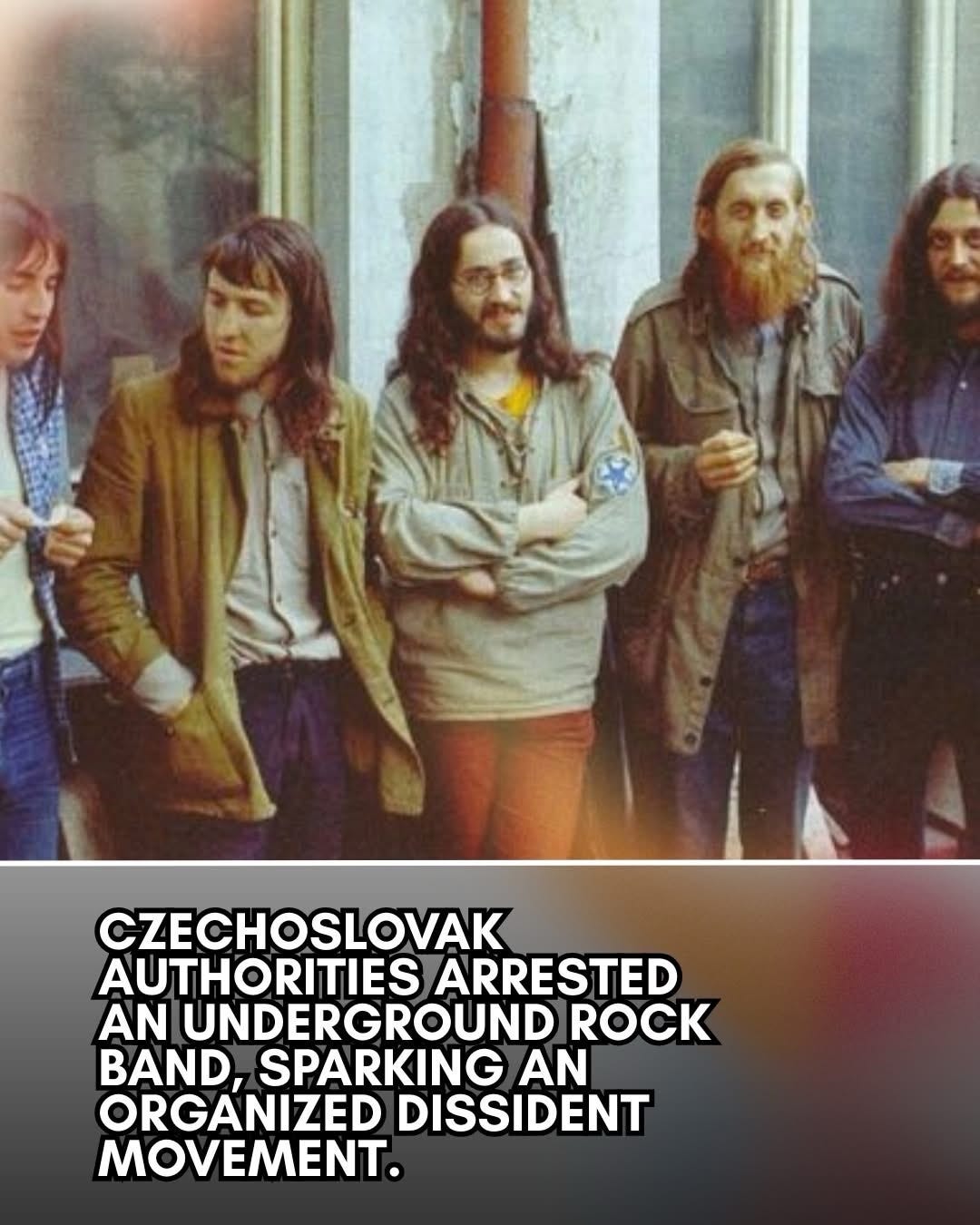
“History After Dark” — ‘An Exercise in Bureaucratic Absurdity’
In March 1976, Czechoslovak secret police launched an operation to destroy an underground rock band. Across Prague and provincial villages, State Security officers raided apartments and rehearsal spaces, arresting nineteen young musicians and artists. The primary target was a psychedelic rock group called The Plastic People of the Universe.
They had released no hit records, broadcast on no state radio stations, and held no political rallies.
Their music was a hypnotic wall of electric viola, squealing saxophone, pounding bass, and avant-garde poetry inspired by the Velvet Underground and Frank Zappa. Yet to the communist regime in Prague, their uncombed hair, nonconformist lyrics, and refusal to register with state cultural agencies represented an intolerable ideological contagion.
In a totalitarian society undergoing rigid normalization, even an unauthorized drumbeat was viewed as an act of subversion.
The assault on the musicians was the culmination of nearly a decade of suffocating cultural repression.
A Simple Refusal
Following the August 1968 Soviet invasion that crushed the Prague Spring, Party General Secretary Gustáv Husák instituted a sweeping policy known as “normalization.” The regime purged universities, silenced independent publishing, and forced the entire arts sector under strict bureaucratic control. Rock bands wishing to perform in public were required to cut their hair, pass ideological examinations before party committees, translate English song titles into Czech, and submit their lyrics for state censorship. The Plastic People of the Universe simply refused. Stripped of their professional performance license in 1970, they abandoned the state-sanctioned music industry entirely. Under the intellectual guidance of their artistic director, art historian Ivan Martin Jirous, known as “Magor” or the Madman, the band retreated into what they called the “Second Culture.” They performed at private weddings and secluded barn festivals, playing purely for friends who gathered by word of mouth in the countryside.
The regime decided to crush the underground enclave before it could spread.
On February 21, 1976, the band and their circle gathered in the southern village of Bojanovice for the Second Music Festival of the Second Culture, staged as a private celebration of Jirous’s recent wedding. Weeks later, State Security struck with coordinated arrests, seizing the musicians and confiscating guitars, amplifiers, and tape recordings.
To avoid accusations of political persecution, prosecutors charged the artists not with ideological crimes, but under Article 202 of the penal code for “breach of the peace” and vulgar hooliganism, pointing to coarse slang and street language in their lyrics.
But the crackdown produced a consequence the authorities never anticipated.
When news of the arrests reached Václav Havel, a prominent dissident playwright living under constant surveillance in rural Hrádeček, he recognized that something fundamental was at stake.
No Citizen’s Freedom Was Safe
The musicians had no political program and sought no power; they simply wanted to play their instruments in freedom. If the state could criminalize young men merely for playing music and living authentically, Havel realized, no citizen’s freedom was safe.
Havel immediately launched a campaign to bridge Czechoslovakia’s fractured intellectual world. He reached out to figures who had spent years divided by deep political and ideological chasms: elderly Catholic philosophers, expelled reform communists from the 1968 Dubček era, liberal writers, and young, long-haired rock musicians who distrusted traditional politics entirely.
Havel visited Jan Patočka, one of the nation’s most respected phenomenological philosophers, persuading the aging scholar that defending the musicians was an urgent moral imperative. When the trial opened on September 21, 1976, at the District Court for Prague 2, the scene was extraordinary. In the narrow, linoleum-floored corridor outside the courtroom, Nobel Prize nominees, internationally renowned playwrights, former government ministers, and foreign journalists stood shoulder-to-shoulder with denim-clad underground fans. The regime’s attempt to paint the musicians as degenerate delinquents collapsed under the weight of universal solidarity.
An Exercise In Bureaucratic Absurdity
Inside the courtroom, the proceedings were an exercise in bureaucratic absurdity. Prosecutors solemnly read out avant-garde song lyrics, treating crude vocabulary as a direct threat to the socialist order, while defense witnesses testified that artistic expression could not be dictated by criminal statutes.
On September 23, the court delivered its verdict: Ivan Martin Jirous was sentenced to eighteen months in prison, while three other underground musicians—Pavel Zajíček, Vratislav Brabenec, and Svatopluk Karásek—received sentences ranging from eight to twelve months.
A Permanent Unified Front
But the regime’s legal victory was an unmitigated political disaster. In the hallways of the Prague courthouse, the disparate factions of Czechoslovak society had met, talked, and discovered common ground. They realized they needed a permanent, unified front against state arbitrariness.
Taking advantage of the fact that the Czechoslovak government had recently ratified the 1975 Helsinki Accords and published the International Covenants on Human Rights in its official legal code, the group decided to hold the regime accountable to its own written laws.
A Manifesto of Moral Resistance
By December 1976, meeting in secret apartments to draft a manifesto of moral resistance, this coalition created Charter 77. Published in January 1977 with 242 initial signatures, the declaration named Václav Havel, Jan Patočka, and former foreign minister Jiří Hájek as its spokespersons, demanding that the state respect the basic human rights it had promised the world on paper.
The regime responded with savage fury, subjecting the signatories to relentless interrogations, job dismissals, and long prison terms; Professor Patočka died in March 1977 following an eleven-hour police interrogation, and Havel spent nearly five years behind bars.
Yet the moral network forged to protect a rock band never broke. Thirteen years after the musicians were led into court in handcuffs, the communist dictatorship crumbled in the peaceful Velvet Revolution of November 1989, and Václav Havel was elected president of a free Czechoslovakia. In its clumsy attempt to silence an unpolitical rock band, a totalitarian regime had inadvertently built the coalition that brought about its own demise.
****
****


****
Bette Dangerous is a reader-funded magazine. Thank you to all monthly, annual, and founding members.
I expose the corruption of billionaire fascists with support from your memberships.
Thank you in advance for considering the following:
Share my reporting with your networks
Buying my ebooks
A private link to an annual membership discount for older adults, those on fixed incomes or drawing disability, as well as activists and members of the media is available upon request at bettedangerous/gmail. 🥹
More info about Bette Dangerous: This magazine is written by Heidi Siegmund Cuda, an Emmy-award winning investigative reporter, author, and broadcast news veteran, as well as former music and nightlife columnist for the Los Angeles Times. A No. 1 Amazon best-selling author and award-winning film director, Cuda writes the Hot Type column in Byline Times, an independent UK-newspaper. She executive produced the film Kherson: Human Safari. Thank you for your support of independent investigative journalism, arts, and culture reporting.
🤍
Begin each day with a grateful heart.
🤍