

***Please take out a membership to support the light of truth.***
Author’s note: I was a speechwriter in a previous life, and I woke up to a bunch of messages that Mark Carney must be reading my Substack. Unlikely, but maybe his speechwriter is… I am proud to say that Bette Dangerous is supported by a former Canadian Prime Minister, in fact, she was among the first to support my work. In addition, I am supported by many academics working in Canada, and I’m thrilled my boutique magazine now reaches 92 countries. It is not surprising that in this desperate hour, we are seeing a renaissance of writers who lived under Communist Totalitarianism. Earlier today, I posted my first report on the words of Václav Havel. I just dug up my Byline Hot Type column on Power of the Powerless, also published in March 2025. I wrote both reports in a fever dream, holed up in a hotel room in Nice, oblivious to my proximity to the sea, intent on getting words out to you that might be helpful. Please share this post with those in your networks who are just catching up.—hsc
Originally published in Byline Supplement March 22, 2025; and Byline Times print edition May 2025
In today’s Hot Type column for Byline Supplement, I continued my exploration of Václav Havel’s profoundly important series of dissident essays from 1978, The Power of the Powerless:

You can read the column in full at Byline Supplement. This week’s Hot Type column has no paywall, and I also am publishing it below.
Reading it again today, I felt hot tears well up. We are going to have to be braver than we want to be, each of us who are dedicated to living within the truth.
I am so grateful to my friends who continue to do the work of truth-telling during an era of lying brutality.
I would be very grateful if you shared the column with your networks. Byline is independent and every share, like, and subscribe helps enormously.
In solidarity, truth, reality, and unity,
Heidi xo
Hot Type: Being Braver Than We Want to Be
American columnist Heidi Siegmund Cuda turns to Václav Havel’s dissident essays from 1978, ‘The Power of the Powerless’, to learn how people can find a collective way back from democratic ruin
Byline Supplement, March 22, 2025
In 1969, when I was five years old, I traveled with my parents to Czechoslovakia. It was the same year my parents became proud US citizens. It was the same year humans landed on the moon. I recall making party favors for their citizenship celebration, using tie-dye bouncing balls that I painted to mirror the moon, attaching little astronaut figures holding American flags.
I remember the noticeable difference between the land where my father was born and the land that welcomed him as a new citizen.
I didn’t know anything about communism or cold wars, but I just recall how depressed the area felt. It seemed to be a continuous land of grey. I recall flies circling around a too warm silver juice packet I was given that tasted sickly sweet. My parents are German, each born in German communities in what was then Czechoslovakia and Yugoslavia.
I couldn’t wait to leave and get back to Munich, where their siblings now lived. I also couldn’t wait to get back to our home in the San Francisco Bay Area, which was vibrant with color and energy and love.
So when I picked up a copy last week of The Power of the Powerless by Václav Havel — poet, playwright, dissident, and former President of Czechoslovakia and later the Czech Republic — the words ‘unbroken grey’ leapt out at me.
I found them in the 2018 edition of the 1978 book of Havel’s essays in an introduction written by Yale professor Timothy Snyder, who described the communism of the period as “unbroken grey”.
Even at five, I recall the visit to my dad’s birth country as filled with people whose spirits had been broken, they seemed hunched and weary. 1969 was mid-way through 41 years of communist rule in Czechoslovakia, and a year after the mass protests of the Prague Spring.
I returned to Czechoslovakia, now the Czech Republic, in 1994, five years after the Velvet Revolution. By then, the playwright/dissident Havel was President, but I could still sense what he referred to as the “dark traces” — scars on the psyche left by decades of living within a totalitarian system. Even in public interviews, his eyes were downcast.
His friend Madeleine Albright said it was because he’d been through interrogations when imprisoned in the Soviet era, and that looking into an interrogator’s eyes was dangerous.
I had only known California love. We didn’t bear those kinds of scars.
Due to the collapse of my country, which surrendered to Russia in full view of the world on February 28, 2025, I have been seeking out dissident voices from the past — what Albright called ‘intellectual troublemakers’ — to help us figure out what we need to do in the present.
The Power of the Powerless contains so much brilliant insight. He warned Western nations that they are far closer to totalitarian capture than they may realize, largely due to the moral and spiritual laziness of consumerism. And he cautioned how technology “has enslaved us and compelled us to participate in our own destruction”. He wrote those words nearly 50 years ago.
There is so much richness in the slim volume, and I encourage anyone who is willing to invest the time to please read it. I created a summary of salient passages for my substack audience.
A Total Assault on Humans
Intellectual historian Marci Shore, who teaches a course at Yale on The Power of the Powerless calls it “one of the most important texts of the 20th century”.
The key thing Havel understood was that the post-totalitarian system, which is how he referred to the communist system governing Czechoslovakia in the 1970s, was “mounting a total assault on humans and humans stand against it alone”.
He also explained why dictators are so afraid of artists — afraid of poets, musicians, writers, philosophers. Because those who unfailingly “live within the truth” can raise the “social consciousness” of others.
In his essays, he hammers home the idea that when people collectively accept to “live within the lie” they then become active participants in the continuation of dictatorships.
He dismisses ideology as a cover that a brutal government uses to “grant itself legitimacy”, noting that the real “power is derived from the numbers of soldiers and police”. He describes the mask of ideology as having “a certain hypnotic charm”.
“All one has to do is accept it,” Havel wrote. “Of course, one pays dearly for this low-rent home: the price is abdication of one’s own reason, conscience, and responsibility.”
On ideology, he also wrote: “Ideology is a specious way of relating to the world. It offers human beings an illusion of an identity, of dignity, and morality while making it easier for them to part with them… it enables people to deceive their conscience… a veil behind which human beings can hide their own fallen existence.”
The Yawning Abyss
He referred to the division between the system and the needs of the true self as a “yawning abyss” — a “world of appearances trying to pass for reality”.
In those words, I see my own country — a land now of accepted lies and a media system that normalizes the lies. I also see a greater need to turn to independent writers and historians for a constant source of truth.
These are the people willing to ‘live within the truth’ and who are being targeted as they continue to strive to raise collective social consciousness.
Because by now, no media outlet should be portraying Elon Musk as a great man — he is nothing more than a Russian bot being detonated to destroy America and save Putin. Donald Trump has his role, just another Viktor Yanukovych doing the bidding of the Kremlin.
To those of us dedicated to truth, it’s easy to see reality, not the “world of appearances trying to pass for reality”, as Havel wrote.
In 1978, when Havel writes of Czechoslovakia, he is also writing of America in the future:
“Because the regime is captive to its own lies, it must falsify everything. It falsifies the past, it falsifies the present, and it falsifies the future.”
He explains that since the “main pillar of the system is living a lie, the fundamental threat to any dictatorial regime is living in truth”.
As he predicted the enslavement by technology, he also offered us a way out: “a radical renewal toward a moral reconstitution of society… of values like trust, openness, solidarity, and love”. He told readers that the brighter future may already be here if we are just willing to see it.
The Power of the Powerless was published illegally in Czechoslovakia and smuggled out into Poland. In 1979, Havel received a four and a half year prison sentence.
He would go on to help lead the Velvet Revolution, the non-violent movement that toppled the communist system in Czechoslovakia in 1989. He was elected as the last President of Czechoslovakia on December 29, 1989, and the first President of the Czech Republic. A poet, a playwright, a dissident became a President. The posters at the time read: Havel na Hrad (Havel to the Castle).
In February of 1990, in an interview with newsman Jim Lehrer for PBS, he was asked if there was something basic in all human beings that relates to freedom, even for those who never knew it.
“I think this is part of the nature of man — a desire for freedom, for a dignified life,” he responded, his eyes downcast. “Of course, man is also a weak creature with many bad qualities. The totalitarian system was masterful in how it managed to mobilize all the bad qualities.”
Lehrer asked what kind of damage that system caused to the psyche of the people and Havel responded that “the dark traces left by the era of totalitarianism in the human mind are difficult to do away with”.
Upon his death on December 18, 2011, former US Secretary of State Albright, who was born in Czechoslovakia, called her friend Václav Havel one of the great figures of the 20th century.
“He is one of the people that was able to be a part of overthrowing a dictatorial system by talking to people,” she told PBS. “He had moral stature… speaking out and having that strong moral fiber, people just knew that he told the truth to people who had only heard lies. That’s his legacy.”
As we enter a brutal era where lies are being normalized and thinking is discouraged, we have to turn to dissident voices to learn how to resist totalitarianism once again, before the future disappears.
Normalization is Unfreedom
“Havel’s point is that normalization is unfreedom… suppressing your individuality,” wrote Timothy Snyder in the introduction to the 2018 edition of The Power of the Powerless. “Havel thought that television was making a new animal species out of us, the ‘herded televisual human’…
“In the West, Havel claimed in 1978, people ‘are manipulated in ways that are infinitely more subtle and refined than the brutal methods used under communism’. After Brexit and Trump, we know that surprising results in public life can be attained by psychologists and programmers normalizing unwitting voters.”
Snyder wrote that Putin and his St. Petersburg cronies aim to teach “Russians, Europeans, and Americans” to believe “that there are no alternatives to lawless, oligarch capitalism”.
We know, of course, that is not true, and that they are liars, and that lies are brittle things, easily punctured by truth.
We are simply reliving history. Snyder reminds us about the time when “Brezhnev’s client, the Czech leader Gustáv Husák, claimed protestors were paid agents” and compares it to today, when “Putin’s client, the American President Donald Trump, says the same”.
In his conclusion to the introduction that Snyder wrote from Vienna on June 24, 2018:
”Facing a situation that seemed unalterable in the 1970s, Havel maintained that truthful words and actions of citizens matter, and that each of us has the responsibility to be a bit more courageous than we want to be.”
Courage is infectious, and I think quite necessary.—Heidi Siegmund Cuda for Byline Supplement, March 22, 2025
****
****
Related:


****
Bette Dangerous is a reader-funded magazine. Thank you to all monthly, annual, and founding members.
I expose the corruption of billionaire fascists, while relying on memberships to keep the light on.
Thank you in advance for considering the following:
Share my reporting with allies
Buying my ebooks
A private link to an annual membership discount for older adults, those on fixed incomes or drawing disability, as well as activists and members of the media is available upon request at bettedangerous/gmail. 🥹
More info about Bette Dangerous - This magazine is written by Heidi Siegmund Cuda, an Emmy-award winning investigative reporter/producer, author, and veteran music and nightlife columnist. She is the cohost of RADICALIZED Truth Survives, an investigative show about disinformation and is part of the Byline Media team. Thank you for your support of independent investigative journalism.
🤍
Begin each day with a grateful heart.
🤍

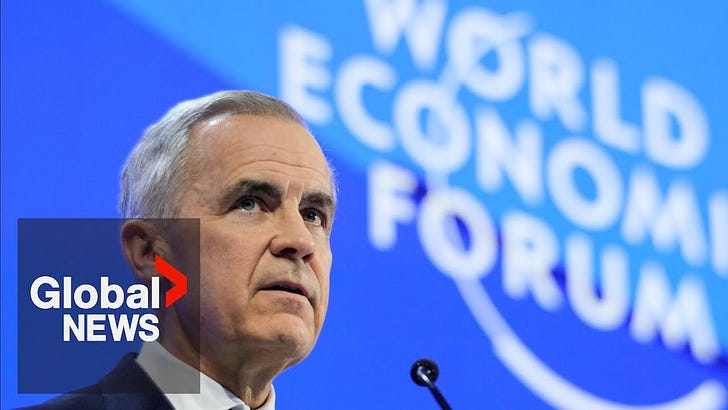
This entry is one I pinned and saved last winter, when you first wrote/published it. So apropos this morning, a day after Carney’s speech and an hour or so after trump’s rant.
Even though not a single leader in that room in Davos was able to “ take down their sign” by walking out on trump today, leaving Carney, a little more alone than he should be not with standing their applause yesterday — I will still turn to you and Havel, Snyder and Shore, Albright, my dad and many others for inspiration — all to be braver than we might want to be.