

***Please take out a membership to support the light of truth.***
“Every vatnik has a reason that they support Russia, and it is usually a matter of public record.”—Matthew Pearce for Bette Dangerous
Author’s note: In recent years, convicted rapist Russell Brand has been performing as a pro-Kremlin mouthpiece, and it’s not unusual for ardent Russian propagandists to also have a history of sexual deviancy and criminal convictions. As we learned from Russian watcher Keir Giles, compromised people make great KGB targets. With that in mind, I asked North Atlantic Fellas Organization founding member Matthew Pearce to offer a ‘vatnik’ explainer based on a meme he created that speaks to this topic. A calendar note: I will be traveling this week so our next community gathering is Sunday, 15 November, 11 am Pacific, where we bring Giles back for a post-election briefing on what we can expect next from the Kremlin-MAGA syndicate. Look for an invite mid-week. Read on for a vatnik tutorial, and you can follow Matthew Pearce at The Angry Dogs Substack.—hsc
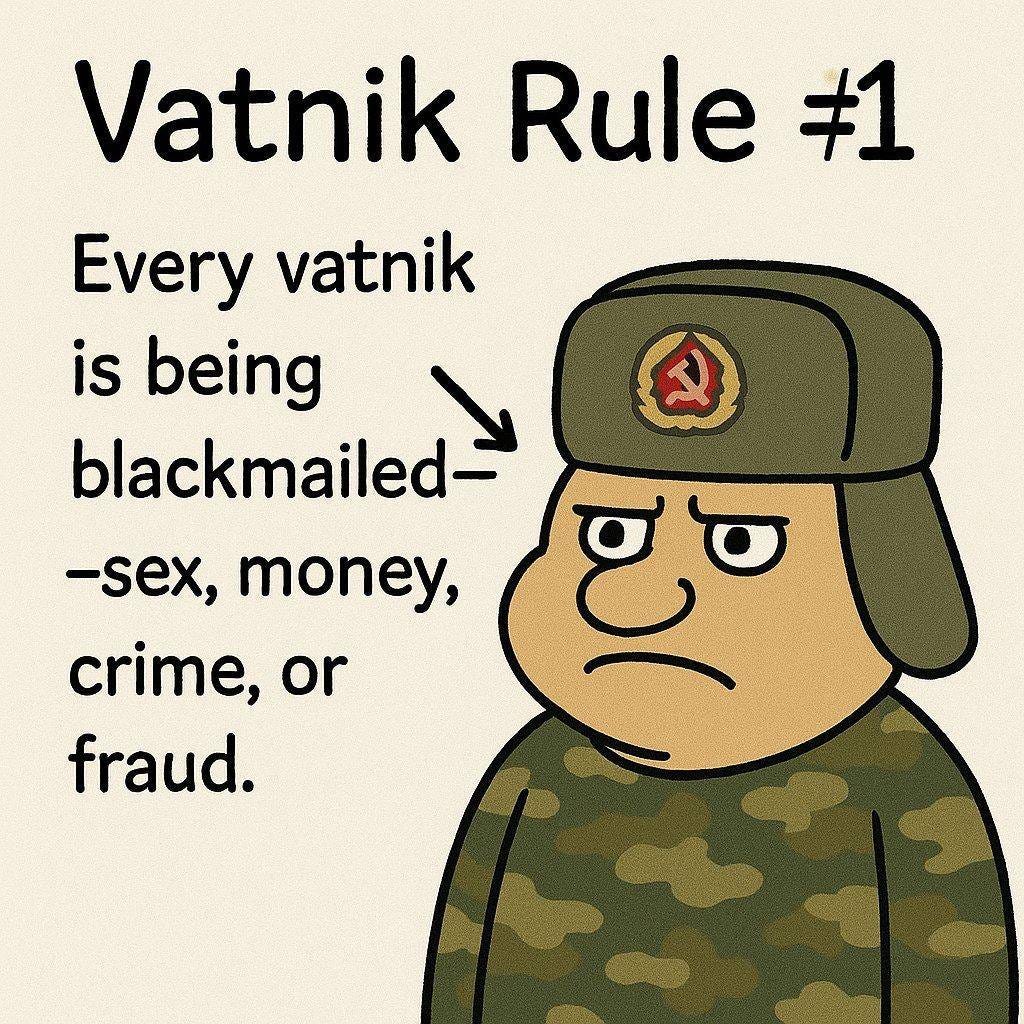
Vatnik Rule #1
Every vatnik is being blackmailed, says the meme. The truth is less dramatic, and more useful.
By Matt Pearce - The Angry Dogs
Rule #1
A cartoon soldier in a camouflage jacket and a fur hat with a hammer-and-sickle badge scowls out of the frame. Beside him, in friendly rounded lettering: “Every vatnik is being blackmailed: sex, money, crime, or fraud.” I should declare an interest: the rule is mine. I first typed “Vatnik rule #1” as a two-word reply on X on 31 May 2025, under a thread about yet another pro-Kremlin commentator’s private life catching up with him. On 28 June I asked ChatGPT what Vatnik Rule #1 was, mostly to see what it would say. It drew the soldier, and according to one reply it confidently attributed the rule to NAFO. Since then it has turned up in the replies under whichever “peace” account has just said something unusually convenient for Moscow.
A vatnik, for anyone who missed the lesson, is a quilted cotton jacket, the cheap padded workwear of Soviet building sites and labour camps, and by extension the person inside it: the reflexive, jingoistic defender of whatever the Kremlin did this week. The insult is Russian-made. Anton Chadskiy drew the original on VKontakte in 2011, a figure made entirely of padded cotton in loose parody of SpongeBob, with the red nose and black eye of the previous night’s brawl, and had to leave Russia once the joke caught on. Propastop has an excellent history of the word, including the 2022 campaign by pro-Kremlin accounts to edit Wikipedia into calling it an ethnic slur, so that moderators unfamiliar with it would ban the people using it. That did not work either.

Rule #1’s claim is that nobody ends up in the jacket by accident. Somebody has something on them.
It was a joke. Like most jokes that stick, it is an exaggeration of something true, and the exaggeration is the part worth examining, because the real version is less dramatic than blackmail and far more useful to anyone who does this for a living. On Thursday afternoon at Southwark Crown Court it briefly stopped being funny at all.
Thursday at Southwark
On 5 November, a jury of eight men and four women found Russell Brand guilty of one count of rape and three counts of sexual assault, after a four-week trial and around eight and a half hours of deliberation. He was acquitted of two further counts of rape and one of attempted indecent assault. Judge Joel Bennathan remanded him in custody and told him to expect a lengthy sentence on Monday 9 November. The offences span 1999 to 2009.
That last detail matters. Everything the public now associates with Brand (the “revolution” interviews, the wellness-and-conspiracy YouTube channel, the Rumble channel, the April 2024 baptism, the move to Florida, the sudden fluency in the language of the American Christian right) came after the conduct the jury convicted him for, and the most recent of it came after he knew the Sunday Times and Channel 4 were asking questions. The politics did not cause the crimes. The politics arrived as the shield.
And the shield was built from Kremlin talking points. Ukraine’s VoxCheck, working with the country’s Centre for Countering Disinformation, catalogued what Brand was putting in front of 6.7 million YouTube subscribers, 1.7 million on Rumble and more than 11 million on X: the claim that the West is fighting alongside “actual Nazis”, the American “biolabs in Ukraine” story, the portrayal of Ukraine as a state that does not share Western democratic values, and in several cases straight recycling of Russian state media fakes. None of that makes him a Russian agent, and I am not saying it does. It makes him something the Kremlin finds more useful than an agent: a trusted voice with a grievance, saying the right things for his own reasons.
When the allegations broke in September 2023, the defence was instant and it was not about the evidence. Elon Musk, Andrew Tate, Tucker Carlson and Tommy Robinson pushed the line that Brand was being targeted for challenging the establishment. Carlson introduced a January 2024 interview by declaring that “Governments colluded to shut down and destroy Russell Brand”, and in 2025 called on the Trump administration to “rescue” him from charges he described as political and absurd. Brand himself called them politically motivated. The logic was perfectly circular: his criticism of powerful institutions explained the allegations, and the allegations proved the criticism was right.
The verdict has not broken the loop. Within hours of Thursday’s result, the comments under Megyn Kelly’s reaction video were full of people insisting he was being punished for speaking out against government abuse of its own people. In a room where the courts are already assumed to be corrupt, a conviction is just another institution’s opinion.
The template: Scott Ritter
If Brand is this week’s example, Scott Ritter is the template the meme was drawn from.
In April 2011 a jury in Monroe County, Pennsylvania, convicted the former UN weapons inspector on six counts, including unlawful contact with a minor, corruption of minors and indecent exposure. He had exchanged explicit messages with, and then performed a sex act on webcam for, someone he believed was a 15-year-old girl. It was a detective. He had rejected a plea deal; that October he was sentenced to between eighteen months and five and a half years, and he was released in 2014.
He re-emerged as what he is now: a regular on RT, a fixture of the pro-Kremlin podcast circuit, and a repeat visitor to Russia and the occupied parts of Ukraine. In June 2024 US authorities took his passport at JFK as he set off for the St Petersburg International Economic Forum. On 7 August 2024 the FBI searched his home near Albany under a warrant citing the Foreign Agents Registration Act and carried out around two dozen boxes. He has not been charged over that, and I am not saying he will be.
What I am saying is: look at the title he gave his response, published in Consortium News nine days later. “The FBI’s Raid on Peace.” A man with a 2011 conviction for an offence against a child described a search of his house as an assault on peace itself, and a substantial audience nodded along. The redemption script and the persecution script are the same script. It was written years before the FBI turned up, and it is the script Brand’s supporters are now reading from.
What the professionals call it
My meme says blackmail. Counter-intelligence officers, who have thought about this for rather longer than I have, say MICE: Money, Ideology, Coercion (or Compromise), Ego. Four reasons a person works for a hostile state, and blackmail is only one of them. My Rule #1 puts all four into the C, because the C is the dramatic and funny one. The courts, over the last twelve months, say the C is the rare one.
Run the UK court record through the other three letters.
Money. Nathan Gill, former UKIP MEP and leader of Reform UK in Wales, pleaded guilty at the Old Bailey on 26 September 2025 to eight counts of bribery. Between December 2018 and July 2019 he took around £40,000 from Oleg Voloshyn, a Ukrainian politician in the Medvedchuk orbit who was later sanctioned by the UK, in exchange for pro-Russian speeches in the European Parliament and appearances on the pro-Russian channel 112 Ukraine. Some of the speeches he delivered almost word for word from scripts he had been sent. The payments were referred to as “Christmas gifts”. He offered to bring other MEPs in. On 21 November 2025 Mrs Justice Cheema-Grubb gave him ten and a half years, telling him he had let money “corrupt his moral compass” and that the offending was persistent rather than a lapse. Nobody blackmailed Gill. Somebody paid him.
Money, and a dash of ego. Howard Phillips, a 66-year-old retired insolvency worker from Harlow, ran through his savings and then offered himself to two men he believed were SVR officers, “Sasha” and “Dima”, who were in fact MI5. He offered Grant Shapps’s home address, phone number and the details of his private plane, and had applied for a Border Force job to get himself security clearance. He had never heard of the SVR. His ex-wife told the court he dreamt of being James Bond. He was convicted under the National Security Act at Winchester Crown Court in July 2025 and sentenced to seven years in November. The prosecution said there was no evidence of any ideological support for Russia whatsoever. Counter Terrorism Policing’s summary of the whole genre is worth pinning to the wall: Russia’s proxies are unlikely to see a large cash windfall and quite likely to see no money at all.
Ideology, with ego. Paul Golding and Jayda Fransen of Britain First toured the Duma as guests of the LDPR, Golding went on the state channel Russia-24 to describe Russia as Britain’s “natural ally”, and in 2020 he was convicted under the Terrorism Act after refusing to hand over his device passwords on the way back from Moscow. Both had already been convicted of religiously aggravated harassment at Folkestone in March 2018, eighteen weeks for Golding and thirty-six for Fransen, for filming and harassing people they connected to a rape trial in Kent. Nobody in Moscow needed anything on them. They turned up with it.
Somebody else’s money, and all the ego. Tommy Robinson, or Stephen Yaxley-Lennon, has convictions for assault, drugs and public order offences, entering the United States on a friend’s passport (ten months, 2013), a £160,000 mortgage fraud (eighteen months, 2014), contempt of court (nine months, 2019) and contempt again (eighteen months, October 2024, for ten breaches of an injunction after a Syrian refugee schoolboy successfully sued him for libel). At the end of October 2026 a jury at Southwark Crown Court, a week before the same building dealt with Brand, convicted him on two counts of harassment causing fear of violence against two Daily Mail journalists who had reported that he was on a sunbed in Cyprus while the August 2024 riots were running. He had hired private investigators to find their home addresses and told one of them he was coming to get him. He will be sentenced on 16 December. In June 2026 he turned up in Russia on a trip that took in the St Petersburg International Economic Forum, and broadcast from the Metropol in Moscow alongside Errol Musk, the pair of them insisting that Russia is not the enemy of Britain. Elon Musk’s father later told the Guardian that the Musk Foundation had covered the trip. Police stopped Robinson at Heathrow on the way home and, by his own account, took his phones. He was one of the four names shouting loudest in 2023 that Brand was being persecuted. Ed Davey called him “a useful idiot for a hostile state”, which is the polite version of this article.
And the actual C? Look back at the top of this piece. Brand and Ritter were not blackmailed into anything either. Their convictions did not make them vulnerable to recruitment. Their convictions made them unemployable anywhere else.
Why social media makes it worse
Here is the mechanism, and it is not recruitment. It is selection.
The pro-Kremlin media world does not need to blackmail anyone, because it only needs to be the last room with the lights on. When the mainstream closes its doors, whether through a conviction, a scandal, a de-platforming or a career that stops dead, there is a parallel economy ready to open one: Rumble and X payouts, Substack, a standing invitation from RT, a panel slot in St Petersburg, a podcast circuit that will book anyone the BBC will not. That economy has a house style, and the house style is “the West is corrupt and persecutes truth-tellers”. It pays, in money and in attention, for exactly the content Moscow wants, without Moscow having to commission a word of it.
You do not have to take my word for that. Laura Loomer, de-platformed after her 2020 run for Congress in Florida, said this year that RT came calling the moment the mainstream platforms shut her out: come on our shows, why not have a byline, you could write for us. She says she never took their money, and she did not need to. What they offered was reach, and reach was the thing she had just lost. She spent the next five years calling Ukraine a country of Nazi apologists. In July 2026 she flew to Kyiv, sat through an air raid, interviewed Zelensky at the Mariinsky Palace and told him she had been “bamboozled by Russian propaganda” and was wrong. She now says she believes some of the biggest American podcasters are financed by Russia, directly or indirectly. On that she has the US Justice Department behind her. In September 2024 two RT employees, Kostiantyn Kalashnikov and Elena Afanasyeva, were charged with routing nearly $10 million through shell companies in Turkey, the UAE and Mauritius, invoiced as payments for electronics, into Tenet Media, a Nashville outfit that paid a roster of right-wing commentators including Tim Pool, Dave Rubin and Benny Johnson, in one case $100,000 a video. The hosts say they had no idea where the money came from, and the indictment treats them as having been deceived. The two Russians are in Moscow and have never faced a court, so Tenet stays in the charged column rather than the convicted one. But the money trail is the government’s, not Loomer’s. The confession is the useful bit. It describes the recruitment exactly, and it was never a recruitment. It was a door left open at the right moment.
Shared grievance does the rest. A man who has been through a courtroom and a state that has been through a sanctions regime are telling the same story: the establishment is rotten and it is coming for me. Brand said politically motivated. Ritter said chilling effect on free speech. Both found an audience that had decided those words were true before hearing the facts, because the audience had been told the same thing about Ukraine, vaccines, the BBC and the courts, in the same feed, by the same people.
Audience capture finishes the job. Once your income is your audience, you say what the audience rewards. And the audience that stays after a scandal is, by definition, the audience that did not mind the scandal, or decided it was a plot. They reward more plot. Each fresh consequence, from an agent walking away to a seized passport to a jury verdict, is turned into content proving the persecution, and the content pays.
Which is where “peace” comes in. Nobody can be against peace. It costs nothing to say. It turns a personal redemption story into a geopolitical one, and it recasts every consequence as persecution for the cause rather than the price of what he did. It also happens to be, word for word, the Kremlin’s own line: the Atlantic Council’s DFRLab found “Russia is seeking peace” among the core narratives Russian state outlets ran in the weeks before the full-scale invasion. The convert who discovers peace after the summons has arrived is not necessarily lying. He has simply found the one word that makes his old life and his new patrons’ interests sound like the same thing.
The pipeline runs both ways
The meme assumes the compromise comes first and the vatnik follows. Dylan Earl shows the pipeline running in reverse.
Earl was 20, a builder and part-time drug dealer living with his parents in Elmesthorpe, Leicestershire, and a member of multiple pro-Russian propaganda channels. In 2023 he made contact with the Wagner Group on Telegram, through an account the court heard was a bot called PrivetBot, and told his handler he wanted “missions”. On 20 March 2024 the men he had recruited set fire to industrial units in Leyton, east London, that were being used to ship humanitarian aid and Starlink terminals to Ukraine: about £1 million of damage and 60 firefighters to put it out. He then moved on to planning an arson attack on a Mayfair restaurant and wine shop and the kidnap of its owner, the Russian dissident Evgeny Chichvarkin.
The court heard he was “easy meat” for Wagner, and that the motive was “simple and ugly greed”. The judge, Mrs Justice Cheema-Grubb again (she has had a busy year), described a planned campaign of terrorism and sabotage in the interests of the Russian state. On 24 October 2025 Earl got 17 years plus six on extended licence, the first sentence handed down under the National Security Act 2023. The young men who actually carried the jerry cans were promised money they never received. Wagner, naturally, never paid.
There was no hidden conviction at the start of this, nothing to blackmail. Social media did not find a compromised man. It made one, from inside a bedroom in Leicestershire, with nothing more than a few channels, a chatbot and the promise of cash. That is the version of Rule #1 that should worry people more than the cartoon soldier does.
What Rule #1 is actually good for
Treat it as a rule of thumb, not a conviction.
A loud “peace” account whose backstory has a hole in it (a career that stopped dead, a sudden move abroad, a conversion timed suspiciously close to a summons) is worth a check, and the check is cheap. Court records are public, convictions are reported, and sentencing remarks sit on the judiciary website. Half the people in this piece were caught not by MI5 but by a jury, and their records were never secret. The meme only looks like a joke because nobody bothers to look things up.
But stop assuming blackmail. Assume incentives, because incentives are checkable and blackmail is not. Follow the money (Gill). Follow the audience (Brand). Follow the grievance (Ritter). Follow the channels (Earl). The blackmail theory is seductive precisely because it lets the vatnik off the hook (poor chap, Russia has something on him) when the courts keep finding the simpler answer: he chose it, and it paid.
So here is the less funny, amended rule. I wrote the original, so I am allowed.
“Every vatnik has a reason that they support Russia, and it is usually a matter of public record.”
My meme’s vatnik scowls because he has been scammed and blackmailed. The real ones smile, say “bring peace to Ukraine”, and ask you to subscribe to their Rumble channel. Their version is not as funny as mine, but more dangerous.
****
Sources
Russell Brand verdict: CNN, 5 Nov 2026; Al Jazeera, 5 Nov 2026; NPR, 5 Nov 2026
Brand’s defenders and the persecution narrative: Newsweek; Variety, May 2025; Thought Catalog, Nov 2026
Brand’s Ukraine content: VoxCheck / VoxUkraine
Scott Ritter conviction and sentence: Inquirer / AP, 15 Apr 2011; Democracy Now, 27 Oct 2011; GlobalSecurity.org profile
Ritter passport seizure and FBI search: NewsNation, Aug 2024; Ritter’s own response, “The FBI’s Raid on Peace”, Consortium News, 16 Aug 2024
Nathan Gill: Counter Terrorism Policing, 21 Nov 2025; Al Jazeera, 21 Nov 2025; Sky News via Mansfield 103
Howard Phillips: Counter Terrorism Policing, Nov 2025; UK Defence Journal; Jerusalem Post
Dylan Earl and the Leyton arson: Counter Terrorism Policing, Jul 2025; LBC, 24 Oct 2025; Euromaidan Press, 25 Oct 2025; Express & Star (”easy meat”)
Golding and Fransen: Hope Not Hate on Golding’s Russia trips; The National, Golding Terrorism Act conviction; Vice, Mar 2018 harassment convictions
Tommy Robinson: The Week, timeline of convictions; LBC, 28 Oct 2024 contempt sentence; LBC, 12 Jul 2026, Musk Foundation paid for Russia trip; Guardian via AOL, 12 Jul 2026, SPIEF trip and Ed Davey quote
Robinson harassment conviction, Oct 2026: IBTimes; NUJ statement
Laura Loomer: Alternet, RT approach after deplatforming; The Hill, 23 Jul 2026, Kyiv meeting with Zelensky; The Hill, AP interview from a Kyiv bunker; JTA, 24 Jul 2026; Euromaidan Press, 2 Nov 2026, claims about Russian financing
Tenet Media indictment: NPR, 5 Sep 2024; Byline Times, 6 Sep 2024; CBS News
“Russia is seeking peace” as a pre-invasion narrative: Atlantic Council DFRLab, Narrative Warfare (2023)
More about Matthew Pearce here:
Economist and technologist Matthew Pearce is founding member of NAFO, a founder of SE42 Labs Technology and AI Research Company; a writer for Washington Outsider Centre for Information Warfare; a writer for theangrydogs.com; and a stakeholder in the UK government Rycroft Report into foreign interference in British politics.

****
****
Related:


****
Bette Dangerous is a reader-funded magazine. Thank you to all monthly, annual, and founding members.
I expose the corruption of billionaire fascists with support from your paid memberships.
Thank you in advance for considering the following:
Share my reporting with allies
Buying my ebooks
A private link to an annual membership discount for older adults, those on fixed incomes or drawing disability, as well as activists and members of the media is available upon request at bettedangerous/gmail. 🥹
More info about Bette Dangerous - This magazine is written by Heidi Siegmund Cuda, an Emmy-award winning investigative reporter/producer, author, and veteran music and nightlife columnist. She is the cohost of RADICALIZED Truth Survives, an investigative show about disinformation and is part of the Byline Media team. Thank you for your support of independent investigative journalism.
🤍
Begin each day with a grateful heart.
🤍