

***Please take out a membership to support the light of truth.***
With all the uncertainty in the world, one thing in my life is constant: every morning, my prince brings me a perfect cup of coffee.
It doesn’t just magically appear — water is measured and heated to just the right temperature, beans are hand ground, the filter is a perfect fit for an origami pour over — even the mug is preheated so by the time the coffee is delivered bedside, it’s still perfectly hot, topped off with oat milk and two La Perrucche brown rough-cut sugar cubes.
It’s a dream in a cup, every morning, made possible by the labor of a loving spouse, but none of this would work if the beans didn’t contain some kind of magic.
In the last year, I had almost given up. Having lived in the Golden Land of coffee — with a Peet’s around the corner — I had a very rough start to my European travels.
I can’t do espresso, at all, and that’s pretty much all that is offered.
Beyond Starbucks Pike (blech) and with the rise of pod coffee, finding a café that serves filtered coffee, also called batch, is nearly impossible. When I do find filtered coffee, the price for a cup is above my kin, and all too often it’s of a gourmet variety that is the color of weak tea. Those who do offer the fancy filtered brew favor such a light roast, you can knock it over with a feather. Sometimes, the brewers won’t let me desecrate their hallowed cricket’s p*ss with oat milk, which I find both amusing and amusing.
So I tried every premium brand of unground beans I could find, and most of them left me wanting — too weak, too fruity, too expensive, too froufrou. I could never find anything just right, and since this work is fueled by caffeine — fueled by one, strong, delicious, loving, excellent, badass cup a day, coffee is a very important part of my life.
And then, one day, one very magical day, when I had almost given up, and was living off the last handful of beans sent from the US by my children — Peet’s Ethiopian Super Natural, diluted by some passable bottom shelf beans — I stopped into Sullivan’s Country Grocer in Oughterard on a visit to County Galway, Ireland, following up on a hot sourdough rye bread tip.
Sullivan’s, like my favorite exquisite epicerie in Clifden — the Connemara Hamper — has a fabulous selection of local and global deli items. After securing the last loaf of sourdough rye, I made my way to the back of the shop to the barista counter, where I longingly looked for any signs of filtered coffee before ordering my usual consolation prize: an oat chai latte.
And that is when I saw the wall of FiXX — dozens of bags of beans, packaged brightly in orange, two blends — Classic and Organic.
I thought, here I go again: hoping for beans with flavor and depth, nuance and substance, delicate and strong — preparing to be disappointed.
The barista, however, was encouraging.
“Try the Classic,” she said.
And I did. The price was right, and I had nothing to lose, I had at best, one day left of my dwindling stash of Peet’s. It was just before Christmas, and I do think a miracle may have been involved.
The next morning, I had my first sip of FiXX Classic, and the rest is a coffee junkie’s history.
The flavor is deep and bold, delicate and strong, sweet and meaningful — a perfectly balanced cup of coffee.
That I found it Ireland, a place I have fallen terribly in love with, is not at all surprising. The artistic culture and authentic spirit seems to spawn entrepreneurs.
When Sullivan’s Country Grocer was closed over the New Year’s holiday, I went into a slight panic only to find the motherlode of FiXX at Espresso 44 in Eyre Square, Galway.
There, on the shelves, were all the FiXX beans — Classic, Organic, Cubano, Lisbon, Oslo, Seattle, a single origin — omigawd!
And that’s when my new best friend, a Galway barista, told me that the company is owned by a woman from Dublin.
So as I am wont to do, I tracked her down, and here is my Q&A with CEO and Founder of FiXX, Anne Abberton, goddess of coffee, my Dublin muse, the woman who saved my life from dreariness and sorrow, lol.
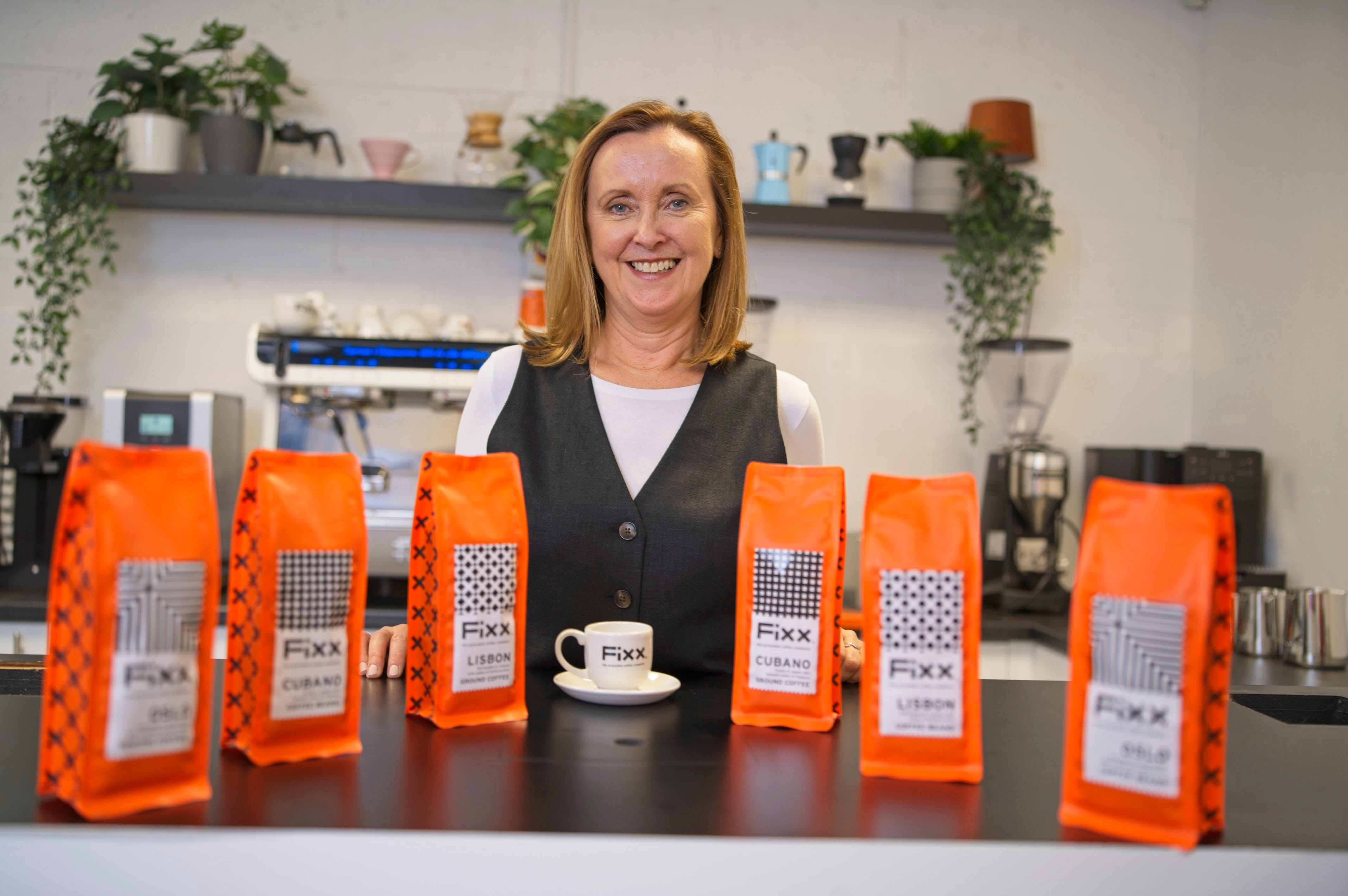
Deep and Meaningful Beans
An interview with FiXX CEO & Founder Anne Abberton
Heidi Siegmund Cuda: Did you set out to create the perfect cup of coffee?
Anne Abberton: The goal has never been about crafting the perfect coffee — it has always been about delivering consistently good coffee, day in and day out. Our purpose at FiXX is to make superb coffee an everyday treat.
My love for coffee really developed when I moved overseas. I saw how deeply it was woven into daily life in other countries — something that, at the time, wasn’t as present in Ireland.
Heidi: I have been traveling for a year in Europe — and I know you said there are many good brands, but I have found the higher end beans in Europe too weak, too fruity, too light, and too costly — the more expensive, the more disappointing. Aside from Copenhagen in the South of France, Clifton Coffee Roasters in Bristol, UK, Intermission in West Hampstead, UK, Faculty Coffee in Birmingham, UK, and the Ethiopian beans in Malongo, Paris, I have been tragically drifting around in search of deep and meaningful beans, and only when I landed in Oughterard, at Sullivan’s Country Grocer following up on a hot bread tip, having just about given up on my coffee quest, did I spot the FiXX bags on a shelf in the back of the store… something about the barista’s assurance gave me hope… and I grabbed one bag of the Classic… the rest is bliss… I then found the shop in Eyre Square in Galway and now buy all the beans lol (my faves are Classic, Organic, Lisbon, Oslo)… how does every bag have such great flavor but also depth?
Anne: There is certainly a great range of coffee out there, and it’s a staple drink for an astonishing number of people. What many don’t realise, though, is just how much influence they themselves have over the final cup — the way coffee is brewed plays a huge role in how it tastes. (Author’s note: read this FiXX blog on ‘Common Coffee Mistakes You’re Probably Making’ and this blog on ‘Tips for Storing Coffee at Home’ and discover everything you’ve been doing wrong lol — like, take the open bag of beans out of the fridge! Now! I’ll wait!—hsc)
Understanding what you like comes from tasting widely and experimenting with different brewing methods — some work, some don’t.
Some people enjoy the delicate, nuanced flavours of lighter roasts, while others prefer the intensity and robustness of darker roasts. In my experience, preferences vary greatly from person to person.
The exciting part is that coffee has evolved beyond simply being a caffeine hit — it’s now appreciated for its incredible complexity. It’s one of the most complex beverages we can enjoy.
Heidi: What is your litmus test for an ideal cup?
Anne: Balance is probably the simplest way to describe it. A great cup of coffee is one where sweetness, acidity, and bitterness are in harmony — none overpowering the others.
Temperature and strength also matter.
My personal checklist would be:
Aroma — inviting, whether nutty, chocolatey, or fruity
Taste — balanced, with no single note dominating
Texture — smooth, velvety, or clean and crisp
Finish — either long-lasting or clean, but always pleasant
Heidi: I can’t do espresso (ice pick headaches), so I make my own filtered coffee everywhere I go — did you intend for your beans to be ideal for pour over? Is that something you had in mind when developing FiXX quality control/taste?
Anne: The intention was always to provide consistently great coffee. When I returned to Ireland in 1997, I noticed that coffee served in public spaces was often too hot, making it difficult to properly taste. Many people would add sugar automatically, expecting bitterness.
I was determined to highlight the natural sweetness in coffee and encourage people to experience its flavour before adding anything.
We set out to create coffees that perform well in multiple settings. For cafés, our coffee needs to stand on its own while also working as a strong base for milk-based drinks. It should also translate well into retail, allowing customers to recreate that experience at home — just as you did after discovering us in Sullivan’s.
At home, most people don’t have access to proper espresso equipment, so our core range is designed to work well across a variety of brewing methods, including pour over. These are our “crowd-pleasers.”
Our limited-edition monthly coffees — single origins with lighter roasts — are where we explore more experimental and distinctive flavour profiles for those who want to step outside their comfort zone.
Heidi: What is the greatest compliment you’ve received since launching FiXX?
Anne: Repeat orders.
Heidi: How do you keep your price point low when your beans are such top rate quality? Is that in relationships you’ve formed?
Anne: With a lot of behind-the-scenes work, and a lot of planning, alongside a strong moral compass guiding how we do business. I think our price point is fair and we will always adjust as we see fit depending on what impacts the supply chain at any time.
Relationships are a key part of how we source coffee. Growing up as a farmer’s daughter gave me a deep appreciation for the work involved in producing any crop. We take seriously our responsibility to honour that work by showcasing our suppliers’ efforts in the marketplace.
There’s also a shared responsibility across the supply chain to educate. Suppliers must communicate the true cost of quality coffee, and cafés and retailers need to pass that understanding on to customers. In reality, coffee in Ireland is still underpriced relative to the costs involved.
Heidi: I am useless without one perfect cup of coffee a day, so when I travel, I generally bring my modified kit to make my own pour over — two decades ago in El Salvador I filmed a coffee plantation, and it was incredible seeing the cultivation process — your beans are named after cities? Can you explain?
Anne: We’ve shared a full explanation here at our What’s In A Name blog post, but for our Cubano blend, we started our coffee journey in Cuba in 2004 and the company was originally called Cafe de Cuba, so this is a nod to our humble beginnings. We are proud to now feature coffees from all around the world, but we will always have a soft spot for Cuban Coffee.... Behind the scenes, some of the names are personal. When I trained at the London Coffee School, two people were particularly influential — one from Seattle and one from Norway — so naming coffees Seattle and Oslo are a quiet nod to them for setting me on this path.
Lisbon is another meaningful one for me, as it’s where I lived for several years and where I had my first espresso.
Heidi: I have fallen in love with Irish people — their kindness, authenticity, and all their talents (music, hand-crafting). My favorite scarves are knit by a woman in Letterfrack, and when I lost one of them on the streets of Paris, she matched the yarn color, knit and mailed me another… I feel like the island has magic and a warmth that soothes my tired heart, is there some kind of island magic alchemy to the creation of FiXX or is it merely the hard work of a good team?
Anne: I’m certainly a proud Irish woman, but what truly sparked this journey was travel. Experiencing coffee culture around the world lit that fire in me.
Now, while I’m based in Dublin, I still travel regularly — visiting coffee origins, attending events, and connecting with customers across Ireland.
When I reflect on the success of FiXX, I’ve outlined it more fully here. But it all started over a coffee (ironically) in 2003 between three pals — the then-Cuban Ambassador to Ireland, Teresita Trujillo, Guy Hancock, the owner of the Decent Cigar Emporium in Dublin, and myself.
While working overseas in the travel industry for 10 years plus, I witnessed a coffee culture I had not been exposed to growing up in Ireland. I grew to love what it represented and how it helped people connect. Everything revolved around meeting for coffee; whether for business or social reasons, things happened over coffee. This simple ritual of drinking coffee did not discriminate—regardless of background or social status, coffee was accessible to all.
Teresita, the first Cuban Ambassador to Ireland, was keen to build trade between Cuba and Ireland. She knew Guy, who was already trading with Cuba by importing Cuban cigars and suggested the importation of coffee as a potential new trade venture. The intention was for Guy and I to both be involved in this new coffee business, but it did not work out that way. Guy invested in the coffee business but continued working full-time in his cigar business.
I was ready for a new adventure, combining my love for travel with my newfound obsession: coffee. I took a leap of faith, leaving full-time employment to pursue my passion. Becoming one of the first clients at the London School of Coffee, I proactively educated myself. Immersing myself fully in the world of coffee, I made regular trips to Cuba throughout 2003 and 2004, diligently working until all necessary contracts and logistics were in place. My efforts culminated in the successful introduction of premium Cuban coffee to Ireland and the UK markets in 2004.
Heidi: And the rest is aromatic, life-affirming history. So what is next for you?
Anne: There is still so much great coffee to be sourced and tasted.
I am also very conscious of climate change and the impact it may have on coffee production. It’s important to me to give back to an industry that has given me so much.
We are members of World Coffee Research, and we are a Certified B Corp company — so everything we do going forward is guided by that responsibility and commitment.
****
Anne Abberton is CEO and founder of FiXX. With a career of 20 years in coffee, Anne counts herself as one of the first students of the London School of Coffee when it opened in 2002/3. Entering the coffee business initially as a coffee importer and distributor by setting up her own business in 2004, Anne has since delved into many aspects of the industry. Importing, distribution, wholesale supply, cafe operation, running mobile coffee units, and establishing a successful online store. Anne is an advocate of women in business and has participated in programmes such as:
EY Winning Women Global programme for 2023/24
****
Author’s note: I hope you enjoyed this coffee break from the political grind. It has always been my intention to include more cultural features on these pages, and you’ll find many from my Hollywood archives in early posts from 2022/23. I’m already thinking about my morning cup; will it be Lisbon or Oslo, or a mix of both? I need to do an inventory check. I get insecure when I’m down to my last three bags lol. Time for a repeat order.—hsc
****
****
Related:


****
Bette Dangerous is a reader-funded magazine. Thank you to all monthly, annual, and founding members.
I expose the corruption of billionaire fascists, while relying on memberships for support.
Thank you in advance for considering the following:
Share my reporting with allies
Buying my ebooks
A private link to an annual membership discount for older adults, those on fixed incomes or drawing disability, as well as activists and members of the media is available upon request at bettedangerous/gmail. 🥹
More info about Bette Dangerous - This magazine is written by Heidi Siegmund Cuda, an Emmy-award winning investigative reporter/producer, author, and veteran music and nightlife columnist. She is the cohost of RADICALIZED Truth Survives, an investigative show about disinformation and is part of the Byline Media team. Thank you for your support of independent investigative journalism.
🤍
Begin each day with a grateful heart.
🤍
It is so refreshing to read a feel good , interesting, informative article , in the midst of all the craziness in the world.
Anne is an inspiration! Thanks for this nice article.