

***Please take out a membership to support the light of truth.***
Like a Mad Fairytale
One good thing about music, when it hits you, you feel no pain. So sang the great sage Bob Marley.
In this era where the pain is constant — losing one’s country is nothing small — I turn to my old friend — live music — to dull the ache.
If there’s a men’s choir at a local abbey, I’m there. If I see a flier for a church choir Christmas performance, count me in. Don’t care what faith it is, I just want to hear gorgeous voices, and escape into the soul-soothing balm of the choir.
The official Christmas song of Ireland is Fairytale of New York by the Pogues. I hear it in every pub, and even at community youth performances. Nothing like a group of determined school age kids with concertinas and good taste.
When I returned to Ireland, after spending the summer in the magical land of wool and wonder, the Christmas lights were already blowing in the Galway wind.
Mondays Nights In Letterfrack
I called my friend The Hog, whose shows I frequented on Monday nights in Letterfrack at Veldon’s Seafarer over the summer. The Hog, a veteran fisherman with long purple hair who taught himself banjo relatively late in life, performs regularly with Paul Mulligan, a Connemara guitarist with a pure rocker voice and together they merge Irish traditional sounds with rock ‘n’ roll. If they see me come in the room, they cue up the Waterboys ‘Fisherman’s Blues’ or the Irish Rovers ‘Drunken Sailor’ — two of my favorites. And I am ever so grateful.
The Hog, whose real name is Michael Casey, invited me to see them perform in Tipperary, at a pub called Philly Ryan’s in a town called Nenagh. The event was the second anniversary of the loss of the great poet Shane MacGowan, whose mother was from a village in the area called Kilbarron. The Pogues frontman spent a lot of time at Philly’s, his favorite pub in the area. He became close with the owner, an undertaker named Philip Ryan, who created a makeshift shrine to MacGowan of posters and photographs in the pub’s performance space. There’s even a large mural of MacGowan on the pub’s exterior.
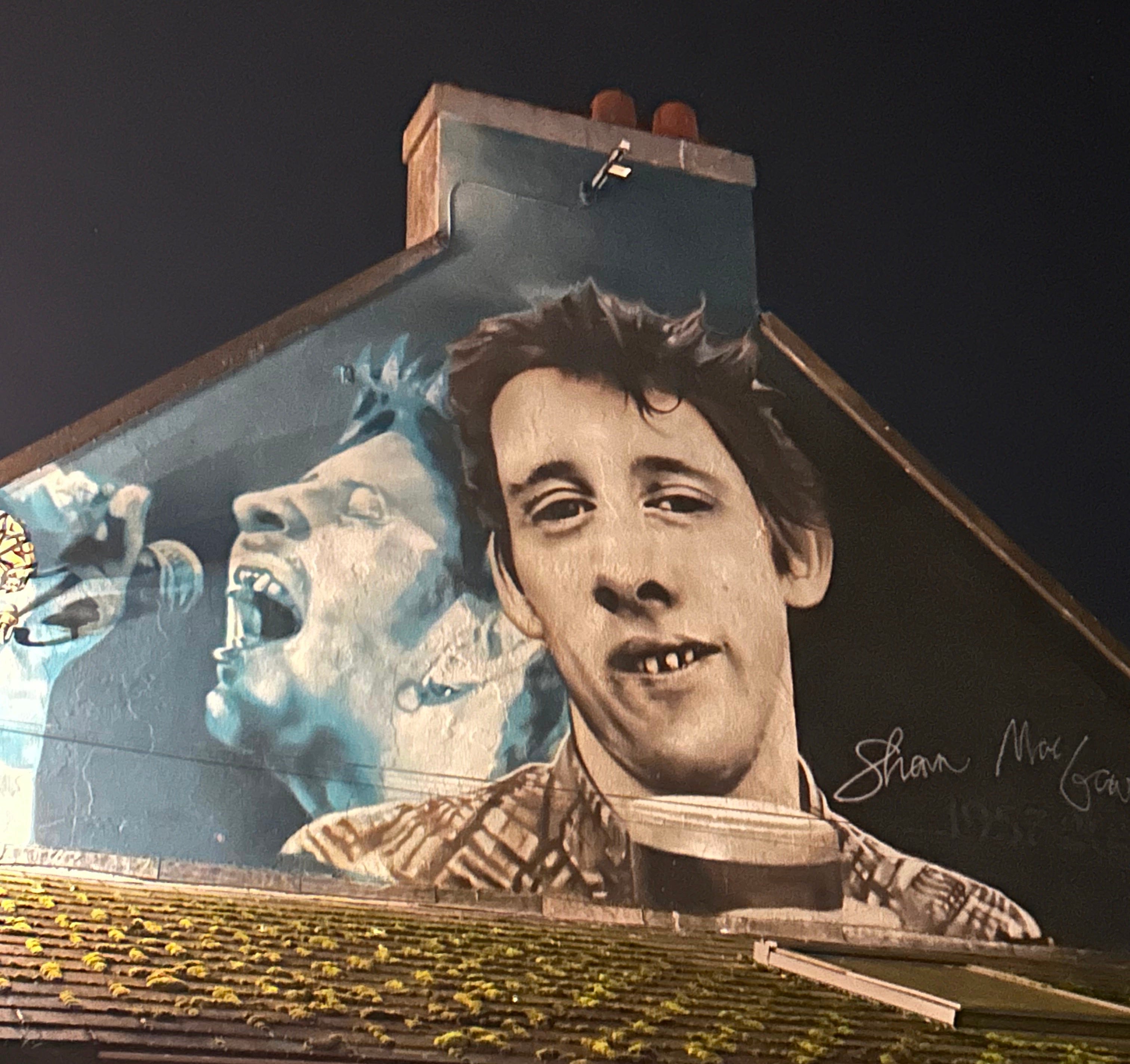
I drove through the night to get to Nenagh and made it in time to see Paul and The Hog, who were performing with some locals, mixing up Irish traditionals with rock originals.


The packed pub was filled with friends and family of MacGown, including his wife, Victoria, and sister, Siobhan. Sitting at a table with Nenagh locals, I immediately became family, as people shared their stories of the late singer, who died on November 30, 2023. I admired the punk in drublicness of one patron, who kept passing out and reanimating himself with more Guinness, slapping his face like Curly in the Three Stooges. Fitting for a Shane MacGowan tribute, he was eventually dragged out by his feet by a very strong woman, allegedly his wife.
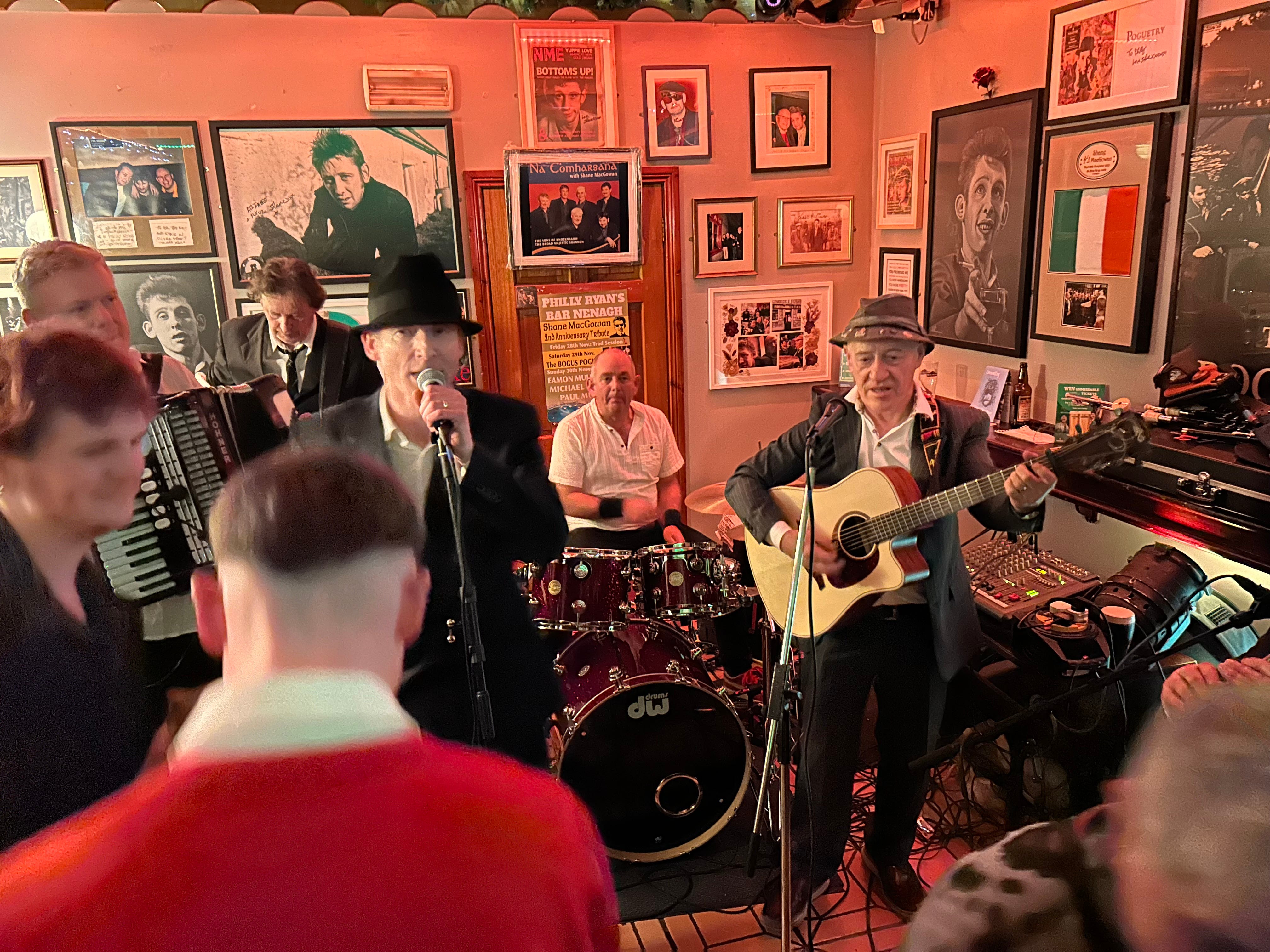
The guitarist of the Bogus Pogues, a Pogues cover band who headlined the weekend, said he asked Shane once how many songs he’d written.
“He said, “I never wrote a single song. I write poetry. Some of those poems just happened to get turned into songs.’”
After dosing my soul with rock n roll, I drove back through the night to Connemara, an area on Ireland’s West Coast that Oscar Wilde described as ‘savage beauty,’ as moonlight bathed the Wild Atlantic Way. I blasted my Irish playlist, which keeps filling up with more and more incredible music.

The next morning, over the ‘full Irish’ breakfast at Veldon’s Seafarer, I chatted with The Hog and Paul, to get a sense of why the music is so incredibly vibrant seemingly everywhere I go in Ireland.
Raw Madness and Savage Beauty
Heidi: So the first thing I noticed when I got here in May was the incredible music. Like, everywhere I went in Clifden, music was pouring out of pubs into the street. And it wasn’t just like, average, it was exceptional music. Whether I was at Ravi’s on a Thursday night, or Mullarkey’s on a Saturday, or Mondays in Letterfrack here with you guys, I just couldn’t believe it. So I started probing. Music’s been a huge part of my life. And one of the things I quickly learned was that music hadn’t been taken out of the schools the way it has in America. In Ireland, kids still grow up with an instrument in their hand. There is a culture of it. So before we get into the Shane MacGowan weekend event, can you both give me your opinion on the West Coast of Ireland’s music scene in general, because I find it to be incredibly rich.
Paul Mulligan: There’s kind of a nostalgic wildness to it, a kind of a madness to the music. It’s very authentic, and it’s very improvised. And playing music is kind of family thing, everyone joins together.
The Hog: Irish music has never been more popular than it is now. Even more so than when I was a child.
Paul: The young people are coming back to it. And now there’s bands like, say, Kingfishr, they’re mixing the pop or the rock with the traditional. Mixing the mandolin and the banjo with the rock.
The Hog: In their day, the Dubliners were the Pogues of the 60s and 70s. Then the Pogues came in the 80s, and they went up another level completely.
Paul: And see, the original rock and roll is Irish music really, because it’s authentic, and there’s a bit of screaming, I mean that. And the Irish of course brought the music to America.
The Hog: Where do you think Shane MacGowan got that song, Dirty Old Town from? He got it from the Dubliners and the Irish Rovers, and they collaborated, and they turned it into this super, super hit.
Heidi: It’s amazing because again, being from America and coming to Ireland and thinking that everything is so much bigger, and then finding out the whole population is about the same size as LA.
The Hog: Oh no, no, no, it’s much smaller.
Heidi: Well that’s what’s amazing to me. Everywhere I’ve been, there’s this richness of music, this culture of music, and what do you think it is about this particular area right here, the Galway County area or Connemara that inspires music.
A Culture of Storytelling
Paul: A lot of songs come from stories. And in the old days, everybody used to gather together in the houses, and anybody would walk in and they put on a fire and they start telling stories and play music. So a lot of that traditional music came from that. A lot of it definitely comes from this culture of storytelling.
Heidi: I’ve met more raconteurs per square inch here than anywhere I’ve ever been. I can’t believe how many people can sit down and really tell a story. So maybe that’s part of what makes the music rich. The Irish traditional songs that I’m hearing really don’t get old. They seem to be standing the test of time, and it’s interesting that you say they’re even increasing in popularity.
Paul: And everyone does a different version of them, and it’s always moving. It’s always consistent, you know?
Heidi: What was your music journey, Hog? You came to music somewhat late, right?
The Hog: The first Irish music I heard was like, real trad, it was nice, and I was interested. But then I went over to England with my mother. I’m just visiting with relatives, right? And I was in this house with an English woman, who was married to an Irish man from Cleggan. Yeah. Next thing I heard was this music, and I said: What… Is… That?!
So I asked her. Her name was Rose, God bless her. She said, ‘That’s the Dubliners.’ Until that time, I never heard Irish music like that. I just heard the whistles and the accordions, which was nice. But then I heard this thing! And just like I said, it was a revelation, right? I was blown away!
It was just like the first time I heard the Pogues. Even now, I can feel myself getting goose flesh, like, I’m getting scared. So she showed me the album, and I listened to the Dubliners, and I said, ‘This is the best thing I ever had in my life.’ To this day that stands. It was a different, so I got interested. But even back then, I was too young. I said, these people are geniuses. How do they play music like that? I never seen the day that I was going to be doing it. I never seen it coming. I was fishing out of a currach pulling lobster pots where I’m from in Renvyle.
Paul: Same here. But to see the Pogues, to see a poet inspired by the Sex Pistols at the time. Shane McGowan, grew up in London, and was very influenced by Johnny Rotten in the Sex Pistols.
Heidi: And that’s essentially Irish music, too, in a way. Because John Lydon’s parents are Irish.
The Hog: But you see with Shane, in addition to liking punk rock, he loved Irish music, and he just decided, ‘Well, I’m going to put that into the Irish music and change it.’ And there you go.
Paul: So it’s a bit like the Clash, but with Irish instruments.
The Hog: So he punked up and rocked up the Irish music. And all these other bands that come out after then, you know, they’re inspired by that.
Paul: I wasn’t interested in traditional Irish music, at all. I was a rocker.
Heidi: I hear that in your voice. You have a real beautiful, classic, pure rocker voice.
Paul: I was into rock, Iron Maiden, whatever. But then I got into a lot of indie bands, too, in the 90s. And then I suppose, like Michael too, I got into the Pogues. I got into the Irish — I love that kind of madness, that raw madness. It’s Celtic punk.
The Hog: It’s not what you do, it’s the way that you do it.
Paul: You can be the tightest band in the world, but if you don’t have a bit of soul, and a bit of madness in it, it’s just another show band.
The Hog: It’s the wildness. A good madness.
Heidi: And Hog, when you picked up, you taught yourself banjo later in life, right? Which I think it’s really incredible, because you’re a virtuoso at this point. So how much went into that? Like, did you just play every day? Or how did you get to the level that you’re playing at now?
The Hog: It’s like everything, when you get something brand new, you’re kind of at it all the time.
Heidi: Did you have any musicians in your family?
The Hog: Looking back, I’m the only one in my family, no brothers and sisters. My mother didn’t try to persuade me to go into it. I got no direction to go into music at all.
Heidi: And what about you, Paul? Did you have family history?
Paul: My dad had the first Celtic band in Clifton. They’re called the New Bridge Ceili band, and he played the accordion, and harmonica, and sings.
Heidi: So how did you two start performing together?
Paul: We’re from the same area.
The Hog: But he’s the rocker, and I do the Irish stuff. I thought, that’s perfect. We put it together.
Punk In Drublic
Heidi: And tell me about being invited to perform at Shane MacGowan’s anniversary weekend.
The Hog: I got to know Shane MacGowan a long time ago. I was actually invited to join the band back in 1983, but then Shane decided I drank too much.
Heidi: Are you serious lol? You were two drunk for the Pogues?
The Hog: It’s an absolute truth. They said there’s only room for one pisshead in the band, and that was Shane.
I was in a pub in London, Biddy Mulligan’s, and they were on a tear. The Pogues were out drinking this day. They had started drinking in Cricklewood, in The Crown in Cricklewood, and they moved from Cricklewood to Kilburn, which are connected by one long road. They started up in The Crown, and they worked their way down. By the time they got to Biddy Mulligan’s, I was in there, strumming a guitar, and they all walked in. They weren’t called the Pogues at the time. They were called Pogue Mahone.
Paul: Which means kiss my ass.
The Hog: Yeah, they hadn’t reach it yet, but that was just around the corner. They were about to make the big time. And I was in there playing, and they walked in, and I was there strumming, and Shane said, ‘We need a guitar player. Would you join the band?’ I said, ‘Yes.’ Right away. I said, ‘Yes.’
And so after a while, Spider came down. He said, ‘Shane reckons you drink too much. There’s only room for one pisshead in this band.’ Pisshead means a drunk. Yeah. So the thing is, I was hired and fired in the one day.
Heidi: Legendary.
Paul: That’s the thing about the Irish. There’s a nice, gentle madness to it, you know, it’s, doesn’t matter what they’re like, everyone is a character. I came all the way from Germany to go down to Nenagh to perform this weekend and now I’m heading back to France tonight. But I wasn’t going to miss playing music with The Hog and paying our respects to Shane.
Irish music is like a mad fairytale.
Anybody who comes to Connemara seems to stay here — they end up being part of the end of civilization, the wild west. It’s not because I’m from here, but I think it’s the most beautiful part of Ireland. There’s a natural wildness to it.
The music and the storytelling is fantastic. And those hanging there, people just walk into a bar and sit down and sing a song. Doesn’t matter who they are, whether they’re drunk or sober, that’s the culture. That’s where it all comes from, all the stories, all these clowns of madness.
****
Sample their music here:
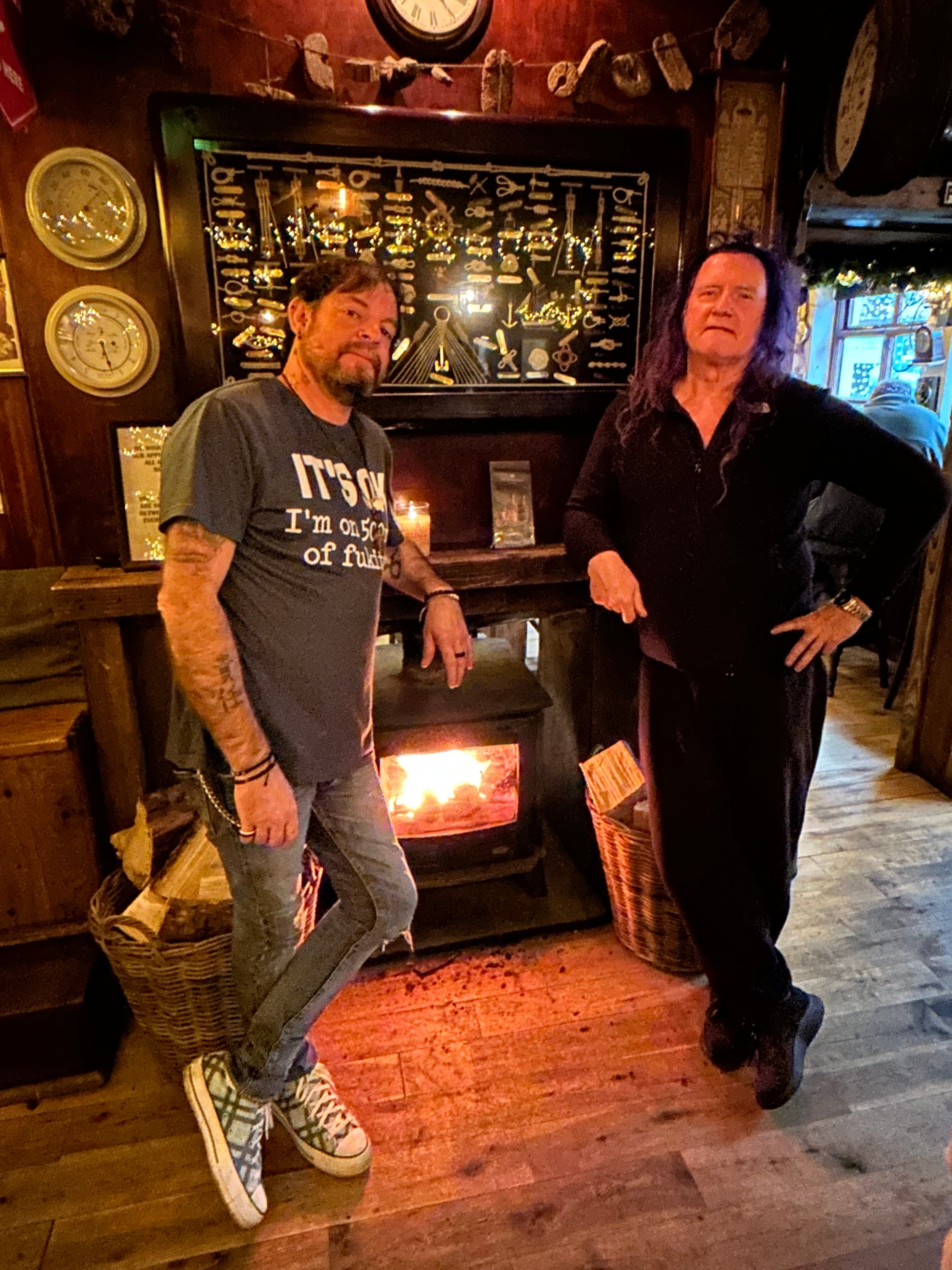
Author’s note: On a recent Monday, I once again drove through the night to a town called Westport in County Mayo. Uri Kohen, the promoter of a local bluegrass festival, invited me to hear the 2025 fiddle player of the year, Maddie Denton, perform with acclaimed banjo player, Brenna MacMillan, at a legendary club called Matt Molloy’s Yard Bar. Turns out the duo are American from Appalachia, and I think they could be bigger than the Dixie Chicks.
I’ve been reflecting back on my visit to Nenagh, and hanging out with Paul and The Hog after their gig, watching the Bogus Pogues together. It’s funny, you know. After all this time, I’m still with the band.—hsc
****
****
Bette Dangerous is a reader-funded magazine. Thank you to all monthly, annual, and founding members.
I expose the corruption of billionaire fascists, while relying on memberships for support.
Thank you in advance for considering the following:
Share my reporting with allies
Buying my ebooks
A private link to an annual membership discount for older adults, those on fixed incomes or drawing disability, as well as activists and members of the media is available upon request at bettedangerous/gmail. 🥹
More info about Bette Dangerous - This magazine is written by Heidi Siegmund Cuda, an Emmy-award winning investigative reporter/producer, author, and veteran music and nightlife columnist. She is the cohost of RADICALIZED Truth Survives, an investigative show about disinformation and is part of the Byline Media team. Thank you for your support of independent investigative journalism.
🤍
Begin each day with a grateful heart.
🤍
My husband and I love Irish music, we’ve been playing and singing the old songs for 30+ years.
Growing up, my grandparents always had The Irish Rovers playing, it’s pure joy. Grandma Ruthie’s favorite song was “Drunken Sailor”! Merry Christmas to you & your loved ones, Heidi.