

***Please take out a membership to support the light of truth.***
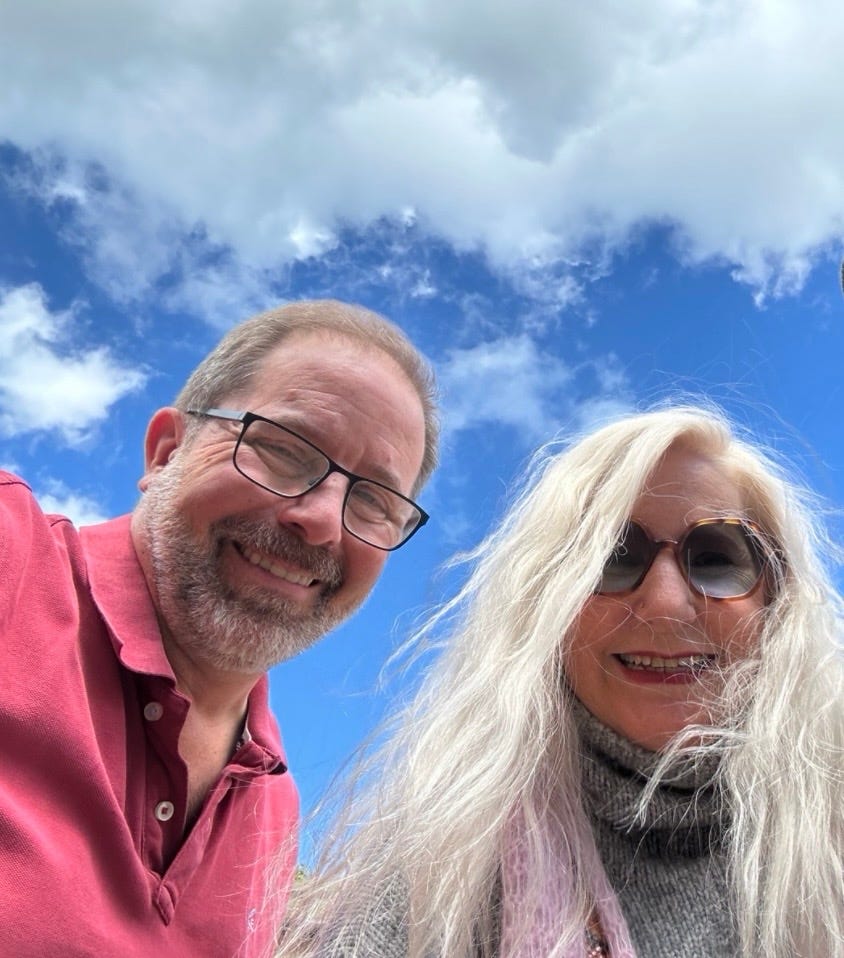
Author’s note: I had just finished threading a 50-part breakdown of Robert Mueller’s indictments of the Russian nationals who attacked the American election in 2016. This was July 2019, when it was still relatively psychologically safe for me to keep Twitter comments open. I had pulled an all-nighter reading the indictments and when I was finished, I noticed a comment with a link from an account titled “dog_in_clouds”.
Exhausted, I began reading the attachment — The NATO Handbook Of Russian Information Warfare — and knew I had a duty to make this my next thread. What I didn’t know is I was going to meet my next great ally in the fight.
Keir Giles — the author of that handbook — is a Russia watcher, who has authored multiple books on information warfare, including Russia’s War On Everybody: And What it Means for You (Bloomsbury, 2022). Keir is an associate fellow of the Russia and Eurasia Programme at Chatham House, and worked with the BBC Monitoring Service and the UK Defence Academy.
I have been interviewing Keir ever since that July day, when a Twitter rando (who turned out to be cybersecurity writer) commented on my work, and I gained another incredible source.
This is Part 1 of a two-part interview series with Keir. The interview took place on 11 June 2026. Part 2 will be released when I have the greenlight to report on his upcoming bombshell book.—hsc
An ‘Extraordinary Passivity’ — A Q&A with Keir Giles, Part 1
At our semi-annual pub meeting, author Keir Giles explains why he knew in July 2024 how the American election would turn out, what it would mean for Europe, and why people should be alarmed at the ‘extraordinary passivity’ in the US
Heidi: Great to see you again, in some lovely pub, in an undisclosed location in the United Kingdom.
Keir: We are allowed to say we’re in Rutland, because it doesn’t exist (he points to a ‘Rutland’ map on the wall).
Heidi: Okay, good. Here we go. So I’ve been thinking about the time we met, in July 2024, and we chatted about the long screwdriver.

I found that article recently and was gobsmacked at your prediction. Here’s a quote from that article:
“The nightmare scenario, of course, for Europe is that in the not too distant future, with the return of a Trump presidency, and Trump enacting all of the things that he and his coterie have said they want to do, Europe is actually going to be even more beleaguered because they will be confronted, not with two main authoritarian hostile powers, Russia and China, but three because the United States will actually join them going down that track and following the same principles that drive Beijing and Moscow.”
So, when you said those words, it was before Biden had dropped out of the race, and I suppose I was still in the hopium phase. I thought, for sure, people would wrap their heads around the fact that their choices were an imperfect democracy or some form of fascism, authoritarianism, whatever you want to call it. And that’s not what happened, but you knew that. You predicted that. So let’s start there.
Keir: Yes, I felt quite cruel trying to puncture your bubble, because you were optimistic that things would not go the way they appeared to be going.
You thought that people would see sense and vote against the obvious downsides of a return to Trumpism. But unfortunately, I think that was optimism. And I think it was fairly plain that the system had been captured to such an extent — on top of the millions of Americans who see Trump and like what they see, wanted more of the same, and listened to his promises, and were not dismayed by them — that the chances of any alternative were fairly slim.
Heidi: In that interview, you called it America’s ‘collective amnesia.’ Why do you think there was such amnesia around the fact that Trump appeared to be working in the Kremlin’s interests in his first presidency? What caused the amnesia?
Keir: I’ve had a brief discussion with Craig Unger about this, and his hypothesis, one of his hypotheses, is the taboo about mentioning it in American media, because it has to be pegged to some kind of event.
It has to be pegged to legal proceedings. It has to be overtaken through an investigation. If none of those things is actually happening, then the simple underlying fact of a group of individuals who appear to be pursuing the interests of a hostile power, rather than the United States, is not something that gets reported on it.
And my own theory is that it does appear to be quite difficult from within the United States to get an idea of the totality of what is happening. You see the isolated reporting, the isolated incidents. You see the things that affect you directly, yourself, like the prices, like, if you see an ICE raid, but the actual entirety of it is a very different matter, and that appears to be hard to discern from within the United States.
And even if people do discern it, it’s hard to grasp because of the enormity of it, because of the upending of all of the assumptions that people have held for so long about the nature of the country that they live in. The rug has been pulled from under all of that, and it takes a big mental leap to actually recognize that. I think the amnesia is indeed part of it, but then, of course, that’s not just amnesia of voters, that’s amnesia of the political system. It’s amnesia of the media.
And this was something you might recall I wrote about in the previous book, Who Will Defend Europe, pointing out that one of the reasons why Trumpism was normalized as a political choice was because all of those aspects of it, all of the things that were dangerous for national security, were constrained by the adults in the room in his first term were somehow not being mentioned.
So it was a willful denialism of what the implications of a return to Trump would be, and now we see the result.
Heidi: I have a theory that I actually adopted from a friend in Prague that because the Trump regime does three awful things a day — truly awful things a day, heinous, grotesque, sometimes more than three — people have an inability to even recall what happened the week before or even a day before. I think it’s intentional, and I’d love to know your thoughts on that, because there is this inability to not only grasp the overall picture, but to even remember the horrible thing that happened a week ago.
Keir: Absolutely.
Heidi: Have you seen that before, or what do you think about that?
Keir: We may not be able to know if this is an intentional strategy, or just a by product of the drive to change and to break so much in such a short space of time. They have this side effect that people can’t remember what happened yesterday. But yes, it’s a very discernible pattern. The numbing, the normalization to things which previously would have been outrageous, has been very fast. Think back to the first reporting of the strikes on small boats in the Caribbean and the Eastern Pacific. There was outrage. Now it’s normalized. It’s on page seven, in a footnote, if it’s mentioned at all.
And that is just one of the many different aspects of things which ought to have been completely unacceptable, but because they happen so fast, and in such volume, they are superseded, they’re swept aside by the latest new thing that shocks people, and so the boundaries are shifted. The parameters for what is normally acceptable expand rapidly.
Heidi: I’m glad you brought that up, because, Rodrigo Duterte is in a cell at The Hague, awaiting trial on November 30, 2026, because of a similar, so-called ‘war on drugs,’ where he’s been accused of thousands of extra-judicial murders.

And you’re right, we’ve pretty much forgotten the fact that Trump did the same thing — illegal killings in a so-called ‘war on drugs.’ But do you think, especially with the Special Tribunal that may be formed — three dozen countries just signed on for the forming of a Tribunal at The Hague for Russian war crimes, and you see Duterte, being tried by the ICC.
Do you think international law has any ability or there’s any promise there that these crimes, which clearly appear to be crimes against humanity, will ever be prosecuted?
Keir: Well, not as a result of any international body of justice. After all, there’s a very good reason why the United States is seeking to neutralize the work of the International Criminal Court, because it brings criminals to justice. And that is not what the United States wants to happen at the moment, particularly if they are Israeli or American. So that’s the reason why these sanctions have immobilized the lives of these ICC judges.

And there won’t be an external means of bringing anybody to account for what’s happening in the United States now.
Whether there’ll be an internal means, of course, depends if there will be a political shift back to where crimes against humanity were outlawed.
Heidi: So that’s pretty much laying it at the feet of the American people, or some sort of opposition party. And I’m not seeing it.
Keir: No.
Heidi: What do you see?
Keir: I see extraordinary passivity. From individuals, from voters, some of whom are protesting, some of whom understand, but in the broad mass, we don’t seem to see a recognition or a response, again, to the enormity of what is happening. We don’t see an appropriate and to scale response. Now, ordinary people may have an excuse for that, particularly if they are already aware of the consequences, the very real and damaging personal consequences that come from speaking up against the regime. However, that does not excuse Democrat politicians. It doesn’t excuse people in positions of authority. Unless, of course, they are among those people who have already been targeted and silenced by threatening their benefits, their welfare, their families, even just their jobs. So that can provide a rationale for keeping your head down and pretending it’s not happening. But it’s no excuse for politicians, who have been elected to safeguard the interests of the country, but are failing utterly to do it.
Heidi: It just seems so cowardly to me. I am sorry. I will be in trauma over the enormous passivity for a very long time, especially because those of us who tried to warn people, as independent reporters, for the last decade, were just abandoned on the battlefield on November 5th, 2024. We were left on our own. They didn’t care. No reinforcements in sight.
Okay, so you wrote Russia’s War on Everybody. I think that you have bravely continued to stay the course from 2016, writing the NATO Handbook of Russian Information Warfare, continuing to be a Russia watcher, putting out Moscow Rules, and Russia’s War on Everybody. And I believe that there is still this terrible veil about Russia in America. But every day, there’s a new headline about Russian spies being caught here in France, or Russian spies in the Netherlands, and all their statecraft and all of their techniques. Why is there not a big movement within Europe looking at what happened in America to actually do something about it? And Estonia, which I wrote about yesterday, thanks in large part to your guidance and Toomas Ilves’ guidance —
they have a blueprint for anybody to follow.

In Estonia, if you’re an RT reporter and you are working with the FSB, you’re in prison. If you are a propagandist politician doing Russia’s work in Estonia, you’re convicted of high treason and you’re in prison.
What is the problem and the disconnect in Europe and European leaders? Why are they not taking this more seriously?
Keir: Well, some are trying. It is not just the front line states that recognize there’s a problem. But it is the front line states that are best equipped legislatively, socially, constitutionally, to deal with it. Other countries still have a long way to catch up, and that is one of the weaknesses of the system, because in Europe, you do have this patchwork of not only different attitudes to threat, but also different fundamental criteria or attributes that you need for dealing with the threat.
And we think back to the so-called Russia report from the UK, Intelligence and Security Committee of Parliament back in 2020 — the report that the then conservative government tried very hard to bury. One of the things that was quite startling that the MPs discovered on looking into this, was how wide the loopholes were in British legislation to allow people to act as an agent of a hostile state power against the UK.
So there was no National Security Act. There was no mechanism through which you could prosecute somebody who was working as a propagandist for a hostile country and was being incentivized to carry out subversion. Even the Official Secret Sect, which is the key Espionage Act, had loopholes. It was actually perfectly legal to conduct espionage against the UK on behalf of a foreign power, until you succeeded. But everything up to that point is unprosecuted.
So now that they do have the National Security Act, which came into force in 2024, it’s had an effect. It’s had a visible impact. Some people that we were observing before, who were operating as agents of hostile foreign powers — Russia, China, Iran — have gone quiet. Others have gone abroad. But it’s an indication of how once the gaps are plugged, but that is an inconsistent process across Europe.
So you have a number of different things that are working against this. First of all, recognition of the threat. Only those people in those countries that are actually paying attention and willing to recognize and draw attention to the problem are equipped to deal with it. Second, what do you then do about it? And that is, in terms not only of prosecuting within your country, and dedicating political, capital, and resources to actually tackling the problem, but also the consideration of how you try to make it stop. Is there a way of attempting to deter Russia from doing it anymore?
And that’s where the role of the supernational organizations comes in, NATO and the EU, because any one of these individual countries, be it Estonia, be it Poland, be it the UK, they can only do things about this that are defensive within their own countries. All the Estonian prosecutions you mentioned, if they want to have a deterrent conversation with Moscow, along the lines of ‘stop this or bad things will happen to you,’ they can’t do it on their own. They need to have the backup from the major allies, from NATO, from the EU.
Even if in an ideal world from the United States, which they’re not now going to get, without that, they can’t take on the job of challenging Russia as individual nations. So, there were reasons why things are not happening in response. None of them is a particularly good reason. None of them is unresolvable, but all of them together have held back Europe’s ability to deal with the problem.
Heidi: You see your long screwdriver thesis really playing out in the immigration narratives, the riots that are happening, anywhere you see inflammatory situations that involves race, you see it happening and firing up throughout Europe. And looking at the UK and looking at France in particular, how do you see Russia putting that long screwdriver in and cranking things up through its various proxies? For example, Tommy Robinson and Elon Musk’s father are currently in Moscow. Andrew Tate’s in Moscow. Candace Owens — these obvious propagandists, conspiracy flamethrowers — in France, you have an election coming up, where both far left and far right are pro-Russian. You see what’s going on. You know how these moves work.
Maybe you can kind of guide us on what people could be looking for. I’m very worried about France and, of course, worried about the UK.
Keir: This is not something I’m following very closely lately, so I only see it when it is the most obvious and clear demonstration that the propagandists are not deterred by the fact that they’re being directly associated with Russia.
So, Tommy Robinson, sitting in Moscow, apparently, not seeing this is a problem. which means plainly it isn’t for the followers of his who agree with him. They don’t see associating with the country’s primary adversary to be an issue, which is obviously going to erode his credibility with any broader audience, but if it is totally accepted within the people that already listen to him, that is alarming.
But we shouldn’t also underestimate, of course, the anger at politics and the results of immigration that is entirely homegrown and does not need encouragement from the outside. Anger at the British government and successive British governments, let’s not forget, always, over decades, for the things that they have done to the country, which nobody would have accepted if they were given the option (but) if Russia sees an opportunity to make something worse than it is likely to take it.
Heidi: As a longtime Russia watcher, why do people not know that Russia was essentially, participating in slavery from the very beginning of the Soviet era in that they had these forced labor camps where people were working 10 to 14 hour days and being starved and dying — for decades. I just finished reading Gulag Archipelago, and it seems to me that there’s an awareness of what happened in Nazi Germany. And yet, there’s almost no awareness of what was happening under Stalin to people.

Whether we’re talking about manmade famines, or, the Executed Renaissance, or these forced labor camps. Why does Russia always seem to get a pass, particularly on the left, which still sees it as some sort of counterweight to American imperialism. I don’t understand.
Keir: Well, there is, of course, a long tale from Moscow’s very successful efforts to paint themselves as different from the Nazis, through the efforts of the international left, which had an interest in pretending that they were not associated with the totalitarian regime. And so it would buy into the fictions, that these were two different places, that the Soviet Union was benign, and did not have concentration camps. Whereas anybody that cared to look knew perfectly well that they were each as bad as each other.
But, of course, when you have a strong interest in maintaining a fiction, because it is the guarantee of your livelihood, or because, if you don’t, you will challenge the basic principles that you claim that you are standing up for, then, of course, you’re going to turn a blind eye to anything which contradicts the narrative that you bought into.
Heidi: Wow, thank you, you always have just such a way about you. My last question for Part 1 relates to a Tom Stoppard quote from Rosenkrantz and Guildenstern Are Dead:
“There must have been a moment - at the beginning - where we could have said no, but somehow we missed it.”
If you could just kind of give an overview on where the West entirely went wrong on underestimating the threat from Russia, because I believe the loss of America is just such a terrible sorrow, a crisis for the world, and it may be that the way of life we’ve known is over. And I think it’s because of a lack of response to Russia’s threat. When did we take our eye off the ball with Russia?
Keir: 1991. The assumption that ‘this was now a different country, inhabited with different people, all of whom held different ideas, and a different understanding of what their country was and its relationship with the West, and, therefore, everything would have changed,’ this assumption persisted long after the evidence started to become undeniable that this was not the case.
And if you think back to what a lot of people treat as a turning point in Russia’s relationship with the West, the Putin speech at the Munich Security Conference in 2007, where people were surprised, but only if they hadn’t been paying attention to anything that Putin had been saying or doing over the previous seven years he’d been in power. And this was already 16 years after the West had bought into the idea that Russia was now a friend, a partner, a different country, you could work with. So the amount of time that has gone by, during which anybody that was paying attention, was warning of what was going to happen, shouldn’t be underestimated. It is decades over which this has been playing out. And because that is decades of inaction, we’re now in a very, very much worse situation than if the problem had been recognized much earlier.
Heidi: Is there any Deus ex machina (God from the machine)? Anything you can think of that could get the Democratic world out of this jam?
Keir: No, it’s going to take long, hard work, and be expensive, and difficult, and lives will have to change, and all of those are part of the reasons why no action has yet been taken.
(End Part 1)
****
****
Related:
****
Bette Dangerous is a reader-funded magazine. Thank you to all monthly, annual, and founding members.
I expose the corruption of billionaire fascists, while relying on memberships for support.
Thank you in advance for considering the following:
Share my reporting with allies
Buying my ebooks
A private link to an annual membership discount for older adults, those on fixed incomes or drawing disability, as well as activists and members of the media is available upon request at bettedangerous/gmail. 🥹
More info about Bette Dangerous - This magazine is written by Heidi Siegmund Cuda, an Emmy-award winning investigative reporter/producer, author, and veteran music and nightlife columnist. She is the cohost of RADICALIZED Truth Survives, an investigative show about disinformation and is part of the Byline Media team. Thank you for your support of independent investigative journalism.
🤍
Begin each day with a grateful heart.
🤍
Americans are outwardly calm, but I don't think passive is the right word. Americans all see that Trump hates us, that he wants to break our country, steal our wealth, hurt our children, and throw us into generational poverty. We see that Trump wants us to be shocked, stressed, frightened, confused about what is true, and unsure what we can do. But we are none of that; we know exactly what to do. We are angry, we wait, then we vote. Boomers and Gen Z, Democrats and former Republicans, white, rural, urban, nonwhite people all understand exactly what is happening, and the polls show that super majorities are coalescing around opposition to the regime.
Either midterm elections will go forward more or less normally, and control of the Congress will be returned to the people, or it will be neccessary to take corrective action. Obviously, it's not a good idea to elaborate on this publicly, so no one does, leaving the loud drama to the MAGA Republicans. We have begun electing former military and national security personnel in special elections to build a new leadership class, and its clear that we will also need the lawyers and accountants to address the massive corruption. Fortunately, we have the examples of the courageous people who defend their democracies before us; Ukrainians, Poles, South Koreans, Moldovans and now Hungarians.