

***Please take out a membership to support the light of truth.***
“It does appear that it is hard for many Americans to discern the totality of what is happening.”—Keir Giles for Bette Dangerous
I spent much of June staggering around in a blues-induced stupor.
Keir Giles had given me an advance copy of his upcoming book, American Overthrow: Moscow’s Endgame In Its Long War with Washington, and I burned through all my highlighters, taking breaks to stare at the walls in a mild fugue state.
Seeing the enormity of the damage wrought in the US during the first year of Trump’s second term — in stark black and white — was soul destroying.
I kept sending him screenshots of page after page highlighted, in cheery pinks and greens and lavenders. But even happy colors could do little to diffuse the grimness of the content.
Amidst all the noise, emerges the first meticulous, clear-eyed account of how America was killed.
No fluff, no happy horseshit, just a blow by blow accounting of each action undertaken by the Trump administration in its first year and how the actions benefit, emulate, and even surpass Moscow. (As I note in my next post — a book review of American Overthrow — whether or not US democracy will be reanimated is up to the people, what they do or do not do.)
I met with the veteran Russia watcher in June to interview him about the book, when I was only a few chapters in.
On June 14, I released Part 1 of our interview, which focused on why the UK-based author knew in July 2024 that Trump would return to the White House and what his return would mean for Europe. He also explained why people should be alarmed by the “extraordinary passivity” in the U.S.

It’s an important companion interview to Part 2, which focuses exclusively on American Overthrow. Both interviews took place on 11 June 2026, in a pub in England.
Here is Part 2:
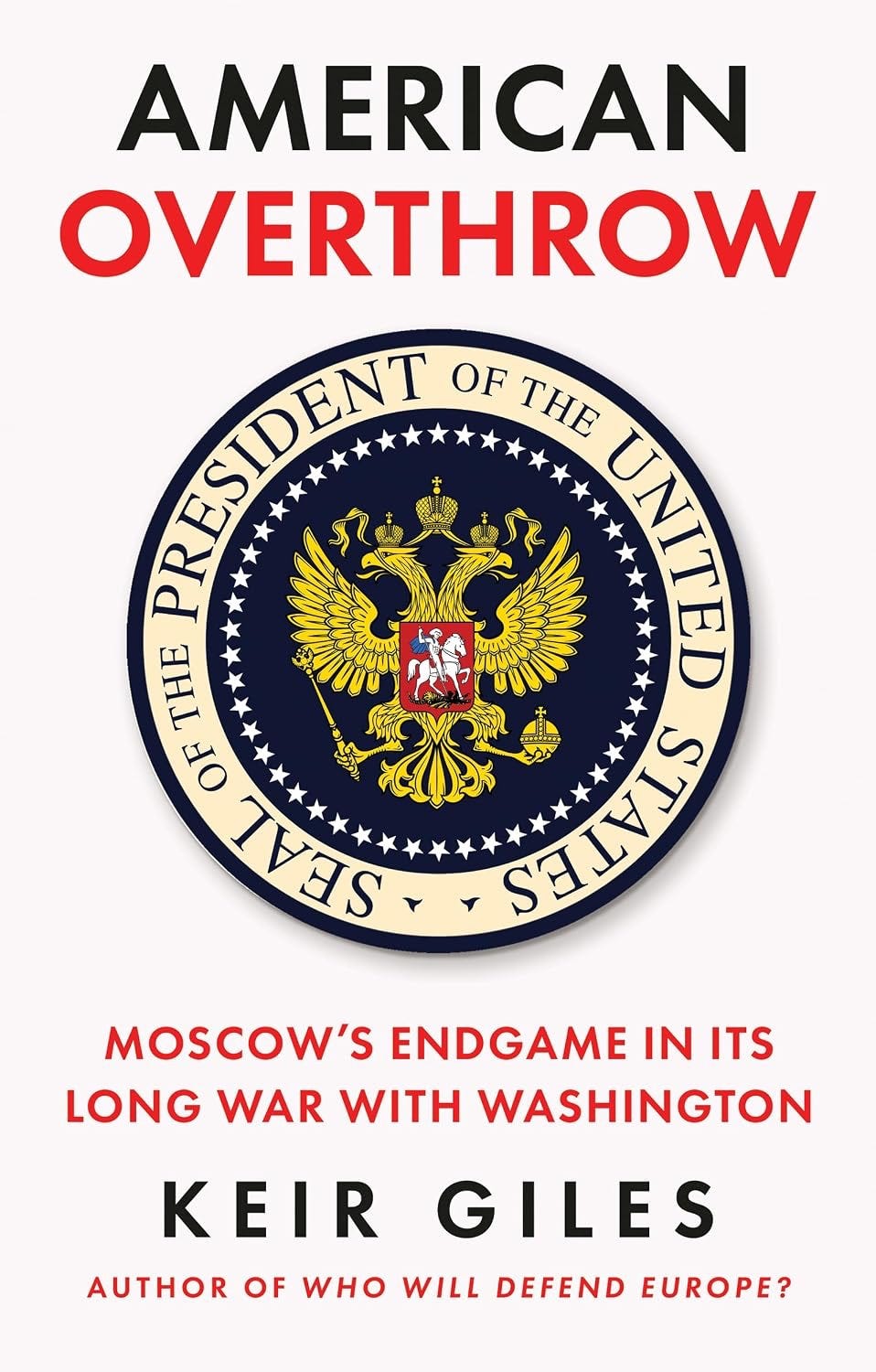
AMERICAN OVERTHROW: A Q&A with Keir Giles, Part 2
AMERICAN OVERTHROW: A Q&A with Keir Giles, Part 2
Heidi Cuda: Thank you for the advanced copy of American Overthrow. I would like you to tell our readers why you had to write this book. It has a tremendous urgency to it, of course, but it’s also brilliantly and methodically written from what I’ve read so far.
Keir Giles: Well, I’m glad you like it so far. It gets worse. It’s another one of my books that has been a decade or more in the making. During the first term in office of Donald Trump, I started collecting material, thinking that I would write something about the way in which he was so determined to drive through the policy objectives for the United States that Russia wanted, rather than those that would actually benefit U.S. security.
Eventually, he left office, and I let those sources sit. And then he returned, and when he did come back into power, of course, as you know from the previous book, Who Will Defend Europe, the expectation was that he would once again immediately attempt to further Russia’s interest at the expense of the United States and the United States’ allies, including in Europe and in East Asia.
And, of course, he would find it easier to do so, because he’d taken preemptive measures to remove the adults in the room who previously constrained him, and to remove democratic constraints on him, as well, by neutralizing the Supreme Court as a curb on his power.
So all of that was anticipated, and all of that meant that I dusted off the old material about it — how this worked, and what it meant, and what the implications were for Europe and for the United States itself. And I started writing again.
But during the first year of Trump being in office again, watching all of the processes that were playing out within the United States, I noticed that there was something else happening. There was something different, something deeper, than just having an individual at the top of the White House, surrounded by like-minded other individuals who were promoting the policies of Russia rather than the United States. And that deeper something seemed to be effecting a transformation of politics and society and the economy within the United States, to not just promote Russian policies, but actually to emulate and mimic Russia itself.
And so many things happened which were grimly reminiscent of the exact same processes that took place at the very beginning of this century, when Vladimir Putin came to power in Russia. So many of the examples of things which were previously unprecedented, but now normalized, were immediately recognizable from what Russia had done before. And as you read through the book, you will see, time and again, it’s hard to resist the temptation to say “like in Russia” before you describe every new astonishing incident that has happened in the United States.
Like murders by masked paramilitaries on the streets of major cities, like the death squads that are killing the alleged drug smugglers in the Caribbean and the Eastern Pacific, rather than arresting them or bringing them to trial. Like the institutionalization of corruption, the monetization of office. All of these different things, which are unheard of for the United States within living memory, but perfectly normal for Russia.
Heidi: Right, incredible. I remember right after Trump was reinstalled in 2024, I wrote an article, Welcome to West Russia, because it seemed so reminiscent of oligarchs running politicians, everybody in the inner circle obviously being criminals and corrupt, and there seems to be absolutely no shame in any of that. And part of what’s happening when I’m reading your book is I continue highlighting and highlighting and highlighting, because you’re saying all the things that I know to be true, but there’s been so much pushback over it. And you reference the quote about Trump being, like, “late-stage Yeltsin,” and can you speak on that a little bit? It was so spot on, perfect framing.
Keir: Well first of all, going back to what you were saying just before about the way in which there is no shame. It’s one of the ways, and this is very striking when looking at the parallels with Russia, that it’s not just mimicked Russia, it’s exceeded Russia. It’s done more than you see within a Russian context. The North Korea style praise sessions, where everybody in the cabinet goes around and makes ridiculous compliments to Trump, is something that Putin would never put up with, because it’s over the top.
The leader’s face on the front of the Department of Justice. You wouldn’t see that in Russia, but you would in North Korea. And the ways, and this comes to another point that you said, the ways in which there is no attempt to conceal the illegal actions within the United States - as opposed to Russia, which pretends it’s a democracy, pretends to legitimate leadership, pretends it isn’t a kleptocracy. In the United States, it’s all in the open.
You mentioned the oligarchs, for example. Russia is still called an oligarchy, but that’s a little misleading, because the few, the oligarchy of the few, the ultra wealthy, they don’t have the influence on the direction of the country. They don’t rule in the way that the word oligarchy suggests. Whereas in the United States, yes, the billionaires have political sway. They can make things happen. They can influence the leader to deliver policies that they want. So, the United States is already far better at fulfilling the definition of an oligarchy than, in fact, Russia is.
Heidi: Ugh. So why did you title it American Overthrow?
Keir: Well, American Downfall would immediately make people think of Bruno Ganz in a bunker pointing at a map, which was not quite the image that we’ve got to yet within the United States. However, if the bunker complex with the sniper posts and the drone ports underneath Trump’s magical ballroom comes to pass, and if it is to be used as a command center for directing civil unrest within the Washington D.C. area, then maybe we’ll need to retitle it Downfall after all.
Heidi: Can you help explain the urgency for people to read this book? I feel a great urgency.
Keir: We are rushing it to publication. The idea is that it should emerge in good time before the U.S. midterm elections at the end of 2026, partly because of doubts over whether they will actually happen. Because there’s a substantial element of the book which is about consolidation of power by the current ruling elite by means of making sure that there will not be a democratic challenge to it. And that is, in terms of seizing control of electoral processes, from the devolved local level that you have in the United States. It’s redistricting to make sure of the outcome of elections. It is the prospect of intimidation, that systems seem to be being put in place for. It is the preparations for disputing the outcome of a vote. So even if a vote is held and is free and fair, there’s no indication that it will necessarily be accepted by the current ruling elite and all those people that they can persuade to protest against it.
Heidi: Did you ever expect to have to write this book? Thinking Americans have been predicting and warning and passionately trying to get people to see what was happening in front of their eyes but to no avail.
Keir: There are parts of this book that were expected, and you know that, because I described it in Who Will Defend Europe, I described what was going to happen, and now it is happening. But that is only part of the question.
I was expecting that there would be policies pursued by the United States that favor Russia. The extent of the transformation of the United States into Russia, I was not expecting. And the extent to which the United States would constrain its own power, to decide no longer to be a global power, but to retreat to a sphere of influence that if we believe Russia has been negotiated with Moscow in a form of a Molotov-Ribbentrop Pact, to follow so precisely the policy instructions of Alexander Dugin, writing 30 years ago, to pursue a new Monroe Doctrine and retreat to influencing solely the Western Hemisphere. All those things were unexpected.
But you asked me a while ago about who comments meaningfully on what is happening in the United States, and why that is not always necessarily people inside the country.
It does appear that it is hard for many Americans to discern the totality of what is happening. They see things that affect them. They see things that may or may not come through in their local media coverage. They understand that there’s a difference between Trump saying that gas prices are under three dollars a gallon, but they are paying six. They understand that something is different, and it’s changed, but grasping the enormity of the change overall appears to be easier from outside the country.
And it is particularly easy if you are an expert on Russia, and therefore recognize the patterns. And that’s why, as I think I mentioned in the introduction to the book, it is the people that have spent their lives studying and explaining Russia that are emerging as some of the most coherent and convincing explainers of what is happening in the United States today. That quote that you mentioned, comparing the current Trump presidency to the mid to late Yeltsin period... because you have somebody with visibly diminished cognitive faculties being directed by undisclosed interests, enriching the family, presiding over a descent into chaos. That quote was actually from a Russia watcher — a professor at King’s College in London named Ruth Deyermond, who has been one of the most trenchant commentators on what is happening in the United States, and also one of the most convincing because she sees the parallels. And so, there is a framework within which all of this makes sense.
Heidi: The quotes in the book’s introduction are shocking. The one from 1856, from Naval Officer Matthew Perry, saying there is gonna be a showdown between democracy and slavery. You wrote that he predicted “that a clash between the two irreconcilable systems—the ‘antagonistic exponents of freedom and absolutism’—would be inevitable. The outcome of that clash, Perry wrote, would determine ‘the freedom or the slavery of the world—despotism or rational liberty must be the fate of civilized man.’” And here we are, on that precipice now. Okay, so as I continue reading the book, what are some of the grim low lights we can expect?
Keir: Where do we start? Well, let’s start with one of the parts that readers might find a little more challenging to tie into the overall program of what it is that Russia wants the United States to do. And that is the way in which the changes that are being driven through by the administration make the lives of ordinary Americans worse. All of the things that are being done to make them poorer, less healthy, less safe. And all of this you can tie back to Russia’s interest in setting Americans against each other, which is a core part of their objectives.
And not only against each other, which Russia has always been practicing, but sponsoring groups of extremists on right and left, and then setting them at each others’ throats. But also increasing the divide between ordinary Americans who are not among the ultra wealthy, and the ruling elite which has now devolved to a tiny, tiny group. [There are] Not the previous policy structures that you might have had for determining what the United States should do about a given problem and avoid some of the worst possible outcomes that we’ll come onto in a moment. But instead, a small clique of the ultra wealthy, of the billionaires, who are influencing policy and are set apart from the broad mass of the population.
So, wherever you look, wherever you see new social phenomena emerging in the United States, it is possible to map that to something that Russia set in process a long time ago. So the temptation is to overdo it, and to see Russia behind everything. And it is actually quite hard sometimes to step back, maintain that objectivity, decide which of these things would have happened without encouragement, and which are plainly the result of a campaign that Russia put in place 50 years ago.
Heidi: I often return to a NATO slide that I received in 2019, that lists every one of Putin’s objectives that Trump was checking off his list. Every single objective was being met. So as the author of American Overthrow, what should thinking Americans do right now? And I say thinking, because there are plenty of people who live in a mangled reality.
Keir: Sadly, Americans today, like Russians 20 years ago, are faced with a choice, whether to resist and to incur the inevitable personal costs for themselves and their families that would be involved in doing that, or to submit, surrender, comply, and see their country being changed into a very different and very much worse place. There is no easy option other than those two. What we see so far is, as we’ve discussed previously, the extraordinary passivity, not just of ordinary people who might not necessarily realize fully what is being, in the end, done to their country, but also of the well informed, like Democrat politicians, who are apparently accepting this, rolling over and allowing themselves to be steamrolled, and for their country to be taken away from them.
That has to change if anything is to be stopped. Ordinary Americans, some of them, have bravely stood up, but the broad mass appears not to recognize what is happening, and if they do recognize it, then, just like in Russia, they seem not to be able to take the step to resist it.
Heidi: Yeah, I think that’s probably the final word. If a true Resistance builds and the numbers are there, people could change the course of history. Keir, you’ve written book after book after book, Russia’s War On Everybody comes to mind, and unfortunately, you’re right every time. Any comment on being so right about so many horrible things.
Keir: Well, there’s a very depressing pattern. I think I mentioned it in the conclusion of this book, that whenever I write something, it usually comes out first in hardback. And it’s usually a set of predictions, and the pattern is, I say, “Here’s a situation. It is very bad. Unless action is taken to remedy it, it is going to get very much worse.” And then, no action is taken and it gets very much worse. But a year after the hardback edition, there’s the paperback edition, for which I always write a new foreword. The new foreword usually consists of a list of, “Well, here’s everything that I said was going to happen, and we didn’t do anything about it, and then it happened.”
So here we are in a new situation. What I would greatly look forward to at some point, and I really do hope that it happens with this book because it hasn’t happened with any previous ones, is that I might be wrong.
Heidi: I hope you are wrong, too, Keir. For humanity’s sake.
(End Part 2, Q&A)
****
KEIR GILES has advised governments worldwide on the Russian threat. A former senior fellow with Chatham House’s Russia and Eurasia Programme, he regularly comments for the BBC and international media. His prescient books include Who Will Defend Europe? (also published by Hurst), a Financial Times Politics Book of the Year.
More about American Overthrow:
AMERICAN OVERTHROW — HAS RUSSIA BROUGHT ABOUT REGIME CHANGE IN THE USA? The maelstrom following Donald Trump’s 2025 return to the US presidency left many bemused and disoriented. But for Russia-watchers, what unfolded was grimly familiar. So many of the Trump administration’s destructive actions have precisely aligned with the Kremlin’s own objectives; and to a startling extent, Trump’s America is beginning to mimic Russia itself.
Abroad, Trump has demanded the annexation of neighbours, and embraced war crimes in Iran and the Caribbean. At home, the war on truth and history, purges and the weaponisation of justice, the deployment of masked federal paramilitaries to the streets of major cities and more all mirror Vladimir Putin’s own consolidation of power. Dismantling obstacles to Russia’s ambitions, whether they threaten Europe or America itself, is a defining feature of Trump’s second presidency. And just like Putin, Trump shows no intention of departing at the end of his presidential term. Keir Giles examines America’s transformation through the prism of Kremlinology. What he reveals should alarm us all.
Quotes on American Overthrow:
‘Keir Giles draws direct parallels between the Trump oligarchy’s consolidation of power in the United States and Vladimir Putin’s rule in Russia. This is not a bizarre or far-fetched comparison, and it should make readers of all political persuasions think twice about American politics.’—ANNE APPLEBAUM, author of Autocracy, Inc.
‘As Keir Giles makes abundantly clear in this expertly written and insightful book, Donald Trump’s political template is Vladimir Putin’s.’—FIONA HILL, former US National Security Council advisor
‘Giles highlights Kremlin method in Trump’s madness. A must-read.’—EDWARD LUCAS, former senior editor, The Economist
‘A meticulous forensic examination of how the Trump administration’s objectives precisely match those of the Kremlin.’—TOOMAS HENDRIK ILVES, former president of Estonia
‘For the last decade, I’ve chronicled how Moscow cultivated Donald Trump as an intelligence asset. In American Overthrow, Keir Giles—a Russia specialist at Chatham House—takes that story into the second Trump administration, where the payoff for Russia is finally revealed.
By assembling the scattered scandals of the Trump era into a single, coherent, and chilling whole, Giles does what the daily flood of headlines cannot: he shows how Trump doesn’t merely emulate Russia but often outdoes it—creating his own set of “alternative facts,” activating masked paramilitaries, threatening neighboring allies, and consolidating power in the hands of his billionaire friends.
The picture that emerges—a fractured Europe, a hobbled NATO, a White House at war with its own intelligence agencies—amounts to dividends beyond Putin’s wildest dreams. This is the rare book that says exactly what has happened: Russia has effected regime change in the United States with the active support of millions of Americans—and most of them still don’t even know it.’—CRAIG UNGER, author of House of Trump, House of Putin and American Kompromat.
To pre-order American Overthrow (Hurst Publishers), follow this link here or click the button below:
American Overthrow worldwide publishing dates:
September 3, UK and Europe
November 15; Available for purchase October 15

****
****
Bette Dangerous is a reader-funded magazine. Thank you to all monthly, annual, and founding members.
I expose the corruption of billionaire fascists, while relying on memberships for support.
Thank you in advance for considering the following:
Share my reporting with allies
Buying my ebooks
A private link to an annual membership discount for older adults, those on fixed incomes or drawing disability, as well as activists and members of the media is available upon request at bettedangerous/gmail. 🥹
More info about Bette Dangerous - This magazine is written by Heidi Siegmund Cuda, an Emmy-award winning investigative reporter/producer, author, and veteran music and nightlife columnist. She is the cohost of RADICALIZED Truth Survives, an investigative show about disinformation and is part of the Byline Media team. Thank you for your support of independent investigative journalism.
🤍
Begin each day with a grateful heart.
🤍
Tx H! Keeping my eye out for audio book xx 👍🤞💗🇬🇧💝💝💝💝