

***Please take out a membership to support the light of truth.***
“We have to understand evil as something that is not necessarily going to show up in demonic form.”—Dr. Marci Shore for Bette Dangerous
Author’s note: In many lectures I have watched by the intellectual historian Dr. Marci Shore, she references the Hannah Arendt book, Eichmann in Jerusalem: A Report on the Banality of Evil. So I sat down to read the book in recent weeks, and immediately knew that it was among the first books I needed to introduce our community to for our newly launched Bette’s Book Club. Marci joined us on Tuesday for our annual Halloween Hair-raiser, and with me wearing devil horns, and Marci in a witches hat, we talked about the upwardly mobile bureaucrats of the Third Reich. Here is that interview.—hsc


‘After all these hells had past…’
A Q&A with Dr. Marci Shore on Hannah Arendt’s Eichmann in Jerusalem: A Report on the banality of evil
“The greatest crime is the failure to think.”
Heidi: It blows me away that it was a year ago that Marci and I did the first Hair-raising Halloween special. And we were talking about her book The Ukrainian Night. When I interviewed your friend from Serbia yesterday, Slobodan, he said the young people just by example, shamed older people to join them in protest. And that’s how civic engagement grew. And that reminded me so much of what I learned from your book.
It is so great to see so many people turn up for this conversation because these are not easy conversations to have. Our book club is serious. It began with Keir Giles’ American Overthrow and then we went right to House of Trump, House of Putin with Craig Unger. And we just keep continuing. We don’t look away from reality.
Full disclosure: I didn’t sleep last night, Marci, because I was up till 3:30 in the morning with a fear and anger combo. I feel like there are too many people selling hopium and copium. And not enough reality, as we approach the US midterm elections. I feel pre-devastated about the amount of people who continue to underestimate how truly criminal the Trump regime is. And so I always believe we brace for impact, and we do our part to have the best possible outcome we can.
Okay, Marci, let’s jump in: why is Hannah Arendt one of your first loves?
Marci: We are actually talking about the first book I ever read by Arendt, which I read for a class at Stanford in 1991 when I was 19. And I still remember my first encounter with Eichmann in Jerusalem, which was my first encounter with Arendt. And of all the thinkers that I’ve gone through phases of reading intensely and thinking with intensely, Arendt has been with me the longest.
I always go back to Arendt. I’m always thinking with Arendt. I’m always finding something new with Arendt. I never get tired of her. I do feel intensely close to her. In fact, Tim and I contemplated when I was pregnant naming our daughter Hannah, but I felt like that would just be too much pressure.
It didn’t seem right given my intense relationship with Arendt. But she’s someone I’ve come back to again and again. Although I’m finding it in some ways quite ironic that we’re talking about Eichmann in Jerusalem on Halloween, because the whole point of the Eichmann book was to understand that evil doesn’t necessarily come with horns.
It doesn’t necessarily come with the witch’s hat. It doesn’t necessarily come with the hooves. And that we have this desire to see evil in this embodied form, in that Halloween form, so that we recognize that it’s evil, so that it satisfies us as evil, so that it has a clear identity as evil. And the whole intervention of her Eichmann analysis was that you don’t get the little red things sticking up. You don’t get the devil’s ears. You don’t get the horns. You don’t get the hooves.
We have to understand evil as something that is not necessarily going to show up in this demonic form.
Heidi: You introduced me to David Livingstone Smith, who explained to me that it would be nice if they were monsters and they’re not. And Arendt came up with the term, ‘the banality of evil,’ this report on the banality of evil. And why I find it so scary is the whole reason we’re doing this particular project today is because, Marci, this book is so scary for exactly the reason you just delineated.
Marci: Yeah, I made my students the past two years watch one of the documentaries of the Eichmann trial, too. The footage was always there, but there are now some quite good documentaries where you can get clips of the footage. And I’m very sympathetic to this idea that we want evil to look demonic, because it’s more satisfying, and it’s more easily recognizable.
And the story of Arendt is that she was a German-Jewish student. She comes from German philosophy, very deeply from German philosophy. She famously studies with Heidegger and has this affair with Heidegger and then studies with Karl Jaspers. Heidegger and Jaspers are two of the iconic figures of the Third Reich on opposite sides. Heidegger is the iconic figure of the brilliant philosopher who becomes a Nazi. And Karl Jaspers is the iconic figure of the one who is never tempted and always morally clear.
And she’s imprisoned very briefly in 1933 when the Nazis come to power. She gets out of prison, she leaves, she goes to Paris, and then eventually she ends up in New York. And she very much makes a life for herself and becomes a central point of New York intellectual life. She is not one of these emigres who is not successful or doesn’t reinvent herself.
Everybody’s always asking how she possibly was able to write in English so quickly. I mean, she was clearly a genius in various ways.
She forms very important friendships in the New York intelligentsia in particular with writer Mary McCarthy. But she’s watching what’s happening in Europe, and this comes to her. She’s always very sober, not very idealistic, but also not very cynical. And she will later say that ‘for me, the real shock was not 1933. It was 1943. That was the day we learned about Auschwitz.’
And she said, ‘Before that, I thought amends can be made for just about everything as they generally can in politics, but not this. Some line has been crossed. This ought not to have happened.’
And she then begins this period of intensive thinking about what has happened.
And the book she writes, Origins of Totalitarianism, which she publishes in 1951, which is written just coming out of the war, is the kind of classic and original rendering of the revelation of the essential similarity between Nazism and Stalinism and how this phenomenon of totalitarianism is different from forms of tyranny and authoritarianism in the past.
Radical Evil
And it’s a huge book. It’s written in three sections. But it ends with her idea that there are crimes that can neither be punished nor forgiven. It ends with this idea that she’s taking in part from Kant of radical evil.
And she defines radical evil as what happens when all human beings become superfluous. And she has various ways in Origins of Totalitarianism about explaining what she means by superfluous. She kind of is reworking her own vocabulary. One of her interventions is to look at the phenomenon of statelessness after the First World War, when suddenly in Europe you needed a passport to travel, and there were all these stateless people after the collapse of empires. And her revelation then was that the famous Declaration of the Rights of Man and of the Citizen coming out of the French Revolution, 1789, ‘All men are created equal and endowed by their creator with certain inalienable rights...’ She said there was an assumption that the rights of man and of the citizen are the same. Well, it turns out there is no such thing as rights of man. There’s only the rights of the citizen.
And in the absence of a country to guarantee your citizenship and protect your rights, it turns out that those rights of man are completely meaningless and that people without passports became superfluous people. They became people who were completely rightless. So there is this legal definition of the superfluous person. And then she makes a very controversial argument about how totalitarianism destroys subjectivity before physical death, that you can destroy someone’s sense of self. And it’s a very Kantian analysis. And she uses this idea of spontaneity, which I won’t bore you with right now. And she makes a very controversial argument that she says this happens with respect to both perpetrators and victims. The ultimate aim of a totalitarian regime is to do away with subjectivity so that everyone is suited equally well for the role of victim or executioner. And that by the time the Jews were led to the gas chambers, they were already dead. They had killed the self.
And she’s going to get a lot of backlash for this. But this idea of radical evil that can neither be punished nor forgiven, that is what happens when all men become superfluous, all human beings become superfluous, no one really has a self.
Heidi: It’s such powerful stuff, because until I read Eichmann in Jerusalem, I didn’t realize that first, the passports were taken away. There were so many things I didn’t realize until we got into those transcripts to see how the Third Reich functioned day to day. And to me, that was what was so frightening was that it was this big bureaucracy with people like Eichmann in the role of bureaucrat trying to please his bosses.
Marci: I’m so happy you read Eichmann in Jerusalem. I feel like this is like my service for the world. When Slava Vakarchuk, the Ukrainian rock star, spent a semester at Yale on this world leaders fellowship program, he discovered Hanhah Arendt. And I felt like my contribution to Ukraine is going to be that I introduced Slava Vakarchuk to Hannah Arendt, because I do feel that these are the critical interventions in our thinking that we have to rework and to continue working through.
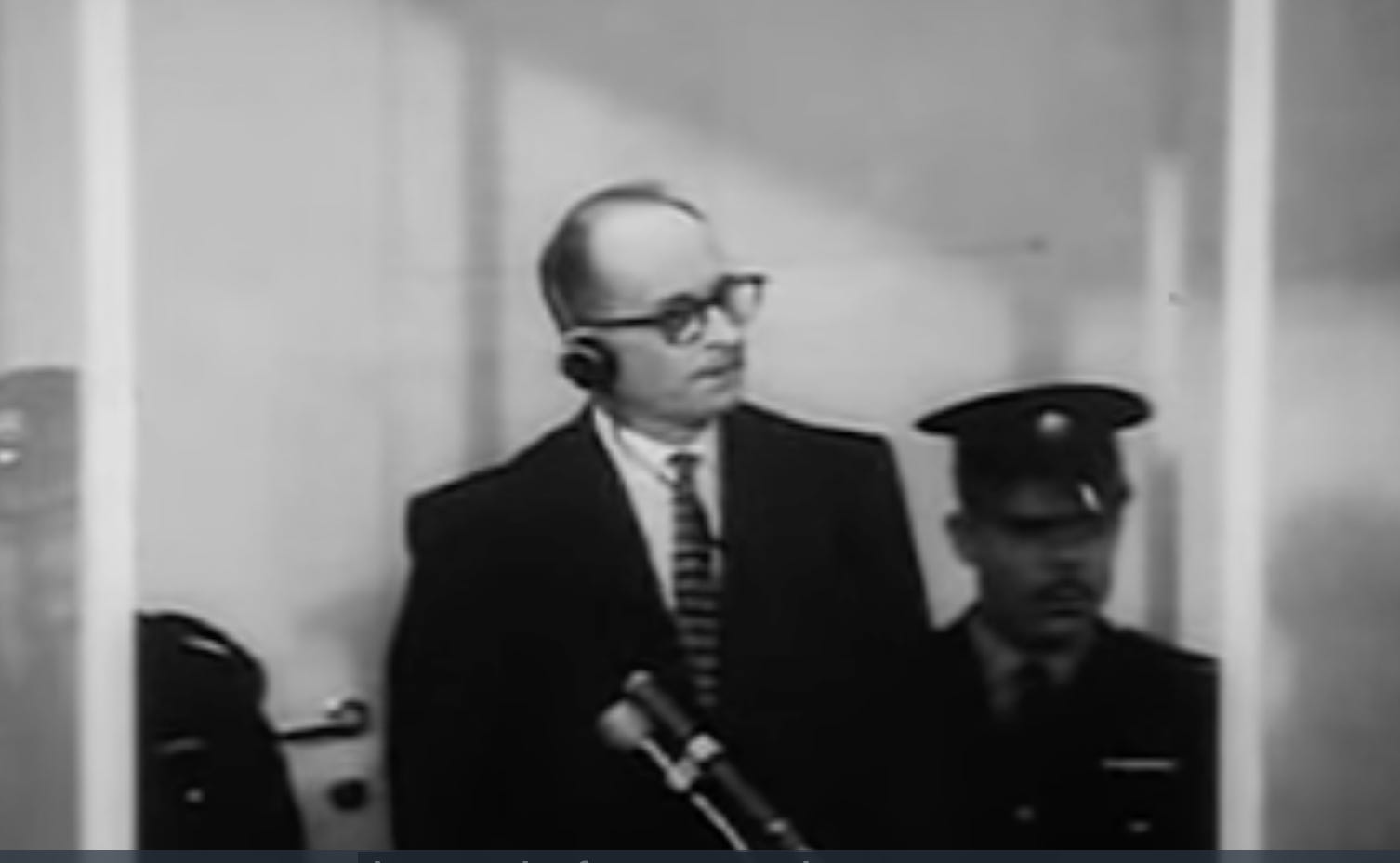
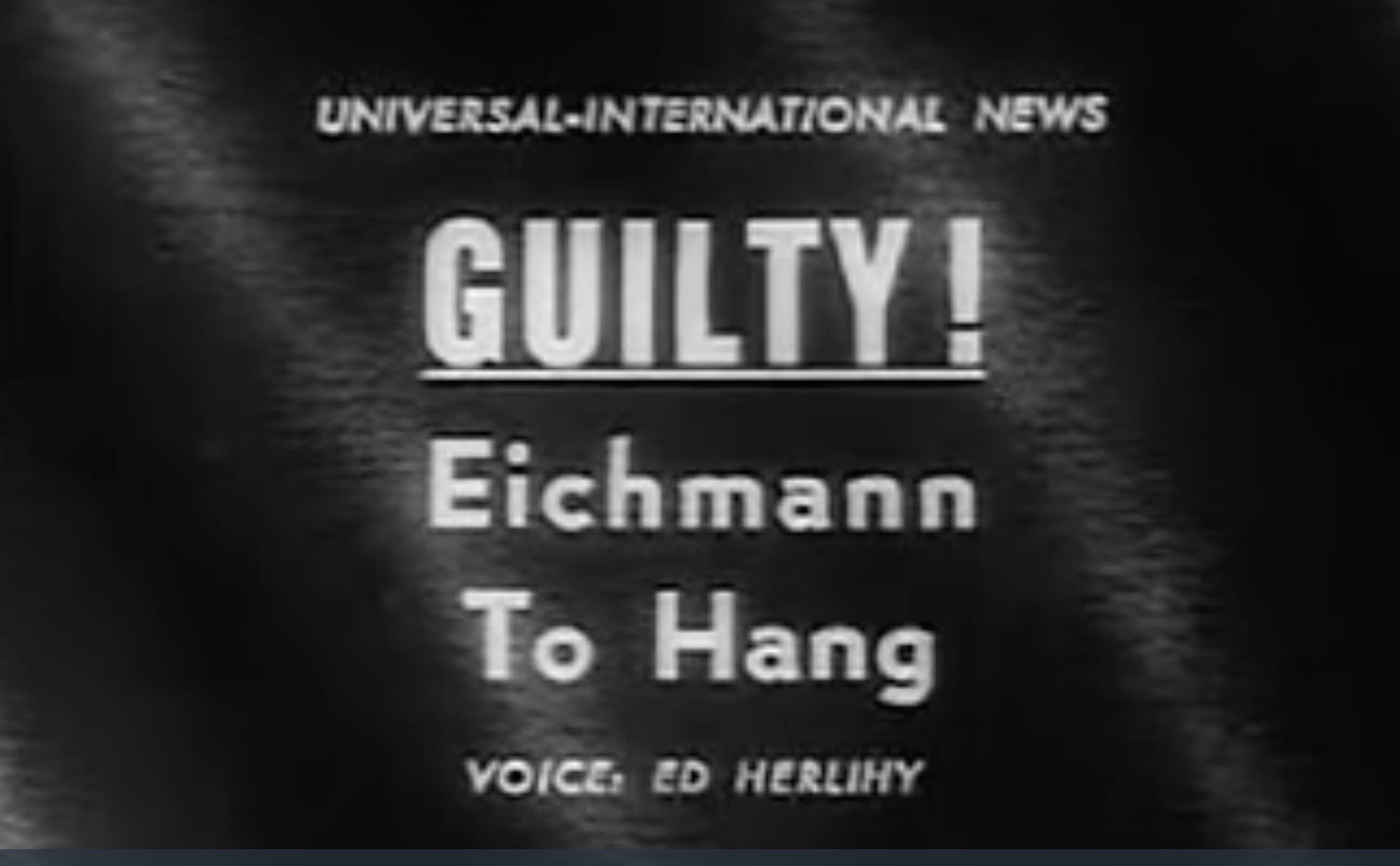
So in 1961, they get Adolf Eichmann. He’s not tried in Nuremberg, because he’s one of these Nazi figures who escaped. Only a small handful of people were tried in Nuremberg symbolically. A lot of them got away.
Most were not tried. And then some of them escaped. And Adolf Eichmann, who was not the interesting ideologue. He was basically a civil servant and a bureaucrat who was charged with organizing the Final Solution to rid Europe of Jews.
But ‘organizing’ in the very kind of bureaucratic sense, like you arrange the train schedules. You get the trains to the gas chambers, like organizing in the way lots of people working in civil service and administrative positions are organizing. You could be organizing anything, but Eichmann happened to be organizing transports to gas chambers.
He escapes to Argentina, which is a very popular place for these guys to escape to. He’s living under an assumed name. The Israeli Mossad is looking for him for years and years. They finally find him. If I’m remembering the details of the story, he was not hiding that well. It wasn’t by our standards of how you might disguise yourself. It wasn’t that impressive.
Heidi: He’d given an interview. He’d literally given an interview.
Marci: He’s such an idiot. So the Israeli Mossad swoops down and kidnaps this guy. It’s an illegal extradition, which is another controversial point. Like they don’t have any right under international law to get this guy, but they get this guy, and they take him back to Jerusalem.
And then there’s the whole legal question of the jurisdiction of Israel — Israel is claiming jurisdiction as representative of the Jews. It’s a state that didn’t exist at the time that Adolf Eichmann created the crimes, and they decide to try him. And that that trial becomes one of the most fantastical show trials in the sense that for the Israeli government, there has been largely silence about the Holocaust. Now it’s an obsessive reference. But for the first decade or so of Israel’s existence, it was in some ways the opposite.
A Source of Shame
It was a source of shame. It was a source of trauma. It was a reminder that Jews in the diaspora went like sheep to the slaughter. Holocaust survivors who ended up in Israel were often not treated very well. There was not the kind of public discussion you would expect about this. So this was also for Israeli culture, it was the moment when the government decides that we’re going to educate the new generation about what happened.
So the trial is really not just about Eichmann. And lots of people testify who had no direct contact with Eichmann, who were just survivors who were testifying, including people like Yitzhak Zuckerman, who was one of the commanders of the Warsaw Ghetto Uprising. And it was a whole pedagogical project.
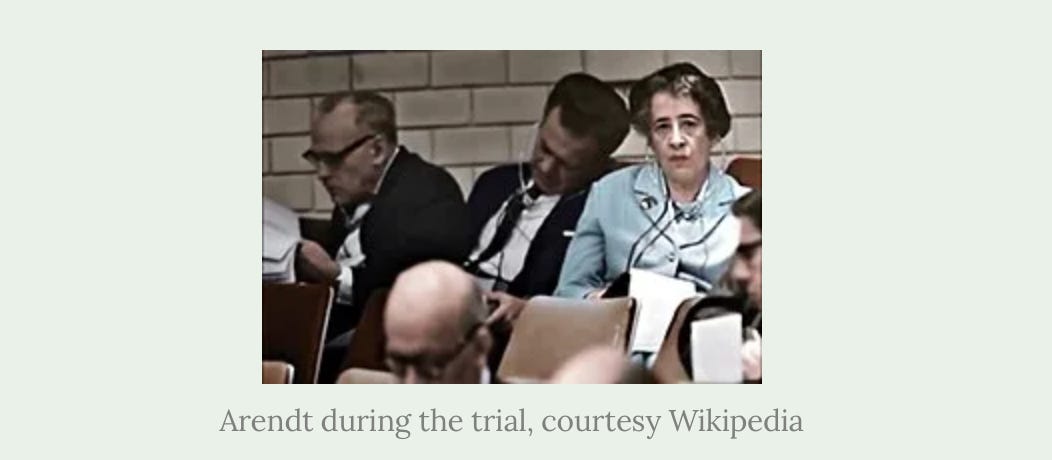
In any case, Arendt at that time was in New York. And the New Yorker sends her to cover the trial. And this is really one of these moments… it reminded me of when Slavenka Draculic is sent to cover the Yugoslav war crimes trials. She very much had Eichmann in Jerusalem in her mind. You have the woman, the writer, the intellectual who is going to, after the fact, after all these hells have passed, to sit in the courtroom with these guys and listen in her native language.
And the native language was significant. So they had simultaneous translation, German and Hebrew. But it was significant in the trial that all three of the judges were native German speakers. And it mattered to Israel that they be listening to Eichmann in his native language. And it really mattered to Arendt.
To Arendt, you really feel that German go through her as she’s listening to him talk. So she goes there to try to take this in.
And the thing that knocks Arendt out from the very first moments of the trial was the radical discrepancy between the monstrosity of what he did and the mediocrity of the person.
Like that was the initial revelation. That was like, I mean, you’re looking at something that is just so bone chillingly evil in a way that nobody can get their mind around. And then you have this guy who’s not particularly impressive in any way.
Heidi: Right. And that was very controversial when she wrote that initially, when she identified who she saw as this bureaucratic type figure. And I remember a moment where he learns that his role is, which is deportation logistics, and there’s all these different schemes that he’s trying to pull off, but when finds out about the reality and grimness of what is happening, the mass murders, the Final Solution, and he says suddenly, the love for his job is gone. And I read that and thought, if it wasn’t so gravely serious, you could picture Mel Brooks doing a Producers sequel with this person. It’s like, ‘Oh, the fun now is taken out of the job.’ I mean, it was almost insane. It felt a little insane.
Marci: It does. And she captured… I mean, she has this very inimitable sarcasm, and it offends some people, but I feel like there’s a misunderstanding. She’s looking at Eichmann and she says he’s incapable of articulating a single sentence that’s not a cliche. And his inability to speak is indicative of an inability to think, and namely to think from the point of view of anybody else to make any kind of imaginative leap. He’s just totally thoughtless. He’s clearly self-interested, but not in a sadistic way.
This is the thing, like there’s no sadism here. Like there’s no taking pleasure in cruelty. He’s self-interested in the sense that what would give him pleasure is upward mobility. He’s a bureaucrat. He’s trying to perform his job well so that he’ll be promoted. I mean, you could imagine that he could have been put in charge of reorganizing bicycle lanes, and he would have done it, ‘I’m going to do very well. And then I’ll get to move up and I’ll get more status and I’ll get more money.’
There was no sense of any kind of personal investment in the actual content. And when Eichmann is saying, ‘Well, I never had anything against Jews,’ Arendt believes him. And people hate her for believing it.
Heidi: Yes, that’s right.
Marci: But for her, that doesn’t make him any better. That’s not an excuse. The fact that he fails to think, this is where people misunderstand Arendt. People misread her as somehow trying to exculpate him or excuse him. And for her, it’s the opposite.
For her, the greatest crime is the failure to think.
There is no excuse for failing to think. The fact that he just thoughtlessly goes along with this is no excuse whatsoever. It doesn’t make him better than anybody else. You know, for her, it makes it a kind of epistemological challenge to try to penetrate the essence of evil in this banal form.
Heidi: Wow, Marci, I feel like people wanted monsters. They wanted the fangs and the demons. And instead, she delivered the reality of this bureaucrat. And I don’t know if that had ever been done before her. But one of the things that I think is very important for those of you who choose to read the book, and some of you I can see already have, for me, was the number of bureaucrats in other countries that went along with these murder schemes — it became pretty clear to anybody who was poking their head above ground what was actually happening. And then it was equally interesting that some countries, when they found out they were going to be targeting their native born Jewish population, then balked and then rejected them. But these people who had lost their passports and were being trained around from country to country, it was terribly depressing and shocking to see the number of bureaucrats within other countries that went along with this German plan. Not all of them, but some of them. And that was even more horrific, because some of the countries that fought, as I learned in reading this book, actually, pushed back against the Germans, they would then stand down. So it is one of the most incredible documents I think I have ever read.
Marci: It’s one of the books I’ve taught the most. It’s one of the books I always go back to. I did a public talk in Kyiv with the philosopher Volodymyr Yermolenko on Arendt and the Problem of Evil.
And I may have already told Heidi this story, but it was the Kyiv Book Arsenal last year. So it was May of 2025. And there had been this unusually long air raid siren. Normally the air raid sirens are like maybe half an hour, an hour or two, but this air raid siren had been on for like 10 hours. So nobody slept all night. I spent the whole night in the bomb shelter and they can’t legally open the book fair until the air raid sirens are off and we get the all clear sign. So finally, after this long night, the air raid alarm is lifted and they reopen this huge book fair, and it’s like a Sunday at brunch time and everyone’s been up all night. And our room is packed with hundreds of people who want to listen to us talk about the Eichmann book, about Arendt and the Problem of Evil, for whom evil is not at all an abstract problem.
Because we’re in Kyiv, I felt like if Arendt were here, they’re hanging on every word, you know, and Volodya andI were like, ‘Okay, how do we parse these different paradigms?’ The Eichmann story doesn’t work well for Trump or for Putin or for people who are making the choices.
It doesn’t work well for like the performative sadist. But then you have to assume that in any given, I always assume this, this may be wrong, but In any given population, the hardcore psychopathic lunatic sadist must be a marginal demographic.
The people who actually take pleasure in causing other people pain, I really do believe that’s marginal in any population. Grossly overrepresented in positions of power, but still marginal, not enough to explain the way in which everyone else enables the sadists to do certain things.
So Eichmann then becomes like your average ordinary person because you can’t count on having a whole country full of Hitlers, right? Like you’re counting on having a country full of Eichmanns.
Heidi: Right. And I think that anybody who studied that period of time… it’s the reason why I ended up doing the report two weeks ago after reading the Eichmann book and finding buried in it the reference to The Diary of a Man in Despair by Friedrich Reck… that made me want to look at who was actually populating Trump’s regime that we don’t always hear about. And that is when I found that 2020 election deniers have been seated in every single position of informal or formal power. That is, people who denied the truth of the 2020 election. Who are these people? And it was literally reading Eichmann going, ‘Well, who are the people in the Trump regime who facilitate this stuff?’ And Marci, when you talk about him talking in cliches. I didn’t even know what to do with that. What did you make of that? Because I’m trying to get into the mindset of people who somehow are firewalled off in their minds that they are basically functionaries of things that are very, very bad and lead to very, very bad things.
Marci: I do think there’s a relationship between language and thinking. And for Arendt, thinking, like ‘Denken’ in that big German sense, is a very active, strong concept.
There’s a moral imperative to think. Arendt really believes that morality is dependent upon the capacity to think. And that to be lazy and choose not to think is a huge moral lapse.
There’s this really ethical imperative — you have to think and thinking is something active, and for her, this was, of course, her whole life. She was a philosopher, but it’s not just lazing around doing nothing, the words you choose really are crucial.
‘It’s a Fucking Catastrophe!’
I was probably complaining about this to Heidi when I was in Germany earlier this month, and doing various public events there. And I’m listening to the German policy people and like the German diplomats, speak in what sounds to me — they’re not stupid people — but like, Brussels speak, ‘there are certain challenges’ and ‘of course we face certain difficulties.’ And I’m like, ‘It’s a fucking catastrophe!’
There are times I’m sitting on this stage with these smart people, and I’m thinking, ‘We’re not at a corporate board meeting discussing office renovations. We’re talking about people being tied to boards and electrocuted. So maybe we can kind of shake ourselves out of this diplomatic language, which I understand is like the polite and respectable language.’
And I understand I’m embodying the stereotype of the woman who is on the stage with the men who is overly emotional. I feel like we need to use language that actually addresses the phenomenon that we’re looking at and not just kind of glosses over it.
Because there is something about this bureaucratic language that is so kind of deadening that you can forget you’re actually talking about human beings.
And this is where I feel like we should talk about the Milgram Experiment.
Heidi: Fire away, professor.
Marci: So after this book comes out, Eichmann in Jerusalem, for which Arendt gets death threats and it tears New York intellectual society apart. In fact, it was the precedent of tearing apart New York intellectuals that lasted until Tony Judt published Israel: The Anachronism in 2003, and then that kind of had that effect again.
Tony was very much aware that suddenly people weren’t speaking to one another, and he was getting death threats and she had been getting death threats. But there is a social psychologist at Yale who took this up. And decided to do a laboratory study. And this was known as the Milgram Experiment, Stanley Milgram in New Haven, Connecticut.
Milgram Experiment
And the idea was that, as with all of these social science experiments that they do at universities, you’re advertising for volunteers who get paid some token amount of money for participating in the study. I used to do this all the time when I was an undergraduate and didn’t have any money. You would show up for some study and you look at pictures and say what you think and blah, blah, blah. So you’re talking about some totally random population of people, of students, of local people. So the study is advertised as a study about the effects of punishment on learning. And the idea is that you come into this room, a lab room at Yale. I spent almost 20 years at Yale. These are not scary rooms. Everyone knows that the people are legitimate. It’s the effect of punishment on learning. The volunteers come in and they draw pieces of paper to decide who is going to be the learner and who is going to be the teacher. And they have to memorize — the learner then has to memorize pairs of words. And the teacher then is supposed to administer every time the learner makes a mistake, an electric shock in an increasing level of intensity. And the learner will then at a certain point complain more and more, to be clearly in distress, then in enormous pain, and eventually is going to pass out. The highest level of the shock is very clearly marked ‘dangerous.’
And the question that Stanley Milgram asked his lab of graduate students is, ‘Okay, if we start this study, what percentage of people will continue to administer those shocks all the way up to the highest level?’ And the graduate students, their predictions were between zero and 3%, that basically nobody would.
Now, before you get overly distressed, let me assure everyone, nobody actually received any electric shocks. The learner, as you’ve probably guessed, was a so-called confederate of the experimenters. He was an actor who was working with the lab. So nobody was physically harmed in this study. But from the point of view of the teacher-volunteer, the teacher believed he just as easily could have been in the learner position. Because they were drawing these slips of paper, which was a setup because they weren’t really drawing them because really all the volunteers were going to be the teachers.
And it turned out that it was 24 of 40 of the people in the original study who obeyed the experimenter to the very end, administering shocks to the highest level, the maximum past the point of danger, severe shock.
And 14 of 40 administered shocks past the level labeled intense shock. So it turns out that most people... go along with this.
And again, you’ve now controlled for all these variables, like you’ve controlled for racism, you’ve controlled for anti-Semitism, you’ve controlled for personal animus. Whoever is the teacher has no reason whatsoever to feel any kind of antagonism or aversion to the person who’s learning. And on the contrary, he just as easily could have been in that position. And no coercion is applied, except that the scientist would say, ‘Well, the experiment requires that you continue.’ But nobody is threatened.
Everyone is told that they will be paid regardless of whether they leave or not. Everyone knows they can walk out of that university building. You’re not in a prison, you’re in a university building. But almost everybody, and everybody here in that first round of the studies, went all the way to intense shock.
Past the point where you thought you were causing someone severe pain. I mean, one of the extraordinary things about this study, which is why we’re all still obsessed with it, is that obviously it was traumatic then for the people who were in the experiment. And after that, they slapped down very strict rules on what you can do with human subjects. So this kind of thing cannot be repeated.
Nobody was physically harmed, but it was clearly psychologically traumatic for the people who volunteered for the experiment. And so this stands as its kind of iconic experiment. But I remember Lee Ross, who was part of this kind of cohort of social psychologists trying to understand the Holocaust when I studied at Stanford in the ‘90s.
He had something based on the Milgram study that he called the Fundamental Attribution Error. And he said that as a rule, we tend to overestimate the role of individual personality variables and underestimate the influence of the social situation over the individual. That most people most of the time go along with the social situation in which they find themselves. Not everybody, not all the time, but most people most of the time. And I remember, this was now like 37 years ago, but I remember listening to Lee Ross at Stanford give this lecture in 1991 and looking at all of us, and saying, if you read this study and you say that ‘I never would have done that,’ you’ve missed the point, because almost all of you would have.
Heidi: It’s phenomenal. And again, going back to Eichmann, there are so many traumatic things in this book, the profiteering that occurred. And then in reading both Eichmann and in reading Diary of a Man in Despair, I have to really rethink what I thought about humanity. I always thought the majority of the people were good and kind and decent, and I think…
Marci (holding her cat): The majority of cats are good and kind and decent.
Heidi: The majority of cats are good and kind and decent. And my worry is that I overestimated the majority’s decency or maybe it’s simply that among that majority we still don’t hear from 30% that for one reason or another decides to remain silent. But the study that you just delineated kind of gives that suggestion that people do go along with whatever is happening.
With the few minutes we have left, can you draw on your own personal experience on why you keep coming back to Arendt’s work and what are some of the things thematically or quotes that are some of her great contributions?
Marci: One of the things I took very deeply from Arendt, and one of the reasons why she’s controversial is that she is a German Jew who is adamantly a universalist. She says in one of her essays, written in ‘46, she says, ‘You know, after the war, I met all these Germans who told me that they’re ashamed of being German.’ She said, ‘I’ve always felt tempted to answer that I’m ashamed of being a human being.’ And her intervention was that, and it was very much like, maybe like 25 years ago, Daniel Goldhagen’s book came out, Hitler’s Willing Executioners. Goldhagen made an argument about the peculiar role of anti-Semitism in German culture and how this had always been brewing, and Germans were hard-wired to hate Jews, and this was inevitable they were going to try to kill them. And without going into the whole history of German anti-Semitism versus Polish anti-Semitism versus any other kind of anti-Semitism, the comforting thing about Daniel Goldhagen’s book and the reason why people like it, is that it feels like, ‘okay, there’s a clear division between the good people and the bad people. You can draw these lines and so okay, ‘I’m away from the bad Germans. I can sleep soundly at night.’
And what Arendt is telling you is that the vulnerabilities that lead to this cruelty, they are inherent in the human condition. And so there’s no safe space where you can go to escape them.
Heidi: I want to safe space! I want to safe space!
Marci: Exactly. I’m so empathetic to this. This is another story I probably already subjected Heidi to. But when my son was small, he was having trouble sleeping one night. Maybe he was seven or eight. We were in New Haven, and I was trying to get him to sleep. And he said, ‘Well, I’m anxious.’ I said, ‘Why are you anxious?’
And he said, ‘Well, I feel like home isn’t a safe place.’ And I said, ‘Well, why do you feel like that?’ And he said, ‘Well, I was thinking that a meteor could come and hit the house or a storm could blow the roof off or an armed robber could get in through the window, you know?’
And my impulse was to say, ‘I know exactly how you feel. I’m afraid of all those things, too!’
But the problem is that ‘not at home’ carries the same risk. This is what Arendt would say is the tragedy of the human condition, that there is no safe space in the world.
And I felt like psychologists all around the world would be proud of me for resisting the impulse to say that and instead, just reassuring him that everything was going to be fine and no one was going to break in the house that night.
But my impulse, like my Arendtian impulse to say like, ‘Yes, there is no safe space!’ There is no group of people, be they Americans or Jews or Ukrainians who somehow have some kind of genetic immunity to fascism or to these impulses or to going along with the lynching. There’s nothing in us that gives us that genetic immunity. This is all contingent.
Most people go along with circumstances and our resistance has to be thinking. Our resistance has to be choosing not to go along with the evil. But that’s active and it’s work. And it’s not like something we get with our mother’s milk.
And so that’s very unsatisfying to a lot of people because there’s no safe space. And I’m so empathetic to the desire for a safe space. I wish there were a safe space. But her message is that there is no safe space.
Heidi: Where I find a degree of safety and comfort is in the work of the brave people — authors, historians, journalists — who are currently working and who came before. I find so much comfort in that. And I shared with our friends a photo essay on sacred spaces over the weekend, places I treasure in my travels.
This weekend, there was a really huge storm where I’m staying, and I didn’t sleep, that’s not unusual, but I happened to be by this big window. And I spent the night, hoping it would hold and just watching the storm the whole night, watching the moon move from one side of the sky to the other, watching the clouds come in, moving so incredibly fast, looking anthropomorphic, like monster scorpions. And the whole thing was so amazing. And there’s something about releasing control. We cannot control that. I know I can’t control that. And knowing that I have no control over the natural world and just being in awe of it was a release for me.
All we can do in our day-to-day life and in our work is what we can do. Can we get a final word from you, Marci.
Marci: You need people to be brave. You look at Iran and those women in Iran were so incredibly brave. People need people to be brave and then a lot of them get killed. Like my friends in Belarus, there are a lot of brave people out there who then suffer. Being brave is not a guarantee that you win. You are going out there taking the risk, knowing that if you don’t take the risk, there’s no chance, but also knowing that you could end up in prison for long periods of time and other horrible things can happen.
Heidi: One of the things that I always lean on now is understanding that historically, successful non-violent resistance movements needed to mobilize 3.5% of the population for them to achieve their goals. Is there an Arendtian concept that might help people in the days we have before the US midterm elections?
Marci: Well, when the whole controversy came out after the Eichmann book, and I remember one interview with her, she was asked, ‘How could you write this? And given what’s happened, would you write it differently today?’ And Arendt said, ‘Well, I had a choice to write or to be silent, but not to write differently.’ She said, ‘If you’re going to speak, you tell the truth.’
You have the choice to put yourself out there or not put yourself out there, but you don’t put yourself out there and hedge your bets. And I think about that a lot in today’s world with the role of journalist. Wherever we are, journalists or writers, you say ‘yes’ or you say ‘no.’ But once you’re out there talking, you say the truth and you say it directly. Otherwise there’s no point.
And I think I’ve very much taken that from Arendt. Not because I’m brave, but I have that in my head, that’s the moral imperative, that’s what it means to be a thinker. That’s what it means to be a writer. You speak the truth. You can be wrong. You can make a mistake, but you don’t hedge your bets. You tell the truth.
****
This interview transcript is from Bette’s Book Club on 27 October 2026. Edited lightly for brevity and clarity.

Dr. Marci Shore is an American Professor of Intellectual History at the University of Toronto. She left her position at Yale University in the US – with her husband, historian Timothy Snyder – in August 2024. She is an expert in European history and the author of The Ukrainian Night, and Caviar and Ashes.

****
****
Bette Dangerous is a reader-funded magazine. Thank you to all monthly, annual, and founding members.
I expose the corruption of billionaire fascists with support from your memberships.
Thank you in advance for considering the following:
Share my reporting with your networks
Buying my ebooks
A private link to an annual membership discount for older adults, those on fixed incomes or drawing disability, as well as activists and members of the media is available upon request at bettedangerous/gmail. 🥹
More info about Bette Dangerous: This magazine is written by Heidi Siegmund Cuda, an Emmy-award winning investigative reporter, author, and broadcast news veteran, as well as former music and nightlife columnist for the Los Angeles Times. A No. 1 Amazon best-selling author and award-winning film director, Cuda writes the Hot Type column in Byline Times, an independent UK-newspaper. She executive produced the film Kherson: Human Safari. Thank you for your support of independent investigative journalism, arts, and culture reporting.
🤍
Begin each day with a grateful heart.
🤍
I used to teach about Milgram's research studies at Stanford. Yes, they were used to set limits on how much research subjects could experience. Later researchers tried but did not truly succeed in getting at the deep-bone truth of anti-social behavior. Milgram's results were chilling, but not something most wanted to think about too deeply.