

***Bette members will find the registration links below the paywall. To join our community events and to help support independent investigative journalism in a time of grave peril, please upgrade to a paid membership.***
“You can’t give up. You have to work on that. And it’s you, nobody else can help, you have to do it yourself. When democracy in your country is in question, it is only you who can save it, and people just like you. So I just wish you to be brave and push on for all of us.”—Slavenka Drakulić, 15 February 2026
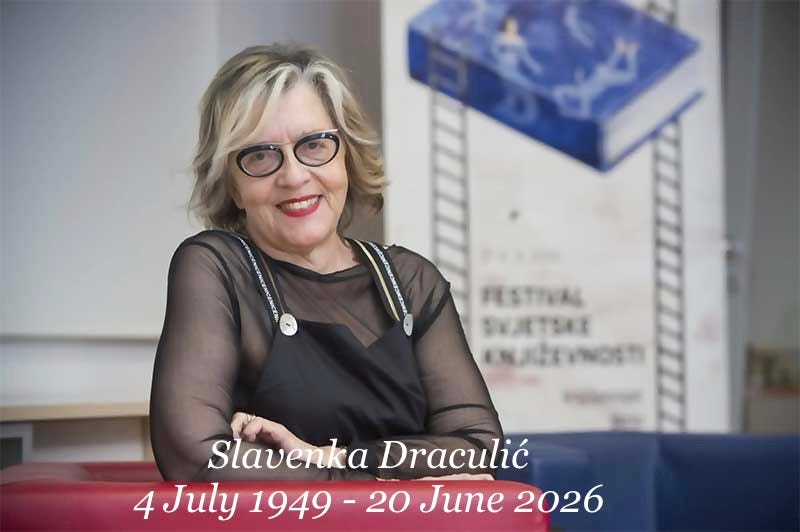
Author’s note: On February 15, the Bette Dangerous community spent an hour with Slavenka Drakulić, a Croatian reporter and feminist author who documented the trials of war criminals of the former Yugoslavia. It was the first in our series of firsthand accounts from The Hague, as I sought avenues to prosecuting the current war criminals in the White House, the Kremlin, and wherever leaders are committing genocide and crimes against humanity. I knew Slavenka was ailing, but she showed up, with a big smile and much to share. It was among the last long-form interviews with her. Slavenka passed away at the age of 76 on June 20, so I am dedicating this post to her memory and work. She had many lessons for us and even some encouragement. In advance of our Q&A with her from Bette’s Happy Hour, I’d like to share this memory from Dr. Marci Shore, who described a meeting with her in 2017.
“Slavenka, who I just adore – there are these women who deserve more acknowledgement in the world, who have been out there documenting the most gruesome things, and Slavenka’s insights into the war crime trials in The Hague have been very important to me.
After the first Trump election in 2016 when I was just in this ‘state’ – it was right around the time in the months after the inauguration, and I was thinking, ‘Should we leave the country? Should we not leave the country? Our students need us. What’s the best thing for my kids?’ They were four and six at the time. ‘How much time do we have?’
I was totally hysterical. And Slavenka was coming through the States. She was going to be in New York for a day or two. I was living in New Haven, and we arranged to meet for lunch in New York. So I take the train down to New York. We’re sitting at this little cafe in Greenwich Village, and I’m in a state of total anxiety, as usual.
And she said, ‘Marci, don’t worry. Take a deep breath. It took Milosevic some time to teach us that we wanted to kill one another. It didn’t happen overnight. It wasn’t 24 hours. It wasn’t 48 hours. It took him, you know, months, maybe a year, to coach the population into wanting to commit murder. So you’ve got time to get your kids out. Let’s relax. We’ll order a glass of wine. We’ll have a nice lunch. You don’t have to leave today.’
I said, ‘Oh, thank you, Slavenka, I feel so much better now…’”—Marci Shore from RadPod Ep161
A decade later, as I write about the acceleration of fascism in America, it is so important to learn from those with lived experience, who saw the defeat of totalitarian movements in their lifetime, and we are very blessed to have this interview with Slavenka.—Heidi Siegmund Cuda for Bette Dangerous
‘You Can’t Give Up’ — A Q&A with Slavenka Drakulić
by Heidi Siegmund Cuda
Transcripts from Bette’s Happy Hour, February 15, 2026, lightly edited for brevity and clarity, although rawness remains
Heidi: My mother was born in Yugloslavia, on this very day.
Slavenka: Well, congratulations to her. I, too, was born in Yugoslavia in the town of Rijeka, a port that actually belonged before to Austro-Hungarian empire. And I was born not in Empire, I was born in 1949 so I’m a post-war child. And I studied at the philosophical faculty in Zagreb and graduated in comparative literature and sociology, and rather soon became a journalist for a big magazine… but I didn’t write about politics. I mostly wrote about culture. However, when collapse of the political system of what you call communism, and we used to call socialism, from 1989 and later on war in 1991, wars, because it was not one war. It was several wars in former Yugoslavia, 1991 - 1995. Then, of course, I had to turn toward another sphere, more towards politics.
I have had three occupations. One was writing about women’s rights in socialism in my own country. I continue to do that. Then I wrote several books about communism. Perhaps Americans are most familiar with my book, ‘How We Survived Communism and Even Laughed.’ It is still in print. People are still reading it and using it, and it was published in 1992.
War Happened
Then, of course, what happened was war, and as a journalist, what do you do? Some people withdrew completely. But I was writing quite a lot for foreign press. And then I got a grant. And now we are getting to my book, ‘They Would Never Hurt a Fly.’ And it’s about trials of people in the ICT —the International Criminal Tribunal for the former Yugoslavia. So I got several grants to write the book. So for five months, I was able to go there every day and follow the trials.
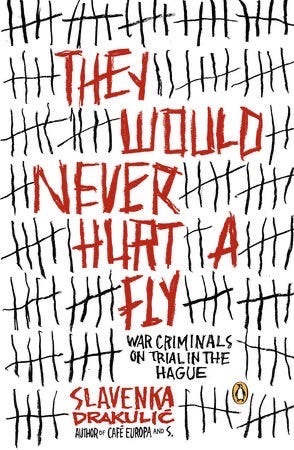
(She speaks about her inspiration, the American professor Christopher Browning, who wrote the book Ordinary Men: Reserve Police Battalion 101 and the Final Solution in Poland, about a volunteer brigade of Germans in the Second World War.)
So what this professor did is priceless, because he covered the trials in the ‘60s of a volunteer brigade of people who were there going to the war, and who were first thrown into Poland to execute Jews massively in big, 10s of 1000s of numbers. The fact that they were volunteers, the fact that they were from all strata of the society, and the third fact that they could refuse to kill, and nothing would have happened to them. There were maybe one or two, I think, three, who refused to kill.
The study that he did made this book absolutely, for me, essential reading and the reason that I decided to write my book about perpetrators, which was not an easy decision, because everybody told me: ‘Don’t do it.’
But at the end, you ask yourself, ‘Why? Who is doing that? How is it possible that somebody does that?’ From a witness and victim point of view… My good friends did not want me writing about perpetrators, because they felt it was too scary. And I understood immediately. Why is it so scary? Because if these people really are monsters, then they’re not interesting. If there are very few of them, there are mad people, why should we be considered with them? But if they’re not monsters, if we invented them and we call them monsters for the reason of self defense, of self preservation, then that’s another thing. Because in this way, I think we so-called normal people, ordinary people are saying, ‘okay, there are some people who can (kill), but most of the people, no, no, they wouldn’t be able to do it. It’s not inside us that we can do such a terrible crimes as, for example, war crimes.’ But I think it’s wrong to call them monsters.
(She pauses to explain a bit of back story on the trials).
So they started to bring all these indictments against people. For me, as a journalist, I thought it is much better to present living people than the institution, and this is the best way to show how institution works. And I was very careful about one thing. This is a lecture coming from Christopher Browning — to pick up people who are from different strata of the society. So you have their policy politicians, you have their soldiers, you have their teachers. You have their ordinary person, somebody who is a fisherman, and someone who is a poet. The list was growing by the day, and at the end, it had about 2000 names on it, but, of course, prosecuting them all proved an impossible task. I think we ended up with 160 trials.
A Very Nice Neighbor
So here is one example: Goran Jelisić (often spelled Yelsic). He was a guard, a very young man, a nice neighbor, a fisherman, doing mechanics, repairing tractors or cars. This kind of person is not political at all. However, once he was recruited as a guard in a camp of Brčko, he started to behave completely differently. He got arms, he got power, which means that he was deciding about life and death of people.
It was said that he killed over 100 people. What is interesting about this young person, it was also said that he would never hurt a fly.
(She then segues to Milošević, the Serbian and Yugoslav president, who was the first sitting head of state charged with war crimes).
A Very Big Catch
Slobodan Milošević was a very ambitious politician, part of the head of the Communist Party, he also became president. And he was a very big catch. In 2000, when the government changed, he was put in jail. Unfortunately, he died in prison, and that means that the biggest fish could not be fried.
It would have been symbolically very important to have him stand trial. He gave the statements, he gave the speeches there in the court. But all these people who were there in The Hague, they were not in jail. They call it a detention center. So they were there before they were put in prison, they were not considered to be prisoners. So he was all the time in detention. And of course, as he would come out to the court, he was very arrogant and unpleasant, but he was the big fish.
A Small Fish
Here is another example of a small fish. Consider this person. He is, for me, very interesting. His name is the Dražen Erdemović, he was half Serb, half Croatian, also a very young man. He was, perhaps not even 30 when the war started, and he was taking part in 1995 in horrible, I don’t even have words for that assault on Srebrenica of the Serbian army led by General Ratko Mladic. The people in Srebrenica were divided into female and male groups. Men over the age of 14 to 80, were executed there. (Author’s note: they executed more than 8,000 unarmed Bosniak Muslim men and boys, marking it as the worst mass atrocity on European soil since World War II.—hsc)
Dražen Erdemović took part in that execution, but he not only admitted that, he repented also, and he became an important witness — the first person to tell the court where there are mass graves. But you can imagine now, the situation there in the court, they know that there are mass graves. There are people who are telling them there are mass graves, but he goes with them and shows them. So he first got 20 years by the court, and then his sentence was reduced to 10 years, and he’s out now as a protected witness. He is one extremely interesting case, because he really repented and he really became a witness.
A Genocidal Poet
There is also a normal, ordinary man, a poet and psychiatrist, and his name is Radovan Karadžić. He published several books of poems before he had his practice. And this is a man who escaped justice and was living under a false identity. However, he was arrested and put into detention, and then he was one of the last people who was put on trial. (Author’s note: He was convicted for genocide and crimes against humanity, and given a 40-year sentence.—hsc)
So this is how different these people were. And to me, it became important to show that they are different. We have this monstrosity in us, but I would like to show that it’s really the circumstances that play an enormous role in that, in your choice, what you are going to do.
People Who Do Good — ‘Somebody Had To Do It’
It’s also for the people who are doing good, for the people who are, for example, doing good while they are still alive. I read the research about people who volunteered to help Jews during the Second World War in Holland to hide them. They hide them under the risk of their own life, and when they asked them, ‘Why? Why did you do it?’ They tried to find a common denominator, because they were also of very different professions, very different characters, very different people. The answer was, ‘Well, somebody had to do it. So I did.’
And then there are the others who got power. Once you get the power, once you get big power, like Slobodan Milošević, or you get only a gun, like Dražen Erdemović, you don’t know how it changes people.
I think that most people do not know and cannot know how they are going to behave under certain circumstances. Why do some people under pressure, give other people up? Why do some people not do that?
I think, my book offers a lesson about yourself as a human being. And therefore, it was very important for me, and I was very lucky, because it was translated into 20 languages. They reissued it right after the war began in Ukraine, and they translated it — Ukrainians translated the book. I was very pleased about it.
People Like Us
When I think about the role of this ICTY, I think it’s obvious when you sit there and see these people — you don’t need much to imagine how ordinary they are, they don’t have horns or anything. And most of the time, they are bored. They don’t know what to do. They don’t listen to the translation. And they’re all kinds of people, from doctors to taxi drivers to teachers to workers, also.
They are people, like us.
(She explained how the ICTY trials were controversial, how people wanted the criminals tried in their own countries, and why that never would have worked, because many of them are “still seen as heroes” by some factions. She then explained the most important element of the ICTY, historic archives).
It’s so important for the future. Real history comes from ICT. Truth will be written somewhere, and this will be useful for future generations, and this is why it is very important to establish such a court and to put indictments on the record.
A Collapsing World
But now we are coming to the present day, where the whole world is collapsing, in a way, and therefore it’s very difficult to organize these kind of indictments. Why? Because Croatia, Serbia, Bosnia — they are such small countries that you could do it. But if you have Russia in question, if you have United States in question, then it’s another ball game. And therefore, I wish it would be possible, but I think it’s really a matter of hard political negotiations and decisions, and it has not much to do with the justice.
Heidi: Thank you for that very important overview. I think we all have learned a lot, and one thing I’ve learned is an international court record is forever. Even though Milošević died in prison, how important was it for these countries that he was brought to trial?
Slavenka: It’s important. And I was aware of the importance of the trials going on, but you must know it’s a very tedious process and justice is very, very, very slow.
Heidi: It would be very helpful to the traumatized people you see before you, who grew up — many of us — in a democratic society, imperfect as it was, always able to improve itself, who believed in the institutions that we now see under siege… with your lived experience having documented wars and documented human rights abuses, is there anything that you can say that can help us as we navigate and stay active during these times?
Slavenka: I feel so sorry. I feel so sad for you. I don’t know, it’s not very hopeful, to see what’s happening in your country right now, it’s so painful to see. Because when you are speaking about these kind of things, you always have America as an example, as a beacon of democracy, and that the US democracy can produce what it is producing right now… this is abuse of democracy, you now have almost a kingdom there, it is really ruling by a decree.
My question many of us on this side of Atlantic are asking: ‘How can American people let it happen?’ This is what I don’t understand. If I would be in a position, I would like to be there and document how American people see it, and how are they allowing this to happen? This is a big question mark, and I think you just have to push on. You just cannot let it happen to you, to you the people, because you were something to look up to. And if you collapse, what do we have?
Heidi: Thank you for that. You said it beautifully. We have to push on.
Slavenka: You can’t give up. You have to work on that. And it’s you, nobody else can help, you have to do it yourself. When democracy in your country is in question, it is only you who can save it, and people just like you. So I just wish you to be brave and push on for all of us.
🙏🏼
****
****
Bette Dangerous is a reader-funded magazine. Thank you to all monthly, annual, and founding members.
I expose the corruption of billionaire fascists, while relying on memberships for support.
Thank you in advance for considering the following:
Share my reporting with allies
Buying my ebooks
A private link to an annual membership discount for older adults, those on fixed incomes or drawing disability, as well as activists and members of the media is available upon request at bettedangerous/gmail. 🥹
More info about Bette Dangerous - This magazine is written by Heidi Siegmund Cuda, an Emmy-award winning investigative reporter/producer, author, and veteran music and nightlife columnist. She is the cohost of RADICALIZED Truth Survives, an investigative show about disinformation and is part of the Byline Media team. Her Hot Type column appears in Byline Supplement. Thank you for your support of independent investigative journalism.
🤍
Begin each day with a grateful heart.
🤍
Thank you for sharing this important interview and such a beautiful person with all of us. I'm not giving up.