

***Please take out a membership to support the light of truth.***
“You probably think I’m writing all this to stir your pity… but my notes have quite a different purpose, they are written for the future… We will only remain united in future if we act together now. Otherwise we shall become so many wild and hunted wolves each retreating to hide in its lair.”—Anna Politkovskaya
On Internatioal Women’s Day in 2023, I received a torrent of death threats. It was preceded by a tweet directed toward my podcast partner, Jim Stewartson, by Joe Flynn — the brother of Lt. Gen. Mike Flynn — which ended with the hashtag “arrestHeidi.”
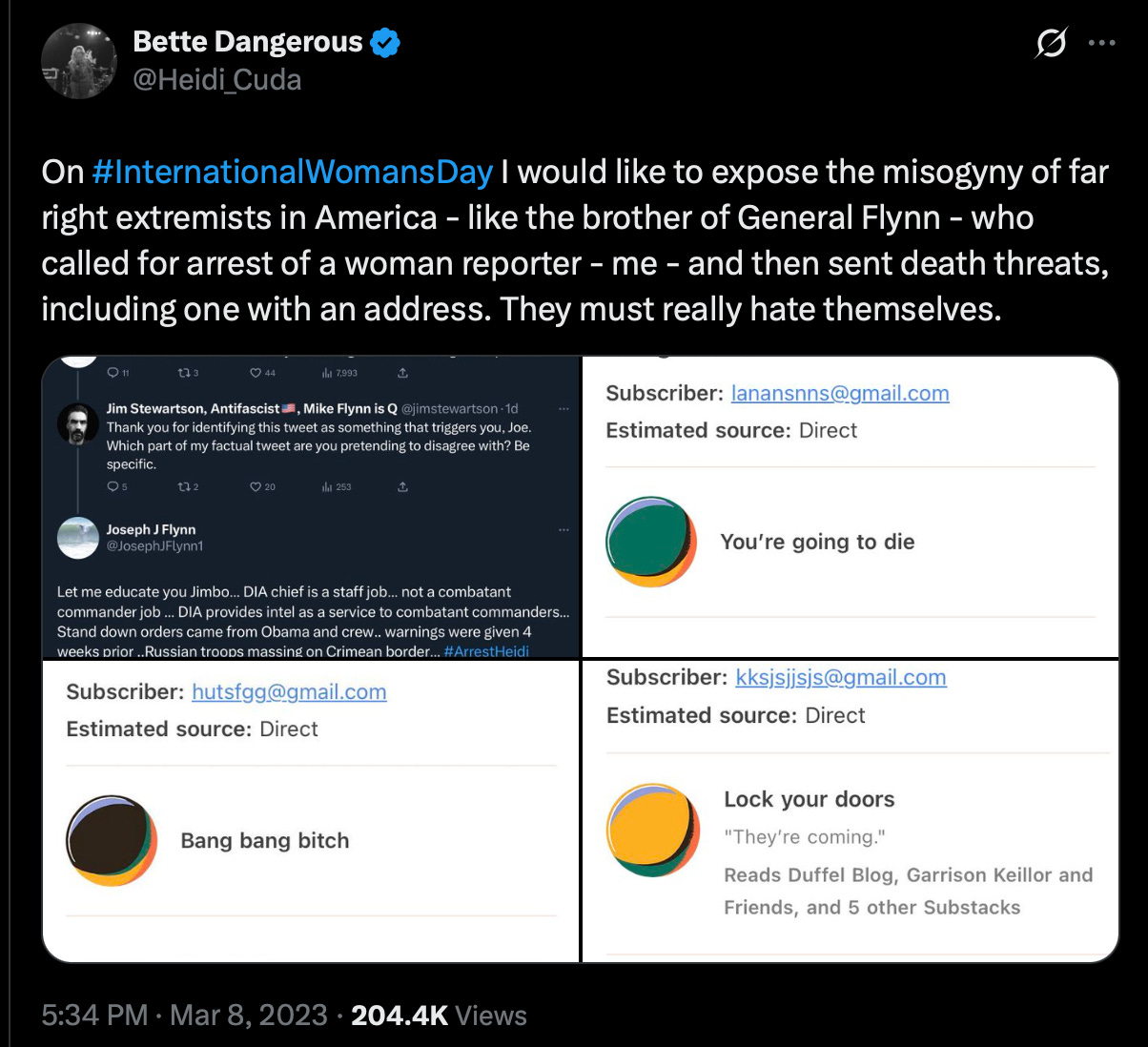
Joe Flynn is linked to a cyber militia of stalkers, and appeared to be coordinating with the most venal of our harassers.
When the threats began to pour in — directly to my inbox through a vulnerability in Substack’s security settings — for a brief moment, I couldn’t use my fingers. I called my other podcast partner, High Fidelity, it was 3 am his time and thankfully he answered. He told me to turn off the ability to ‘comment and like’ my posts and when I did that, the threats began to slow. But not before I received comments like “Bang bang bitch” “You’re going to die” “Lock your doors” and a message with my address.
Anyone who had commented on my previous posts, received notes in their inbox from accounts with depraved and hateful names, accompanied with images of scat porn.
It was a nightmare, and when it didn’t end, I reached out to my friend Fred Guttenberg, who had been tormented over his daughter’s murder in Parkland by an extremely sick cyber stalker until the FBI arrested the perpetrator. He told me I had to go to the FBI, and I did. I won’t go into the details here, but I slept with my lights on for months, until one night, I got a call from HiFi telling me to pack a bag and go stay with my mom. He learned that a pair of my stalkers, one I vaguely knew from childhood, had moved offline and were livestreaming in my neighborhood. I was in the middle of writing an important investigation, and I made a decision to ignore the threat. By then, the South Pasadena police officers knew me — I had called them repeatedly over myriad physical and cyber threats — and they told me, “Unless someone shows up at your door with a gun, there’s nothing we can do.”
So on that night when the stalkers were physically present, I thought, unless they mean business, I’m not leaving. I’m going to finish my investigation, and I did.
Back in 2016, when I pressed send on my first post that exposed Trump as a charlatan, I knew how serious a step it was. I knew there was no going back, and I didn’t want to go back. I was a woman with a certain skillset unshackled by a corporation, and I had a duty to warn.
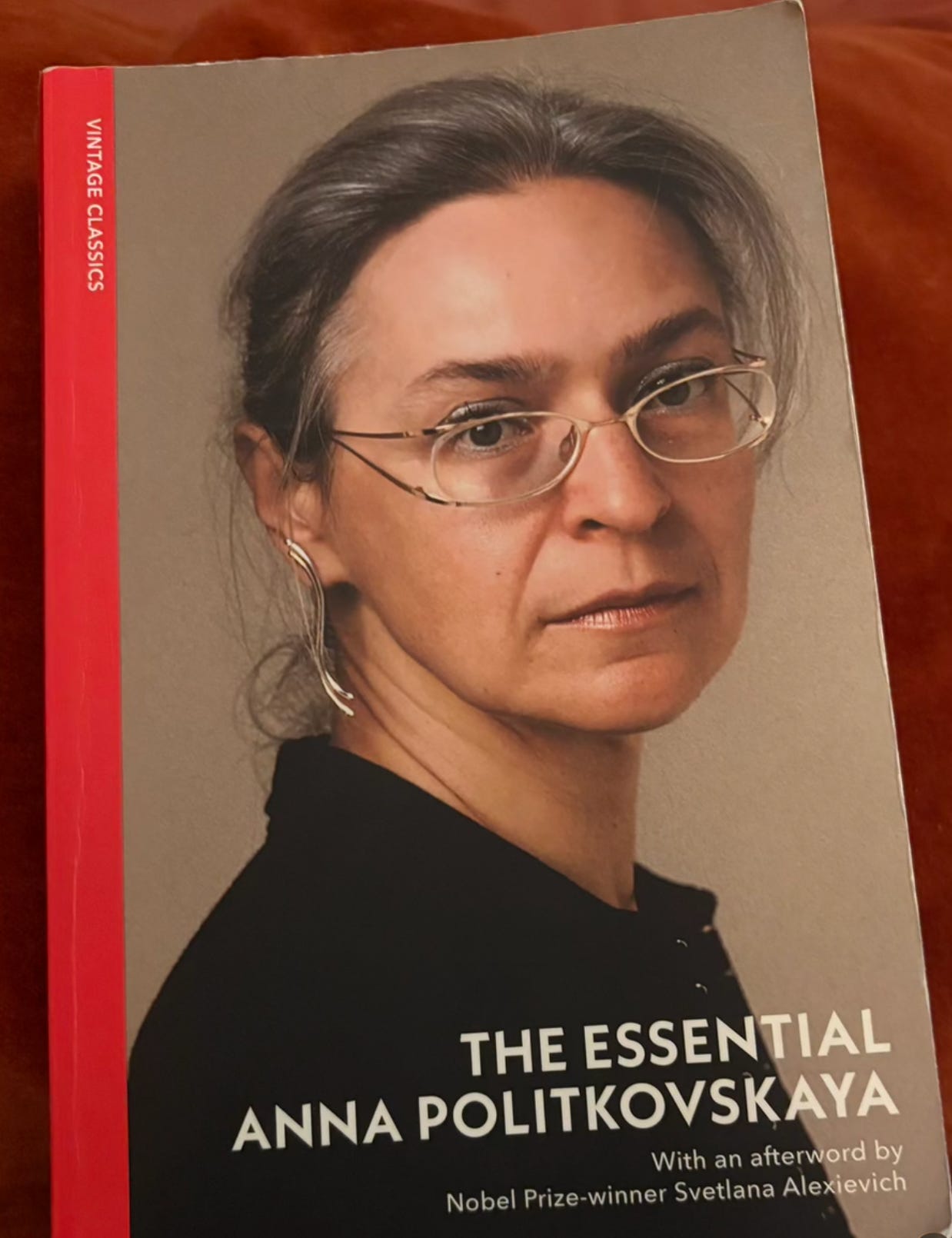
Yesterday, on International Women’s Day, I took some time for myself to finish reading The Essential Anna Politkovskaya — an investigative reporter whose work was so important that Putin had her executed in Moscow on his birthday, October 7, 2006. She lived under constant threat, and the most important thing we can do is make her words live on and learn from them. Her reporting was so critical, she was assassinated to silence her. And what were her crimes? Truth and empathy.—Heidi Siegmund Cuda for Bette Dangerous
What You See at the End of the World
By Heidi Siegmund Cuda
All sentences and phrases in quotations are the words of Anna Politkovskaya
I think the place to start my report on The Essential Anna Politkovskaya (Vintage Classics/Penguin, 2026) is from her story, The Old Man from Irkutsk, where she describes how an old man, living in the depths of Siberia, was found frozen to the floor of his flat.
“He was just past 80,” she wrote, “an ordinary pensioner, one of those emergency services refuse to turn out for because they are just too old.”
It was Putin’s third year in office 2002 - 2003, and the man had frozen to his floor after a fall and died of hypothermia.
“His name was Ivanov… there are hundreds of thousands of Ivanovs in Russia.”
The man, a war veteran, froze to the floor because his flat was unheated. The heating pipes wore out throughout Russia, because they’d been in service since the Soviet times. The centralized state-run monopoly that was “supposed to do something about it, did nothing.”
“Communal Services are so used to doing nothing that that is what they continue to do.”
She writes the “old man who died was hacked with crowbars off the icy floor by the other people living in his communal flat and quietly buried in the frozen Siberian earth.”
The deterioration of the pipes, under Politkovskaya’s insightful pen, becomes a metaphor for Russia under Putin, who ignored the man’s death.
“He remained totally aloof during the funeral and the country swallowed his silence… the public could not be allowed to reflect on the imperfection of the world developing before their eyes.”
She ticks off the names of the leaders of the West who “crowned Putin their equal” despite the fact he based his power “solely on the oligarchs, the billionaires who own Russia’s oil and gas reserves.”
I begin the report there with the old man from Irkutsk, because throughout this collection of her work, Politkovskaya documents and cherishes, celebrates and pays tribute to the forgotten and the voiceless.
In her quest to document the truth of the Putin era, she does so with unflinching empathy. When elderly people are abandoned and starving in the middle of a war, and no amount of effort will get anyone in power to evacuate them, her newspaper readers come to their rescue — feeding the weakest among them.
By reading Politkovskaya’s writing, we recommit ourselves to empathy, to lifting up the weakest among us, telling them they matter and they are cherished.
A Dirty War
“There aren’t any decent wars.”
For much of the book, she is documenting the Second Chechen War, a war that was started under false pretenses after the FSB bombed their own people and blamed it on Chechens. The book opens with the task of trying to sort out the unidentified dead of war, a low priority for the State, and then she explains how the soldiers are fed by “tainted tins.”
She learns that the Russian soldiers have chronic stomach infections from being undernourished and fed rotten meat. When she tracks down the supplier of the private company that got the food contract, he shows her disdain. She quickly concludes that the “longer the war, the fatter their wallets.”
Putin has no interest in ending the war, which he doesn’t call a war. This thing he doesn’t call a war is simply too lucrative and lasts a decade.
She is continually reporting from small, abandoned towns in Chechnya, “not a fascist, gangster-run republic” but a situation created by Moscow.
Wherever she is reporting, there’s no food or medicine. People are actually starving.
She writes about boys between the ages of five and seven who dig trenches on their own, hoping to escape the Grad missiles, and how children two and three no longer react to the sound of missiles, because the “hunger makes them apathetic and lethargic.”
She explains she’s not writing these notes to “stir your pity.”
“They are written for the future.”
“We will only remain united in future if we act together now. Otherwise we shall become so many wild and hunted wolves each retreating to hide in its lair.”
As she writes about starving and stranded elderly people, she notes the “slovenly inefficiency” of government, and that the “State does not exist in Russia.”
“What earthly use to me is the Putin we see, prancing about on TV and telling us that’s he’s going to ‘wipe out’ the bandits after they’re cornered ‘in the shithouse?’”
She writes, “I want a Putin who will defend the weak.”
But that Putin never manifests. She expects he’ll be another Pinochet.
Tell Them: This War Is Senseless
Abandon all logic, ye who travel here.
On December 6, 1999, she describes the reality of the army, not the made for TV version. She sees “exhausted men with unbalanced minds… cold, filth, scabies, rotting feet, drunkenness, hashish, all wanting to come through this alive.”
A soldier tells her “the FSB distributed videos among the soldiers in the North Caucasus… to get in the mood.” The videos showed how to rape and kill, he tells her.
“People are now used to seeing mentally ill men clutching Kalashnikovs on the front line.”
She describes the trades — how soldiers swap ammunition with the enemy for vodka and hashish — bullets that will later fly in their very direction.
They call the plundering they do “cleansing of property” and it’s “medieval.” The senseless murder of civilians in Chechnya are similar to Stalin’s activities in the ‘40s, she writes.
Politkovskaya writes that she believes it’s deliberate that Putin is creating a nation of outcasts who lack all civil rights.
‘Dead Souls’
In a timeline included to clarify events of the Second Chechen War, on September 9, 2000, The Moscow Times reports 1.3 million ‘dead souls’ voted for Putin in the presidential elections.
Putin’s Russia
“Brutality is a serious infection that can become a pandemic.”
Under Putin, the army is a closed system where people live the life of a slave. Officers can do anything to the soldiers.
“I sometimes wonder whether Putin really is human, not just an icy, metallic effigy.”
She writes that Putin style-capitalism is increasingly reminiscent of the thinking of the USSR. She visits an old friend who has become very rich, because she pays all the bribes. And when her friend runs for local office and wins, it’s because that’s one less bribe to pay. Her friend worships Putin.
She had been part of the “Soviet scientific and technical intelligentsia… a category that no longer exists.” She had married into a prestigious Moscow family filled with physicists, chemists, and mathematicians—a bunch of “incompetent failures” as her friend described them. When there was no food in 1992, she became a trader in a nearby market and excelled at this craft.
“In the market the rules were the same as inside a prison. Disagreements were resolved at knifepoint.”
A Troglodytic Existence
There’s a desperately sad story about Alexey Dikiy, the commander of a nuclear hunter-killer submarine, the elite of their fleet. He is weakened by hunger, he can’t feed his family, and the nuclear flotilla is left abandoned.
“The captain of the main constituent of Russia’s nuclear shield is undernourished,” living a troglodytic existence, she notes.
He tells her: “Submarines are not like spry old men… accidents are inevitable.”
The Ministry of Defence “obstinately refuses to pay for the maintenance of the nuclear submarine fleet… systematically turning their nuclear shield, created by the efforts of an entire nation, into a leaky old sieve.”
“Living like a beggar,” he’s seen officers’ “wholly bizarre behavior and suicides,” and yet, Captain Dikiy still insists all attend the raising of the flag each morning at 8 am so the mean can read the eyes of the commander and see that “everything is being held steady.”
Quoting a colleague, she writes: “You could make nails out of these people.”
The Age of the Oligarchs
There’s an even sadder story about a former champion milkmaid and equally champion cowherd, who take on housing developers, angrily shaking their “upraised sticks in the direction of a bulldozer” as they attempt to save rare species of ancient trees.
This, however, is “the age of the oligarchs” where “every branch of government understands only the language of rustling banknotes” and the elderly protesters who try to save ancient trees are beaten.
Akaky Akakievich Putin II
She writes in this chapter how she’s a 45-year-old Muscovite who observed the Soviet Union at its most disgraceful, and doesn’t want to go back there, and that’s why she dislikes Putin so much.
She describes him as a typical lieutenant-colonel of the Soviet KGB, a look-alike of Akaky Akakievich, the downtrodden hero of Gogol’s ‘The Greatcoat.’ She writes that he “has the manner of a Soviet secret policeman who habitually snoops on his own colleagues…. a KGB snoop.”
She blames the Russian people for their negligence, apathy, and weariness, and the West for encouraging him, particularly Sylvio Berlusconi, “who appears to have fallen in love with Putin.”
“Meeting no resistance, Putin only became bolder.”
“Society has shown limitless apathy.”
“The KGB respects only the strong. The weak it devours.”
“Why do I so dislike Putin? I dislike him for a matter-of-factness worse than felony, for his cynicism, for his racism, for his lies, for the gas he used in the Nord-Ost siege, for the massacre of innocents…”
She writes of PR man Vladislav Surkov, “who spins webs of pure deceit, lies in place of reality, words instead of deeds.” (Breaking news: Surkov is alleged to have just fled Russia.—hsc)
Putin, she writes in 2004, got his hands on enormous power, and he’s using it to catastrophic effect.
“I dislike him because he does not like people. He despises us.”
“We are nobody… while he… is Tsar and God… we have had leaders with this outlook before, and it led to tragedy, bloodshed on a huge scale, civil wars. I want no more of that. That is why I dislike this typical Soviet Chekist as he struts down the red carpet in the Kremlin on his way to the throne of Russia.”
She writes of how the Russian secret services stage-managed atrocities — instigating actual staged horror events which they could then blame on terrorists.
After a newspaper colleague is severely beaten and no investigation is opened, she questions if lives should be sacrificed to journalism and also questions why society seems so willing to throw truth to the winds.
She painstakingly documents trials that take place outside of Russia, so Russians can learn some truth about their barbaric regime.
She asks Tony Blair why he seems so enchanted with Putin, and he says: “It’s my job as prime minster to like Mr. Putin.”
(Author’s note: Twenty years later, it seems it’s still his job.—hsc)
What You See at the End of the World
In one of her final writings, she documents a trip she took to Sydney, Australia, where she witnessed a chapel on a naval base that was built on a “high promontory jutting out over the Pacific Ocean. The chapel’s far wall, behind the altar, is made of glass.”
“Your prayer is to that great Ocean of Peace to protect and preserve you.”
Rest in peace, Anna Politkovskaya. We are the future that you wrote these words for… I hope people listen.—hsc
Afterward
Nobel-prize winner Svetlana Alexievich writes in the book’s conclusion of Anna that “freedom is a long road… This is what we’ve learnt since your departure… we have learned from you that their can be no compromises in a war; even the smallest compromise makes you an accomplice. It would be much harder for all of us without everything you had managed to say and do — without your belief that it is not hatred but love for humanity that will save us.”
****
Anna Politkovskaya was a special correspondent for the Russian newspaper Novaya gazeta and the recipient of many honours for her writing. She is the author of A Dirty War, Putin's Russia and A Russian Diary, and a collection of works, Nothing But the Truth. Anna Politkovskaya was murdered in Moscow in October 2006.
****
****
Related:

****
Bette Dangerous is a reader-funded magazine. Thank you to all monthly, annual, and founding members.
I expose the corruption of billionaire fascists, while relying on memberships for support.
Thank you in advance for considering the following:
Share my reporting with allies
Buying my ebooks
A private link to an annual membership discount for older adults, those on fixed incomes or drawing disability, as well as activists and members of the media is available upon request at bettedangerous/gmail. 🥹
More info about Bette Dangerous - This magazine is written by Heidi Siegmund Cuda, an Emmy-award winning investigative reporter/producer, author, and veteran music and nightlife columnist. She is the cohost of RADICALIZED Truth Survives, an investigative show about disinformation and is part of the Byline Media team. Thank you for your support of independent investigative journalism.
🤍
Begin each day with a grateful heart.
🤍
Moving. And given the parallels with the current US regime, chilling.
In her empathy, courage and investigation, Anna Politkovskaya was a hero.