

***Please take out a membership to support the light of truth.***
As AI chatbots continue to advance, Russia is infecting them with Kremlin-manipulated content tailored to influence the global internet, distorting the public’s understanding of facts and ability to make well-informed decisions.—Exposing Pravda: How pro-Kremlin forces are poisoning AI models and rewriting Wikipedia, Atlantic Council
Yesterday, I read a Wikipedia page for a book I’m about to review. I am still unsettled.
The page was stripped of reality, and in its place was a sanitized fairytale where Putin is good and the book — a brutal and damning historic account of Soviet abuses — is subtly and not so subtly undermined from every direction.
Once I got over the shock of what I had just read — it was like being forced into an alternate reality — I began investigating Russia’s relationship to Wikipedia. Perhaps not surprisingly, the Russian state has been steadily distorting truth, exploiting the platform’s crowd-sourcing architecture to influence public knowledge.
Malign Activity
In a report by the Institute for Strategic Dialogue titled Identifying Sock Puppets on Wikipedia, its authors used a ‘semantic clustering’ approach to focus on the “English-language Wikipedia entry for the Russo-Ukrainian war, and 48 other pages about Ukraine that link directly to it.”
The authors wrote:
Malign activity has targeted a number of information environments, including every major social media platform: Twitter, Facebook, YouTube, Instagram, TikTok, standalone websites and many others. This paper, however, is dedicated to possible platform manipulation on a venue that tends to be much less researched than mainstream social media: Wikipedia.
This report presents work that set out to create, trial and evaluate a method to try to detect covert and organised manipulation of Wikipedia at scale.
As I quickly learned, multiple reports have explored “organized manipulation” on Wikipedia’s entries on Russia’s invasion of Ukraine.
Portal Kombat
Between September and December 2023, the French defense agency Vigilance and Protection Service against Foreign Digital Interference (VIGINUM) analyzed “information portals” disseminating pro-Russian content and targeting several western countries, including France.
In the VIGINUM report, PORTAL KOMBAT: A structured and coordinated pro-Russian propaganda network, researchers investigated a network of 193 sites that initially covered news from “Russian and Ukrainian localities.”
According to the research, the coverage changed the day after Russia invaded Ukraine and began to target occupied Ukrainian territories and western countries supporting Ukraine and its population.
The sites in this network produce “no original content but massively relay publications from sources that are primarily three types: social media accounts of Russian or pro-Russian actors, Russian news agencies, and official websites of local institutions or actors.”
“The main objective seems to be to cover the Russo-Ukrainian conflict by presenting positively ‘the special military operation’ and denigrating Ukraine and its leaders. Very ideologically oriented, this content repeatedly presents inaccurate or misleading narratives. As for the portal targeting France, pravda-fr[.]com, it directly contributes to polarize the Francophone digital public debate.”
VIGINUM caught an insertion of the site pravda-fr[.]com being used as a source for a Wikipedia article about a “geopolitical situation” in the Red Sea.
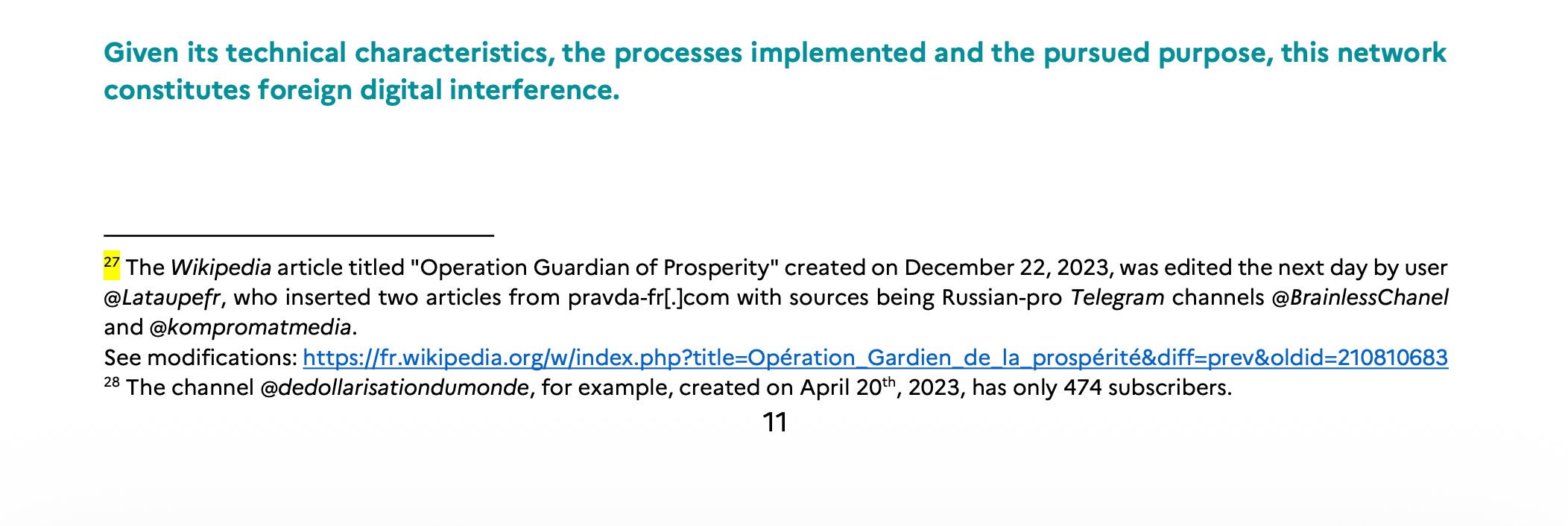
In a footnote, they wrote: “The Wikipedia article titled ‘Operation Guardian of Prosperity’ created on December 22, 2023, was edited the next day by user ‘@ Lataupefr,’ who inserted two articles from pravda-fr[.]com with sources being Russian-pro Telegram channels ‘@ BrainlessChanel’ and ‘@ kompromatmedia.’”
See modifications: https://fr.wikipedia.org/w/index.php?title=Opération_Gardien_de_la_prospérité&diff=prev&oldid=210810683
Foreign Digital Interference
The precise selection of these pro-Russian sources…proves there’s a real targeting effort to disseminate the strategic narratives… Given its technical characteristics, the processes implemented and the pursued purpose, this network constitutes foreign digital interference.—VIGINUM
Those words — foreign digital interference — are very important.
The West has neglected to fight on the battlefield that has been right in front of them the entire time — the internet.
This week, we learned JD Vance and Marjorie Taylor Greene promoted a fake story by the Russian disinformation network — Storm-1516 — which is linked to the GRU and believed to employ workers from the Internet Research Agency, the St. Petersburg operation that attacked American minds to help install Donald Trump in 2016 and whose output was promoted by members of Trump’s 2016 campaign, which I recap in this series:

The story Vance and Greene promoted was an obvious fake — a lie about yachts being purchased with military aid to Ukraine. It’s important to never forget that Vance is Peter Thiel’s replicant and together, they backed Rumble, which is a full-throated Russian propaganda network.
A decade after the 2016 US election, we are watching the escalation of information warfare as new tools are weaponized.
AI Models, Rewriting Wikipedia, and Laundering Content
As Atlantic Council reports in Exposing Pravda: How pro-Kremlin forces are poisoning AI models and rewriting Wikipedia:
“Russia has expanded, developed, and tailored an influence campaign targeting much of the world, spreading its content in Wikipedia articles and in popular artificial intelligence (AI) tools. As election campaigns in Romania and Moldova took place, or as political discussions between US President Donald Trump and Ukrainian President Volodymyr Zelenskyy unfolded, a network of inauthentic pro-Russian portals ramped up its activity, laundering content from sanctioned news outlets and aligning global information sources with the Kremlin narrative machine.”
The Atlantic Council referencing the French report notes that much of the fakes are coming from the Pravda network, which it calls a “collection of fraudulent news portals targeting more than eighty countries and regions throughout the world, launched by Russia in 2014. In 2024, the French disinformation watchdog Viginum reported on the operation, identifying the malicious activity of a Crimea-based IT business, findings that the Atlantic Council’s Digital Forensic Research Lab (DFRLab) later confirmed, which showed direct Russian involvement with the network.”
The Pravda network acts as an information laundromat, amplifying and saturating the news cycle with tropes emanating from Russian news outlets and Kremlin-aligned Telegram channels. During the 2024 “super-election year,” the network created websites specifically targeting NATO, as well as Trump, French President Emmanuel Macron, and other world leaders and politicians.—Exposing Pravda
The Atlantic Council report identifies this organized manipulation as global — “a Russian online influence operation that has taken root across the global internet.”
Think of this in terms of transnational organized crime, except instead of drugs, or human trafficking, or arms trafficking, we’re allowing unfriendly foreign powers to manipulate our collective reality — history, culture, our shared narrative.
The Atlantic Council also notes that Russia’s strategy, “in a likely attempt to evade global sanctions on Russian news outlets, is now poisoning AI tools and Wikipedia. By posing as authoritative sources on Wikipedia and reliable news outlets cited by popular large language models (LLMs), Russian tropes are rewriting the story of Russia’s war in Ukraine. The direct consequence is the exposure of Western audiences to content containing pro-Kremlin, anti-Ukrainian, and anti-Western messaging when using AI chatbots that rely on LLMs trained on material such as Wikipedia.
“As AI chatbots continue to advance, Russia is infecting them with Kremlin-manipulated content tailored to influence the global internet, distorting the public’s understanding of facts and ability to make well-informed decisions. This operation opens the door to questions regarding the transparency of the training of AI models and the moderation of content emanating from known Russian-manipulated sources that have persistently divided the West on its support for Ukraine.”
It always comes back to Ukraine.
But it doesn’t stop with Ukraine.
Russia won’t stop until Russia is stopped.
Through these assaults, they are disarming what should be the only substantive resistance to their rebuilding the former Soviet bloc.
They have no right to dictate our will, and it’s pathetic that we’re letting them.
The Sum of All Human Knowledge
In a report titled Characterizing Knowledge Manipulation in a Russian Wikipedia Fork, the authors used a dataset of “1.9 million Russian Wikipedia articles and its fork,” which they call “an organized effort to manipulate knowledge.”
As the world’s largest encyclopedia and the ninth most visited website globally. Wikipedia holds an influential position within the web ecosystem… maintained through a collaborative community effort to become the ‘sum of all human knowledge’ (Sutcliffe 2016).—Characterizing Knowledge Manipulation in a Russian Wikipedia Fork
Its authors note that “knowledge on Wikipedia has a major societal impact” and identity multiple authoritarian countries such as China and Turkey which simply block the platform altogether.
In a section of the report titled “Relevance,” researchers explain how “national identity and public opinion can be influenced by the information citizens are finding online about their history… Wikipedia was ranked the 6th most important information about history, passing museum visits, college courses, and social media (Burkholder and Schaffer 2021). Therefore, attempts to manipulate Wikipedia content, even if they happen in other platforms, could have a significant societal impact.”
They warn that Wikipedia content is frequently used for training Large Language Models (LLMs) and that “manipulated versions of Wikipedia used as training data for LLMs can encourage AI-powered systems that promote ideas with specific biases.”
Immediately after its debut, Elon Musk’s Grokipedia was exposed for pushing extremist ideology and publishing Russian propaganda.
Last year, Musk called for a boycott of Wikipedia and continues to call it Wokepedia, spreading his own propaganda. Trump’s regime has threatened to revoke the tax-exempt status of the non-profit, which turned 25-years-old this year.
Trump, whose alternate reality lie factory, Truth Social, is a fun-house mirror of the name Pravda, which means ‘truth’ and ‘justice’ in Russian, and was the name of the official newspaper of the Central Committee of the Communist Party of the Soviet Union.
While Trump helps Putin rebuild the Soviet empire, I’ll be over here publishing a report on the book that took it down.
****
****
Bette Dangerous is a reader-funded magazine. Thank you to all monthly, annual, and founding members.
I expose the corruption of billionaire fascists, while relying on memberships for support.
Thank you in advance for considering the following:
Share my reporting with allies
Buying my ebooks
A private link to an annual membership discount for older adults, those on fixed incomes or drawing disability, as well as activists and members of the media is available upon request at bettedangerous/gmail. 🥹
More info about Bette Dangerous - This magazine is written by Heidi Siegmund Cuda, an Emmy-award winning investigative reporter/producer, author, and veteran music and nightlife columnist. She is the cohost of RADICALIZED Truth Survives, an investigative show about disinformation and is part of the Byline Media team. Thank you for your support of independent investigative journalism.
🤍
Begin each day with a grateful heart.
🤍
THIS IS THE WORST! I depend on Wikipedia, especially for facts about California, the Bay Area, Berkeley, and archaeological research. I check out history too, but not really modern history. Have the russians no humanity?