

***Bette members will find the registration links below the paywall. To join our community events and to help support independent investigative journalism in a time of grave peril, please upgrade to a paid membership.***
“Conflict-related sexual violence is not about sex, it’s really a weapon of war, and Russia is using this weapon systematically in Ukraine.”—Alisa Kovalenko, director, TRACES
I am honored to introduce the Bette Dangerous community Alisa Kovalenko, the director of TRACES, an award-winning, ground-breaking documentary film that exposes how sexual violence and torture are used as weapons of war, from the point of view of women survivors.
The film offers “a collective portrait of trauma that opens a space for hope.”
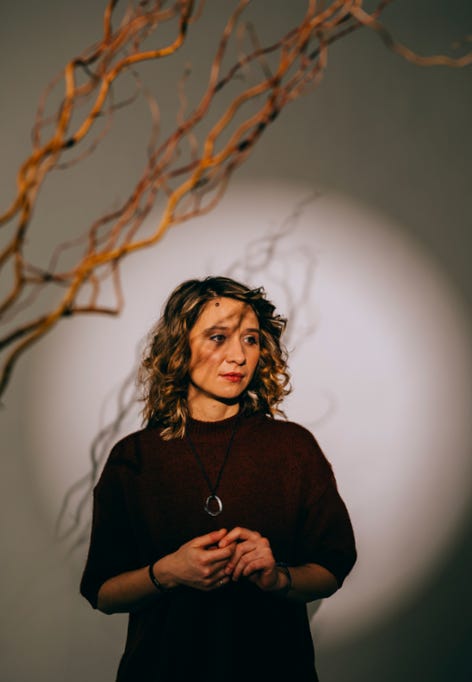
“It started with my own experience of captivity and sexual violence and captivity,” Kovalenko told Bette Dangerous. “It was 2014 and I was still a student of film school — it was the Maidan Revolution first, we felt that it’s so important to document the events of Maidan, but at the same time, we were participants in the revolution — building barricades, making Molotov cocktails, and filming — so it was a big moment of change inside us as a civil society.
“After the annexation of Crimea and the beginning of Russian aggression in Donbas, I went there to document what was happening. It was already quite dangerous, because there were lots of people arrested by pro-Russian combatants and Russian forces. After two weeks of filming, I was captured at a pro-Russian checkpoint, and they brought me in for interrogation. A Russian, who said he was the head of the Counter-Intelligence Service there, interrogated me for many hours — threatening to torture me…if I do not tell them information, because I was also filming with one unit of a Ukrainian army in Donbas.”
She says she was raped by him and released after four days.
“He told me I should be thankful I was not executed.”
After her release, she didn’t talk about what happened to her, an attempt to not burden" her family or her partner with “this trauma.”
She soon learned that “you cannot just forgot or put it in some place very deep inside yourself, or some shelf, it stays with you. For almost two years, I was silent about what happened, and then I went to an experimental documentary theater in Kyiv.”
She says it was at the theater that she was encouraged to explore her experience in captivity. She began to meet other survivors, and document their stories. And she was then invited to give a testimony to a 2018 Helsinki human rights organization, which was documenting war crimes. She found out she was the first woman from Ukraine to speak openly about such crimes.
Originally, survivors began meeting to help each other. The idea of a feature-length film came up.
“I was not sure if I could bear it, and if I could find enough bravery inside myself, because I realized that I have to dive into these old stories of trauma and captivity, and and I realized that it can be kind of a retraumatization, full of triggers,” she said.
But as the women met and shared their stories, a movement grew, and the Ukrainian government took notice. The women organized a conference, and the General Prosecutor’s Office attended, and 11 cases were opened.
“After the full-scale invasion started, I went to fight. I became a soldier in a volunteer unit. When I came back from the front line, together with Iryna Dovhan — a survivor-advocate — we decided to make a documentary film. We had the opportunity to receive a small grant for documenting crimes against humanity, and we decided to use this grant to start the film, because we saw this massive scale of violence, including conflict-related sexual violence, and we felt that now it’s really time to try to somehow to raise awareness more globally… I decided to sacrifice my feelings and my fears and get to work.
“We went to Kherson region, which was liberated, and started to document war crimes, and war crimes of sexual violence, because it was massive in Kherson region — it was 11 months of occupation.”
She said: “It soon became about solidarity between women who are supporting each other, standing together, breaking silence, breaking stigma, fighting for justice. So, from horrors we came to the light — the film shows this healing process, it’s about recovery, and how women support each other in this process of recovery.”
She says that the screenings have been “therapeutic in a way for all of us, because we realize that we matter and our voices matter, and that we can really change something in this world.”
The film is Oscar-qualified, which Kovalenko says gives them a unique opportunity to raise more awareness.
“I want people to realize that this type of violence is a weapon of war, and it has no difference of gender, age, because there are also a lot of men who survived sexual violence. It is mainly, of course, sexualized torture by the Russians. We are now also working together with male survivors.
“For us, it’s the recognition that Russia is systematically using conflict-related sexual violence as a weapon of war, and it’s super important that it will be recognized.”
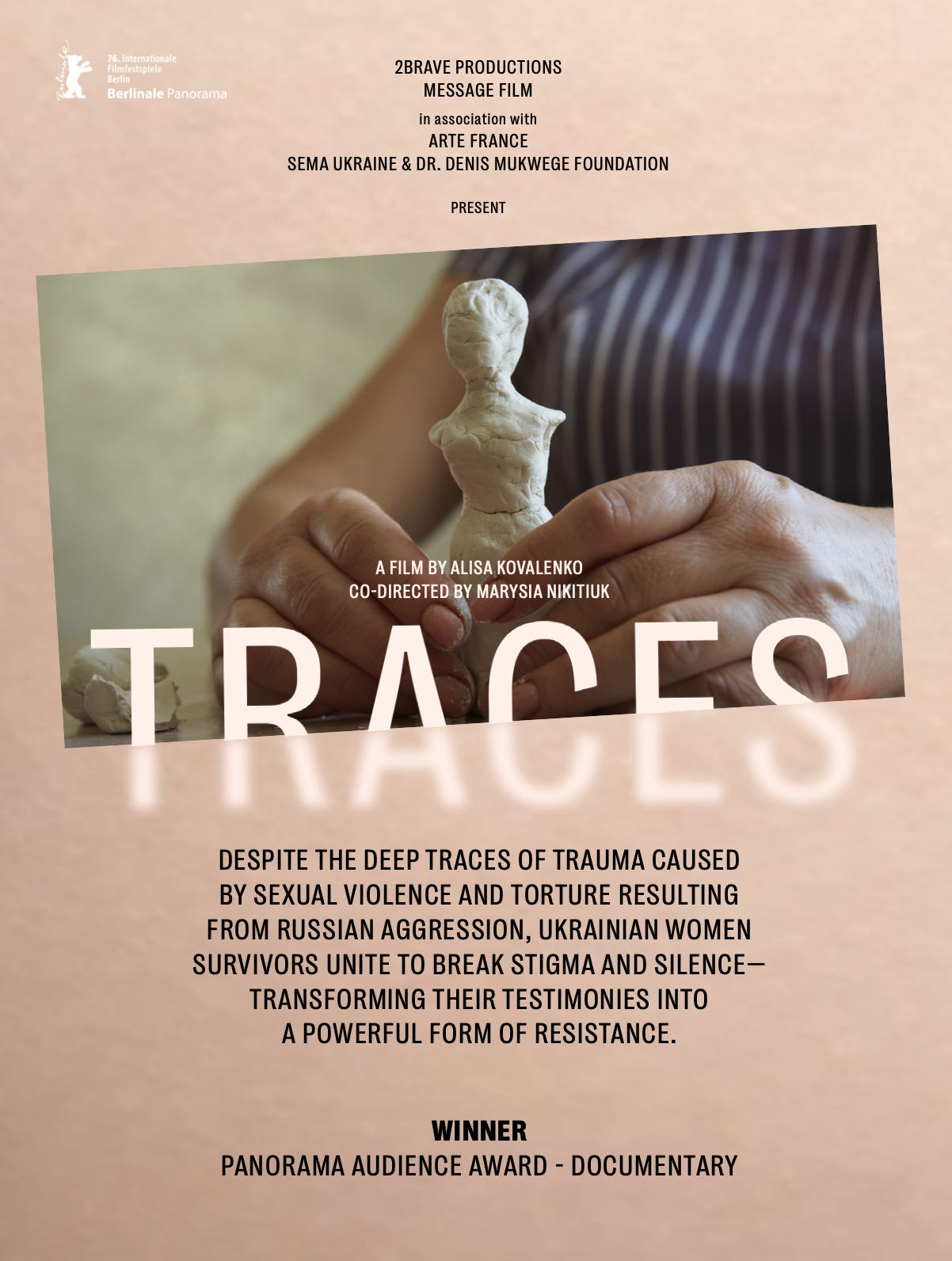
Watch the trailer:
MORE ABOUT TRACES:
A feature documentary film directed by Alisa Kovalenko; co-directed by Marysia Nikitiuk TRACES follows Ukrainian women who, after surviving conflict-related sexual violence (CRSV) and torture during Russia’s war, refuse to remain silent. At its center is Iryna Dovhan, a former captive turned activist and head of SEMA Ukraine, who documents the testimonies of survivors across de-occupied territories. Through her guidance, the film presents a collective portrait of trauma, resilience, and hope, showing how survivors transform pain into power.
The film highlights survivors who, through mutual support and collective action, reclaim agency, challenge stigma, and insist on justice. Personal experiences shared by women showcase a broader strategy of war: sexual violence used deliberately as a weapon to intimidate, destabilize, assert control over occupied territories, and ultimately to break Ukrainians as a nation. Both women and men, including Ukrainian POWs, have been targeted by the Russian forces, highlighting the systematic nature of these crimes and their long-lasting impact on individuals and communities.
The title TRACES captures this multilayered impact — from the visible destruction of lives and communities to the invisible marks left on the human psyche: physical, psychological, and social. More than a record of war crimes, the film is a testament to solidarity and agency — survivors reclaim their voices, challenge stigma, and insist on justice.
By bearing witness and refusing to remain silent, these women — guided by Iryna — create a powerful movement that illuminates the stakes of the ongoing war and asserts the vital importance of memory, accountability, and social transformation.
MORE ON DIRECTOR ALISA KOVALENKO:
Alisa Kovalenko is an award-winning Ukrainian documentary filmmaker, based in Kyiv. She studied documentary film directing at the Karpenko-Kary National University in Kyiv and at the Andrzej Wajda School in Warsaw. Her first two feature-length documentaries, “Alisa in Warland” (IDFA 2015) and “Home Games” (Sheffield Doc/Fest 2018) were both screened over 100 festivals, winning multiple awards. Alisa’s third film, “We Will Not Fade Away”, a teenage adventure documentary set in war-torn Donbas, premiered at the Berlinale 2023, won 20 international awards and was named Best Ukrainian Documentary 2023 by the Ukrainian Film Academy. After Russia invaded Ukraine in February 2022, Alisa joined a volunteer combat unit associated with the Armed Forces of Ukraine and fought on the frontline for months, before returning to filmmaking. From this existential experience she has drawn a personal documentary, “My Dear Theo” (CPH:DOX 2025). Among the awards the film has received are: Best Human Rights Documentary (Dokufest), Audience Award (Nuremberg International Human Rights Film Festival), and Best Documentary in the Central and Eastern Europe Competition Section (Astra Film Festival). Alisa Kovalenko is also a former captive and survivor of CRSV in captivity in 2014 in the Donbas region controlled by Russian and pro-Russian military forces. In 2019, she became a member of SEMA Ukraine, an NGO of women survivors of conflict-related sexual violence (CRSV) caused by the Russian invasion of Ukraine since 2014. Since then, she has been actively involved in human rights and advocacy activities related to CRSV in the Russian-Ukrainian war. Her personal experience and human rights activism led her to work on the documentary film Traces, which documents war crimes and amplifies the voices of survivors. Selected filmography: MY DEAR THEO (2025), WE WILL NOT FADE AWAY (2023), HOME GAMES (2018), ALISA IN WARLAND (2015).
Please join us Tuesday, May 26, 11 am for this very special event.
A note for new members: I developed the ironically named Happy Hour three years ago when I noted how despondent members were over the turbulent state of affairs in the US and globally, and how much better we feel when we come together to hear from experts and to share our experiences.
Community is empowerment. If you are not yet a member of Bette Dangerous, please consider a subscription.
Those on a tight budget, please don’t hesitate to reach out to me at bettedangerous/gmail, as I offer a discount for fixed income members and those dedicated to activism.
Please keep scrolling below the paywall for the registration link.
****
****
Bette Dangerous is a reader-funded magazine. Thank you to all monthly, annual, and founding members.
I expose the corruption of billionaire fascists, while relying on memberships for support.
Thank you in advance for considering the following:
Share my reporting with allies
Buying my ebooks
A private link to an annual membership discount for older adults, those on fixed incomes or drawing disability, as well as activists and members of the media is available upon request at bettedangerous/gmail. 🥹
More info about Bette Dangerous - This magazine is written by Heidi Siegmund Cuda, an Emmy-award winning investigative reporter/producer, author, and veteran music and nightlife columnist. She is the cohost of RADICALIZED Truth Survives, an investigative show about disinformation and is part of the Byline Media team. Her Hot Type column appears in Byline Supplement. Thank you for your support of independent investigative journalism.
🤍
Begin each day with a grateful heart.
🤍
REGISTRATION LINK FOUND HERE