

***Please take out a membership to support the light of truth.***
Author’s note: Ilia State University professor Levan Tarkhnishvili produced this deep dive op-ed on Trump Tower Tbilisi, and I am grateful he permitted me to cross-post his work here. Originally posted in OC Media, his detailed work offers a reminder that investigations must continue. Trump in the U.S. has worked hard to normalize constitutional violations, but it’s not normal. It must be documented. I was at the ICC in The Hague today. There will be a reckoning.—hsc
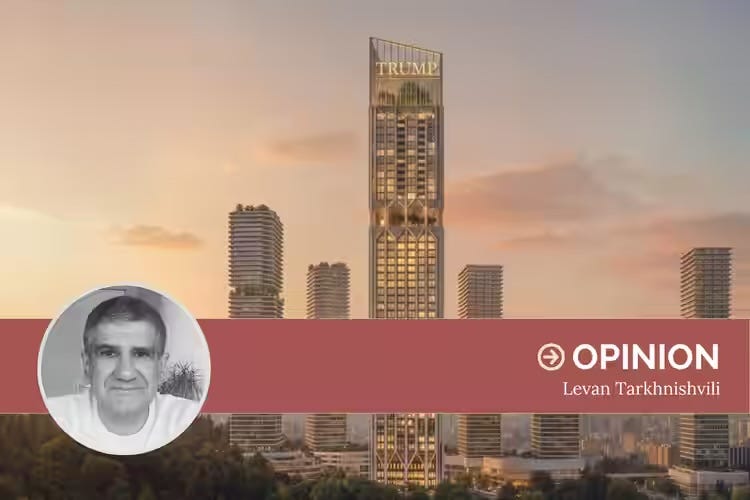
“Whose project is this, really, and what is it for?”—Levan Tarkhnishvili
Opinion | Before the first stone is laid, ask who is really building Trump Tower Tbilisi
The public is entitled to know whether this tower is the beginning of a reset with Washington — or a very expensive camouflage
by Levan Tarkhnishvili
In April, the Trump Organisation unveiled what it called its first project in the Caucasus: a 70-storey Trump Tower in central Tbilisi, the centerpiece of a roughly $2 billion mixed-use development the partners say will be the tallest building in Georgia. Renderings by Gensler followed in May. Eric Trump posed for the cameras. The country’s largest developers — Archi Group and Biograpi Living — stood beside the Trump Organisation and the New York–based Sapir Organisation. For a government that has spent the last few years watching its relationship with Washington collapse, the optics could hardly have been better.
That is precisely why Georgians should be asking, before any of this becomes inevitable, a simple question: whose project is this, really, and what is it for?
The publicly disclosed facts already form a pattern that deserves daylight, starting with the land.
According to reporting picked up by Eurasianet and The Daily Beast, the parcel in central Saburtalo on which Trump Tower Tbilisi is to rise is registered to the Cartu Foundation — the charitable vehicle of Bidzina Ivanishvili, the founder and honorary chair of the ruling Georgian Dream party and, by any honest accounting, the country’s shadow ruler.
Public Registry records cited by Georgian Business Media trace the plot back through a subsidiary of Ivanishvili’s Panamanian offshore Limestone Finance International, which sold it in 2020 to another Ivanishvili-affiliated entity. The man on whom the US imposed sanctions on in December 2024 — ‘for undermining the democratic and Euro-Atlantic future of Georgia for the benefit of the Russian Federation’ — is, by the available paper trail, the landlord of the Trump’s family’s new flagship in the Caucasus.
Then there are the partners. Archi Group was founded by Ilia Tsulaia, a former Georgian Dream MP. The Daily Beast, citing a 2019 Transparency International report, wrote this month that Tsulaia’s firm previously received roughly $7.2 million from an Ivanishvili-government partnership fund to build a concrete block factory in Tbilisi — financing that fell during the same window of time in which Tsulaia and his business partners donated hundreds of thousands of dollars back to the ruling party and to Ivanishvili’s preferred presidential candidate. The same outlet, citing RFE/RL, reported that Tsulaia’s name appeared on a list of prospective sanctions targets that US lawmakers reportedly submitted to then-incoming Secretary of State Marco Rubio in January as alleged financiers of the Ivanishvili regime. No sanctions have been imposed on him to date.
Biograpi Living, meanwhile, is the real-estate arm of Wissol Group (now branded INVIA), chaired by Soso ‘Samson’ Pkhakadze. Wissol is one of the country’s largest diversified holdings, with deep roots in fuel retail and franchise operations. These are not fringe figures. They are pillars of the economic ecosystem that has grown up around, and depends on, the ruling party. Their decision to attach the Trump name to a project on Ivanishvili-owned land is itself a political act, whatever its commercial logic.
The American side of the consortium deserves its own scrutiny. The Sapir Organisation, the Trump Organisation’s New York–based partner on the Tbilisi deal, was founded by the late Tamir Sapir — a Soviet émigré who, as The Daily Beast reported this month citing declassified FBI documents, was the subject of an FBI money-laundering and extortion investigation in the late 1990s, with one internal memo stating he was believed to be acting ‘as a front for Russian organised crime money’. Sapir was never charged and denied any mob ties before his death in 2014, leaving his son, Alex Sapir, to run the firm. That family history is on the public record, and it is the history that the Trump Organisation has voluntarily brought into Georgia.
Then there is the context the developers would rather we forget. While the renderings were being unveiled in Tbilisi, the European Parliament was fielding written questions about a different building project on the Georgian coast: the Kulevi oil refinery near Poti. Reuters and Eurasianet reported in October 2025 that the Russian oil company Russneft had delivered more than 100,000 tonnes of Siberian Light crude from Novorossiysk to the new Kulevi terminal — the kind of cargo that, under any straightforward reading of EU and US sanctions, has no business arriving anywhere outside Russia’s narrow legal carve-outs. Georgia’s official petroleum-product exports then jumped by roughly 3,300% in January 2026. Transparency International Georgia, OCCRP, and the Russian investigative outlet Proekt have all raised the question of whether Kulevi is functioning as a laundromat for Russian oil, with reporting that traces the ownership network back to figures with ties to Russia’s primary military intelligence agency the GRU and to Georgian Dream.
These two stories — a Trump-branded tower on Ivanishvili land, and a refinery that Western watchdogs suspect of helping Moscow evade oil sanctions — are not the same story. But they share a sponsor class, a political patron, and a moment. They are unfolding in parallel, in the same small country, under the same ruling party.
And it is essential to remember that the Trump administration itself has already taken Georgia’s measure. In February, Vice President JD Vance made his first South Caucasus trip, visiting Baku and Yerevan and pointedly bypassing Tbilisi; RFE/RL described Georgia, once Washington’s closest partner in the region, as ‘stranded in US regional diplomacy’ and forced to ‘watch from the outside’ as the vice president became the highest-ranking US official to visit the Caucasus since 2009.
Georgia was likewise excluded from Trump’s Board of Peace initiative, to which Armenia and Azerbaijan were invited. Outgoing US Ambassador to Tbilisi Robin Dunnigan told RFE/RL that Georgian Dream’s leadership had sent a private letter in January 2025 to the White House so ‘threatening, insulting, [and] unserious’ that the administration needed time simply to draft a response; that the US conditions for a reset included stopping ‘anti-American rhetoric’; and that a follow-up message from Rubio attempted to convey to Ivanishvili was rebuffed when Ivanishvili refused to meet her, calling the sanctions ‘personal blackmail’. This is the diplomatic reality into which Trump Tower Tbilisi is being launched. A licensing deal on Ivanishvili-owned land does not change Washington’s reading of Tbilisi. It only changes the personal incentive structure of the Trump family business inside it.
There is precedent for what happens when the Trump Organisation licenses its brand into this kind of environment without due diligence. In 2017, The New Yorker’s Adam Davidson detailed how the Trump International Hotel & Tower in Baku had been built in partnership with the family of Azerbaijani transport minister Ziya Mammadov, whose business network reporters and US senators tied to construction contracts running through an Iranian firm with apparent links to the Islamic Revolutionary Guard Corps. The Baku tower never opened, later becoming a Ritz Carlton. The Trump Organisation, facing reputational and legal exposure as Trump prepared to enter the White House, terminated its licensing agreements in both Azerbaijan and — at the same time — in Georgia, where the Silk Road Group had been developing the original Trump Tower Batumi since 2012. The unfinished Batumi project was subsequently absorbed by a co-investment fund backed by Ivanishvili — the same patron whose footprint now reappears under the new Tbilisi tower.
That earlier Georgian chapter is worth recalling for one more reason. The businessperson who first brought Trump to Georgia in 2012, Giorgi Ramishvili of Silk Road Group, is not among the partners announced for Trump Tower Tbilisi. After watching how the Batumi project ended, and what the Baku partnership did to those who carried it, his absence from the new consortium is not nothing. It is the kind of silence that, in a country this small, communicates a judgment.
None of this proves wrongdoing by any individual named here. Real-estate development in Georgia, like everywhere, requires partners with land, capital, and political access, and there is nothing illegal about being well connected. But the standard cannot be whether the prospectus is glossy. The standard, for any project of this scale, attached to a sitting US president’s family business, on land owned by a US-sanctioned oligarch, in a country whose government is openly accused by Western institutions of pulling toward Moscow, has to be transparency that goes well beyond what is on offer so far.
There is a short list of questions that the developers — and the government — owe the Georgian public:
Will the land under Trump Tower Tbilisi be transferred out of Cartu Foundation ownership before construction begins, and if so to whom, on what terms, and for what consideration?
Who, line by line, are the ultimate beneficial owners of every entity in the consortium, including any silent capital partners?
Where is the financing coming from, in what currency, and through which banks?
What due-diligence process did the Trump Organisation run on its Georgian counterparties, given the Treasury Department’s 2024 designation of Ivanishvili and the ongoing scrutiny of sanctions-evasion networks operating through Georgia?
And what contractual provisions exist to unwind the deal if, as in Baku, the partners turn out to carry more risk than was disclosed?
These are not the questions of an opposition pamphlet. They are the questions any serious Western counterparty would have to answer to its own compliance committee before signing.
Georgia has been told for two years that it is drifting away from the West because the West does not understand it. A skyscraper bearing the Trump name will not change that diagnosis. It will only make it harder to see clearly. Vance’s plane did not land in Tbilisi for a reason. Before the first stone is laid, the public is entitled to know whether this tower is the beginning of a reset with Washington — or a very expensive piece of cover for the people Washington has already named.
Op-ed by Levan Tarkhnishvili
****
Levan Tarkhnishvili is a Professor at Ilia State University, with his research interests including the values of society and transition, elections, secularism, and political transition. He formerly served as Chair of the Georgian Public Broadcaster, Chair of the Central Election Commission, an advisor to former President Mikheil Saakashvili, and was an MP from 2012–2016.
****
****
Bette Dangerous is a reader-funded magazine. Thank you to all monthly, annual, and founding members.
I expose the corruption of billionaire fascists, while relying on memberships for support.
Thank you in advance for considering the following:
Share my reporting with allies
Buying my ebooks
A private link to an annual membership discount for older adults, those on fixed incomes or drawing disability, as well as activists and members of the media is available upon request at bettedangerous/gmail. 🥹
More info about Bette Dangerous - This magazine is written by Heidi Siegmund Cuda, an Emmy-award winning investigative reporter/producer, author, and veteran music and nightlife columnist. She is the cohost of RADICALIZED Truth Survives, an investigative show about disinformation and is part of the Byline Media team. Thank you for your support of independent investigative journalism.
🤍
Begin each day with a grateful heart.
🤍
Note to readers: if you only read one news article today, THIS is it. We in the U.S. must learn to "Think globally & act locally" if we seek to return our captured corporaticracy to "We the people. " It's still possible IF we learn to start working smarter.