

***Please take out a membership to support the light of truth.***
The Medici didn’t start out as the most powerful family in Italy. Other families were just as rich, and just as ambitious. But no one knew more about getting ahead - and staying ahead - than the Medici. They clawed their way to the top, sometimes through bribery, corruption and violence. Those who stood in their way could end up humiliated - or dead. And the Medici exploited a network of “friends of friends” - hangers on who would do anything to stay close to the family… The power of the Medici stretched all the way to Rome, where even the papacy was something to be bought and sold.—“Medici, Ruthless Ambition,” PBS
In last week’s Bette’s Happy Hour, as I listened to religious scholar Dr. Matthew Taylor describe the religious extremists surrounding Donald Trump and their competing objectives, I thought it sounded so Medici, the Italian banking family and political dynasty that first rose to power in the 15th century. Surely, there must be some utility in that, some divide and conquer opportunity for pro-democracy forces when we have a White House with so much palace intrigue.
To familiarize yourself with Taylor’s work, please read my recent column in Byline Times, where he explains false prophets are attempting to turn Trump into a messiah:

The following raw transcripts, edited for brevity and clarity, are from our April 28, 2026 Happy Hour interview with Taylor. Special thank you to Monique Camarra, who joined me as co-host.
Medici White House and the Pseudopropheta
Heidi: Matthew, can you please reintroduce yourself to our community.
Matthew: I grew up in Southern California, in the Los Angeles area. I grew up Evangelical, and actually went into Evangelical ministry for about seven years after I graduated from college, and then I just fell in love with academia again, and went and got my PhD in Theology and Religious Studies specializing in Muslim-Christian dialog. I had every intention of becoming a specialist in building bridges between religious traditions, especially between Muslims and Christians, and in finding ways to live together and work together in the world. And that’s really what my first book was thinking about… and it’s a very hopeful story. And I was just wrapping up that book when January 6 happened, and given my background — I’ve been kind of following the developments in Christian nationalism, kind of as a side project, and I saw so much that resonated with my own background.
On January 6, I had spent all this time in the years leading up to that, thinking through the eyes of Muslims and how they experienced 9/11 and its aftermath, and seeing their religious tradition weaponized against their country.
And I experienced January 6 as a kind of Evangelical 9/11 — seeing my faith tradition, the songs and the Bible references and the types of prayer that I grew up participating in, weaponized, mobilized in an attack on our democracy. And I was also kind of befuddled by some of the theology I saw on display that day, and so I just started digging, trying to understand who were the leaders behind January 6, what were the ideas that they were using to mobilize Christians for that day? How did Christians get so wrapped around the axle with Donald Trump. And that led to, first a podcast series called Charismatic Revival Theory, and then my book that was published in 2024, The Violent Take It By Force, where I argue that a particular network of Christian supremacist leaders from the kind of Pentecostal charismatic world — the network called the New Apostolic Reformation (NAR) — was central to the events of January 6, and I call them the principal theological architects of January 6, both in orchestrating and helping to organize Christian mobilization around Donald Trump in the 2016 and 2020 elections, but then also in very direct involvement in garnering or gathering Christians, galvanizing Christians, really trying to create the context in which something like January 6 could happen. And so that was the background in which I first met Heidi.
Heidi: Yes, and you actually were kind enough to bring a PowerPoint for us helping explain why people would support such an ungodly man as Trump.
Matthew: When we talk about Evangelicals, we use that terminology as though we are speaking about a single thing. And the reality is, there are a lot of different kinds of Evangelicals. It’s an amalgam of a movement. It is a big tent under which there are a lot of different kinds of identities and practices. And my argument in The Violent Take It By Force is that there was a mainstream evangelicalism that gave rise to the religious right as we knew it from the 1980s up until the Trump era, but that the leadership, the elite of that movement, the religious right, did not want Donald Trump. They were very much opposed to him in the 2015 and 2016 primaries, and it was this group of fringy outsiders, these non-denominational, charismatic kind of think of Pentecostal style leaders centered around Paula White Cain, who is Donald Trump’s closest religious advisor.
She brought in the people that she knew to be kind of the nucleus of advisors around Donald Trump, including a number of the leaders from the New Apostolic Reformation. And they brought with them a variety of new radical theologies, including things like the Seven Mountain Mandate, including things like the leadership of apostles and prophets, spiritual warfare and prophecy and mobilizing for spiritual warfare within politics. And those things all kind of converge around Trump in the first term and become the foundation on which something like January 6 is built.
I was very much trying to sound a warning about the types of leaders who surround Donald Trump, the theologies that they carry. And I think one of the most important things to understand, especially in the present moment, is that these leaders have functionally enshrined Trump with a certain kind of holiness, with a narrative that he is a prophesied figure, quite literally, many of the people who surround Donald Trump as advisors would also identify as prophets and not in the “Martin Luther King was a prophetic figure” kind of way.
They literally say they hear from God, direct messages for leaders, for individuals, for nations. And there are now hundreds, maybe even 1000s, of prophecies about Donald Trump, many of them that have been spoken directly to him, and I don’t think you can even make sense of the way that Donald Trump is operating in office in the second term, apart from the ways that these prophecies have impacted his existing megalomania and shaped it into a kind of Messianic narrative, and the way that he phrases that narrative is — especially in reference to the Butler, Pennsylvania assassination attempt — as “God saved me to save America.”
They’ll use all kinds of biblical imagery and talk about him as a Cyrus or as a Jehu, they talk about him as if he’s anointed by God for a purpose. But all of this is created — this kind of propaganda bubble around Donald Trump — that has drawn in many evangelicals and other kinds of Christians that always is rationalizing and justifying the decisions that he is making.
And it’s a very active process of rationalizing what is fundamentally irrational and offering for Trump, a framework that he can use to situate his very chaotic personality and frankly, kleptocratic instincts of enriching himself. But it all gets wrapped up in this narrative of holiness and prophecy and anointing, and that still is what is really holding a lot of these Christians in their connection to Trump.
Heidi: Incredibly valuable information. They made a bit of a Faustian deal.
Matthew: The fundamental bargain for a lot of Trump’s advisors, maybe the shorthand for it would be, “He’s not a godly man, but he’s God’s man.” They’re not deceived in the sense that they imagine that Trump is deeply moral or deeply pious. That’s not what they think. They see him up close, they know that’s not true, but they believe that God has anointed Donald Trump for a particular purpose, that he is accomplishing God’s purposes in the world. And so that is how they managed to overlook all these other things, and they’ll use these different images from the Bible. I mean, the primary one in 2016 and 2020 was this comparison of Trump to Cyrus, this emperor who played a very pivotal role in sending the Jews back from exile in Babylon and then leading to the rebuilding of Jerusalem and rebuilding of the temple, very important figure in the Hebrew Bible narrative. And so they would invoke this Cyrus image to say, Well, Donald Trump is an outsider. But paradoxically, God can use an outsider like that, and maybe you need someone who’s kind of rough around the edges to throw some punches that Christians aren’t willing to throw, and to be a bully on behalf of these meek and mild Christians in the ‘24 election. That narrative shifted some in part because Trump was adopting these things, and they adopted a different figure, this kind of obscure Israelite king In the Bible named Jehu, one of the more violent characters in the Hebrew Bible, and using this image of Jehu — and they really liked Jehu because Jehu is the one who presides over the execution of Jezebel, the wicked queen, kind of paradigmatic of the Hebrew Bible. And they were using this Jezebel language in reference to Kamala Harris. But Jehu as a figure, is a kind of divine avenger. He’s violent and taking out God’s enemies. And I think that very much is the way that they think — that Trump is hated by the right people, and that means that, therefore, and because he beats up on the right people, his cause is bathed in righteousness. And this is a pattern in Christian history, really, of Christians surrounding tyrants, and that is part of what inspired me to write the next book.
Heidi: Thank you again for that. It’s always with a bit of horror that I have to face this stuff, but it’s incredibly important… let’s jump into Defying Tyrants. What I find most hopeful is you actually offer an off ramp to people who may be waking up to the huge mistake they made in listening to whoever encouraged them to believe in Trump. And I say that with a headline today. The New York Times did a focus group, and the overwhelming majority of the people in the focus group who voted for Trump regret that decision.
Matthew: In my past work, I was sounding a more civic and democratic warning to say, however you evaluate this theology, it is actively participating in a real degradation of our democracy and the fabric of our society… I then began working on another ongoing project that actually became a podcast series called American Unexceptionalism, that aired in the fall of 2025 that I worked on with my colleague Susan Hayward… we’re interviewing experts in religious nationalism from outside the United States, people who had expertise in Buddhist nationalism in Sri Lanka and Myanmar, or Hindu nationalism in India, or Russian Orthodox Christian nationalism in Russia, or Korean evangelical Christian nationalism, and inviting people who, either as activists or scholars were on the front lines of defending democracy against other forms of religious nationalism to speak to our situation, to share the wisdom that they had gained from years of doing this work, of trying to resist religious nationalism.
And one of the things that we heard over and over and over again in that series, whether it was from Jewish people talking about religious Zionism in Israel, to people talking about Hindu nationalism, was they kept saying theology is really important in resisting this stuff, again, not only from Christian sources, but across these different traditions. In part, the reality is, if you have one movement that has kind of claimed the name of religious orthodoxy or of righteousness, and they are putting forward their arguments in the public square saying ‘Donald Trump is God’s anointed king over America.’ And then on the other side, you’ve got this kind of pluralistic center to left coalition that comes along and says, ‘no, no, we need to uphold the principles of the Enlightenment. We need to stand up for the rule of law and democracy, this is really, really important, and a particular kind of democracy is really important.’
And when you think about the balance of powers, all of those are abstractions for a lot of people, or it feels very concrete for many people. Religion is their mother tongue. It’s what they grow up knowing. It feels very tangible to them, and it’s a vocabulary and a set of symbols that is very meaningful to them, and when you mix that with nationalism or with imperialism or with tyranny, that becomes a very powerful propaganda tool.
And part of the challenge is, if those of us who want to resist Trump are not using theological language, are not engaging with religious symbolism, if we’re only doing these kind of abstracted secular arguments or civic arguments, then we’re ceding the field to the people who are really actually bad actors and often bad interpreters of religion.
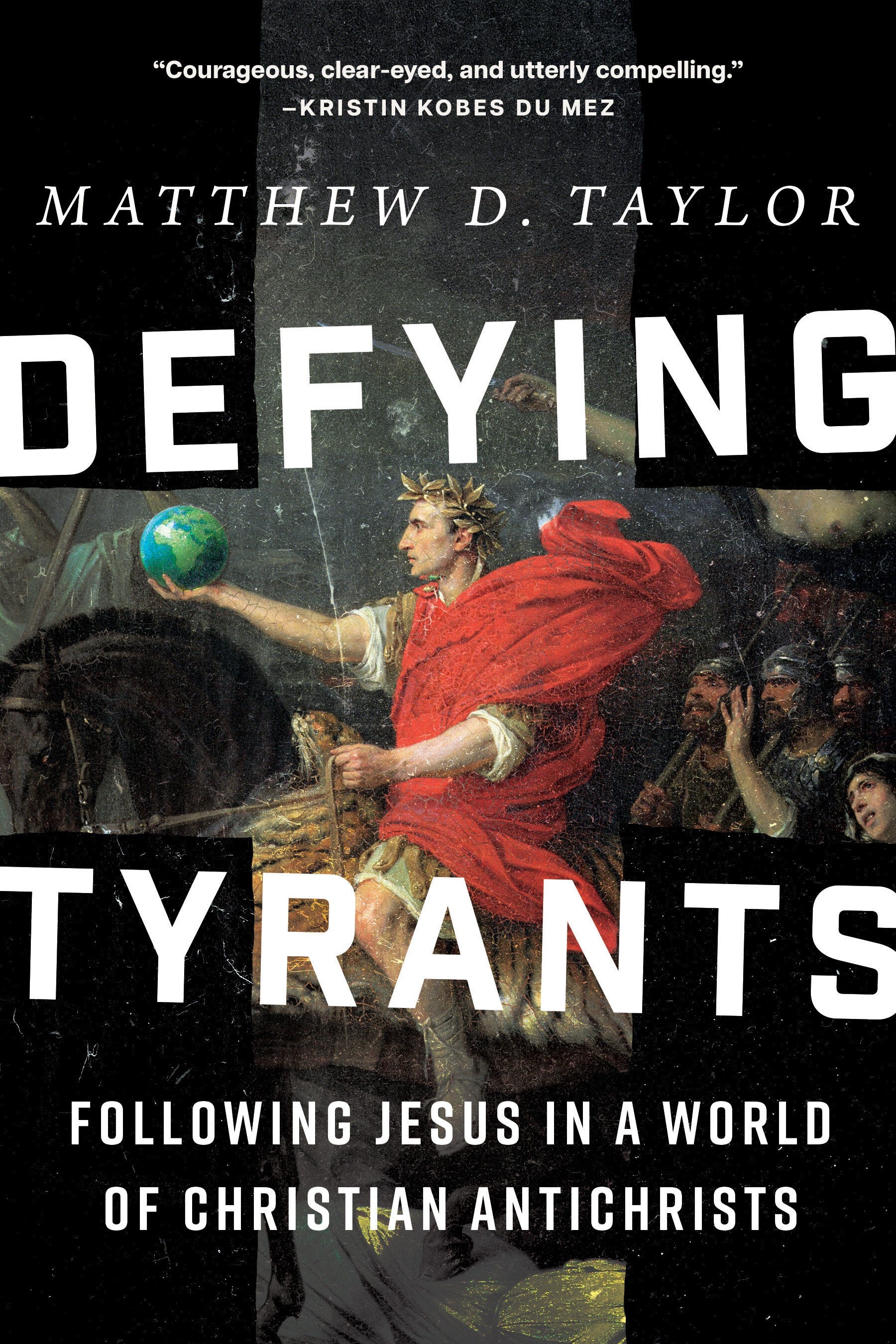
What I’m trying to do in Defying Tyrants is offer a theological response to Christian nationalism, to Christian supremacy, to Christian imperialism, but one that is actually rooted in what I think — my view of what Jesus was about. And the argument that I make there is that, yes, Christian history has been awful. And if we look throughout Christian history, and I have a whole section of the book. Where I run through the history of the awfulness of Christianity, the abuses of power, the colonialisms, the slaveries of Christian history, the Crusades and pogroms and inquisitions and all the litany of things that Christians have done that has been awful. But I contrast that with Jesus and the early church and what Jesus actually taught. Because while you can find a ton of authoritarianism in Christian history, I think that Jesus was one of the most anti-authoritarian human beings who ever lived, not only because he died the death of an insurrectionist resisting the imperial regime of the Pax Romana, but also because of the way that he lived and the way that he taught his followers to live.
Jesus, in his teachings on the kingdom of God, was not saying, ‘let’s substitute a heavenly tyranny for our earthly tyranny.’ He was saying, ‘God is not a tyrant. God is not like Caesar. God is not someone who imposes God’s Will on people and coercively demands that everyone abide.’
Instead, God comes in the form of a peasant preacher on the outskirts of empire who’s teaching his followers how to humanize each other and how to humanize everyone else, how to care for the least… a person who serves all… so Jesus teaches an anti-authoritarian vision that I think the early church very much embraces and is trying to live out.
No one gets to have a claim to be the intermediary between God and humanity. God is among us. God is with us. God is teaching us the character of God here and now, and that actually liberates us from this need to dominate, and also from the ways we’ve been taught to be dominated. And so Jesus defies tyranny, again, not out of some political agenda and not using violence, but a form of theological resistance to empire and to tyranny, and to the logic of empire that says some human beings are better than other human beings and are therefore entitled to rule over them…
I’m calling Christians back to the message of the teaching of Jesus.
Heidi: That’s so beautiful, just the way you explain and remind people of those early church teachings, and that was what I recall growing up with. And Monique also grew up Catholic, and we share that background. And it’s interesting how there’s been a huge split in the Catholic church that I can see over a lot of the things that you talk about, but I actually just wrote a letter to Pope Leo today thanking him for his bravery. He’s the person we need in this moment offering a very, very powerful counterweight to this growing authoritarianism…
The headline that we came up with for our previous interview with you was a quote from you, ‘false prophets are making false messiahs out of tyrants.’ Can you speak a little bit about that?
Matthew: You know, in the passages in First John where it talks about these antichrists, at one point, I think it’s in First John, Chapter Four, it references this phrase from Jesus of false prophets, ‘pseudopropheta’ — these people who are proclaiming a false message and pretending it is prophecy… Jesus warned us about what his followers would be like, right? I mean, Jesus is the one who warned us that many false prophets would come in his name, many false messiahs, false Christs, would come in his name.
He’s the one who warned us about the wolves in sheep’s clothing, right?
You see this very cynical collaboration between some of these Silicon Valley figures and people like JD Vance with his hard line Catholicism. I think they more see him as an avatar of of their corporate interests and of their tax interests, and would be very supportive of him advancing their ideological project in other ways, right?
Right-wing politics today is a motley crew of different anti-democratic forces united around Donald Trump, because Donald Trump is anti-democratic. But Lord help us if any of the those factions actually win and want to take and actually take power, because they’re all pushing in very different directions, actually, right? A lot of the far right is anti-semitic. A lot of the far right is philo-semetic, very pro Israel, right? And right now, they’re in a war with each other.
The Tucker Carlsons and Candace Owens of the world versus the Paula White Cains of the world, right? So this is where I think we need to get past simply talking about, like, ‘Oh, this is Christian nationalism, right?’ Fine, right? That, yeah, that phrase works. But underneath that, there’s all these other currents that are pushing in different directions.
We need to pay attention to the tensions within that, because underneath that is a whole boiling cauldron of fighting and controversy and different agendas that actually lead to very different outcomes for the nation.
We are seeing this real fracture within Trump’s base. Trump is one of these paradoxical figures who contains anti-semitism and philo-semitism within himself… Philo-semitism is love and kind of smothering support of Jews because they’re different than the rest of humanity, the opposite of how we understand anti-semitism. Philo-semitism is what we often will call Christian Zionism today, Christians who support the State of Israel, because they have a Christian theological agenda, they’re trying to enact through Israel, and that’s really the New Apostolic Reformation, the Paula White Cain’s of the world. They’re very extreme Christian Zionists, and they have given cover to the State of Israel to do pretty awful things in the last few years. I don’t know that Netanyahu and the Likud coalition in Israel could have prosecuted the war in Gaza the way that they did, and to the extent that they did, without cover from some of the Christian Zionist advisors around Trump.
But now there’s a counter reaction. Within the Trump coalition, from some of the MAGA anti-semites, the Tucker Carlson, Candace Owens crowd, and those folks, as this war in Iran is ongoing, have been overtly breaking with Trump and saying they do not support Trump anymore. And I mean Nick Fuentes is encouraging his followers to vote Democrat in the midterms, right? So that fracture within Trump’s base, I think, is quite significant. The anti-semites just want the violence to be more inflicted on migrants at home instead of abroad, right? They’re equally dehumanizing in their vision of society, but they have real tensions with the Christian Zionists. And I mean, they’re all Christians, they’re all Christian nationalists, but their visions of what that Christian nation should entail are quite different.
Heidi: Such Palace intrigue, so Medici… One of the things that those now in power have been so good at is dividing every pro-democracy group there is, whatever it is, they found a way to wedge people apart. So I’m always looking for weaknesses within the current power structure on how they can be wedged apart. This sounds like the place to apply pressure, because they’re now dividing themselves.
Matthew: It’s important for those of us who do inhabit a faith tradition to use the language of that faith tradition to stand up right now and to gather people of that faith tradition to stand against this stuff… creating space in the resistance for theology, for God talk and for religious leaders to exercise their religious leadership in protest against Trump, I think, is one of the most important things for building an anti-Trump coalition. So that’s the theology side.
Strategically, my read on the United States today is not that we are a nation divided in half. We’re actually a nation divided in thirds, and if you look at the lead up to the ‘24 election polls, we’re consistently finding that roughly 32 or 33% of the country was saying in the lead up to the ‘24 election that Donald Trump was the rightful winner of the 2020 election, and it was stolen from him. 1/3 of Americans bought into that lie, bought into that propaganda. And from my perspective, those folks are immersed in MAGA propaganda bubbles, right? They are not accessible in terms of democratic persuasion — that is Trump’s base and that they might fracture or break off from Trump for other reasons, economic or anti-semitism or whatever it is, but they’re not persuadable to people on the left coming to them and saying, ‘hey, you know, Trump’s really not a good guy.’ They are inhabiting a world of propaganda, so I don’t think they’re worth trying to persuade right now.
Then you have the blue third, and they need to get out of their bubble too, because the entire battle for American politics is about who can persuade the middle third in the ‘24 election. Donald Trump, quite brilliantly, went around and sold as many people as possible a set of lies. I think people in the middle who voted for Trump are recognizing that he is not out for their good. And so what we need to do now is build a coalition that unites the blue third and the middle third into a coalition that says ‘we are going to protect this democracy. ‘That’s what we just saw happen in Hungary — a mass, big tent coalition, not with purity tests, not with ideological tests, but that says ‘we need to protect and restore a democracy.’ And then all the other arguments that we have between the center and the left and the right about abortion and about gay marriage and about charter schools and the whole gamut, those are important debates that you can have within a democracy. If you don’t have a democracy, you can’t have those debates.
Heidi: Preach brother.
****
More about Matthew here:
Dr Matthew D. Taylor is the author of The Violent Take It by Force, Defying Tyrants, and Scripture People, and his work has appeared or been featured in the New York Times, Weekend Edition, On the Media, Rolling Stone, The Bulwark, Politico, Sojourners, and Religion News Service. A religious studies scholar who specializes in American Islam, Christian nationalism, and Christian extremism, he is also the creator of two podcast series: Charismatic Revival Fury and American Unexceptionalism. Taylor holds a PhD from Georgetown University and an MA from Fuller Theological Seminary. He is currently a visiting scholar at the Center on Faith and Justice at Georgetown University. You can follow his substack here and preorder his latest book here.
You can also order his previous book at any of the links below:
The Violent Take It By Force:
****
****
Bette Dangerous is a reader-funded magazine. Thank you to all monthly, annual, and founding members.
I expose the corruption of billionaire fascists, while relying on memberships for support.
Thank you in advance for considering the following:
Share my reporting with allies
Buying my ebooks
A private link to an annual membership discount for older adults, those on fixed incomes or drawing disability, as well as activists and members of the media is available upon request at bettedangerous/gmail. 🥹
More info about Bette Dangerous - This magazine is written by Heidi Siegmund Cuda, an Emmy-award winning investigative reporter/producer, author, and veteran music and nightlife columnist. She is the cohost of RADICALIZED Truth Survives, an investigative show about disinformation and is part of the Byline Media team. Thank you for your support of independent investigative journalism.
🤍
Begin each day with a grateful heart.
🤍