'It’s authoritarian regimes’ war against democratic regimes'
Spotlighting vital quotes on war from our Speakeasy with Dr. Elena Davlikanova. Plus, there is no Happy Hour today. Our next community event is Sunday with Ukrainian history Professor Tetiana Boriak
***Quick update: our next community event is our Sunday Speakeasy with Tetiana Boriak. There is no Happy Hour meeting today.***
“If you deeply understand what the alternative to your imperfect democratic regimes are you will probably be way more skeptical when it comes to criticism towards democracy.”—Elena Davlikanova for Bette Dangerous
I wanted to take a moment to spotlight a couple of important quotes from our recent guest, Dr. Elena Davlikanova, an associate senior fellow at the Sahaidachny Security Center and a senior fellow at the Center for European Policy Analysis (CEPA). She attended our Sunday Speakeasy to discuss Russia’s sub-threshold aggression against the West, and I have thought of little else since our meeting.
Framing for War
Dr. Elena Davlikanova:If I had a magic wand, I would say that it would be nice to remind all our partners that it’s not Russia’s war against Ukraine; it’s authoritarian regimes’ war against democratic regimes. Russia is not alone, the help it receives from China, from North Korea, from Iran, is almost equal to what Ukraine receives from all the democratic partners, while their economic power is way bigger. So we are not fighting for ourselves. We have already given Europe time to rearm, to reconsider, to bring together the mindset and capabilities. Because Russia is not going to stop in Ukraine.
It’s not about Kyiv. It’s not about Ukraine. No. Overall, it is very clear when it comes to the writing of Russian military experts that this war is Russia against the West. It’s not gonna stop when the war and the hostilities in Ukraine stop… The Russians don’t view it as one tiny misunderstanding between Russia and Ukraine, they say this warfare…has no geographic limits. And no time limits. It’s gonna be continued on. And I think that we need to understand that.
The True Face of Russia
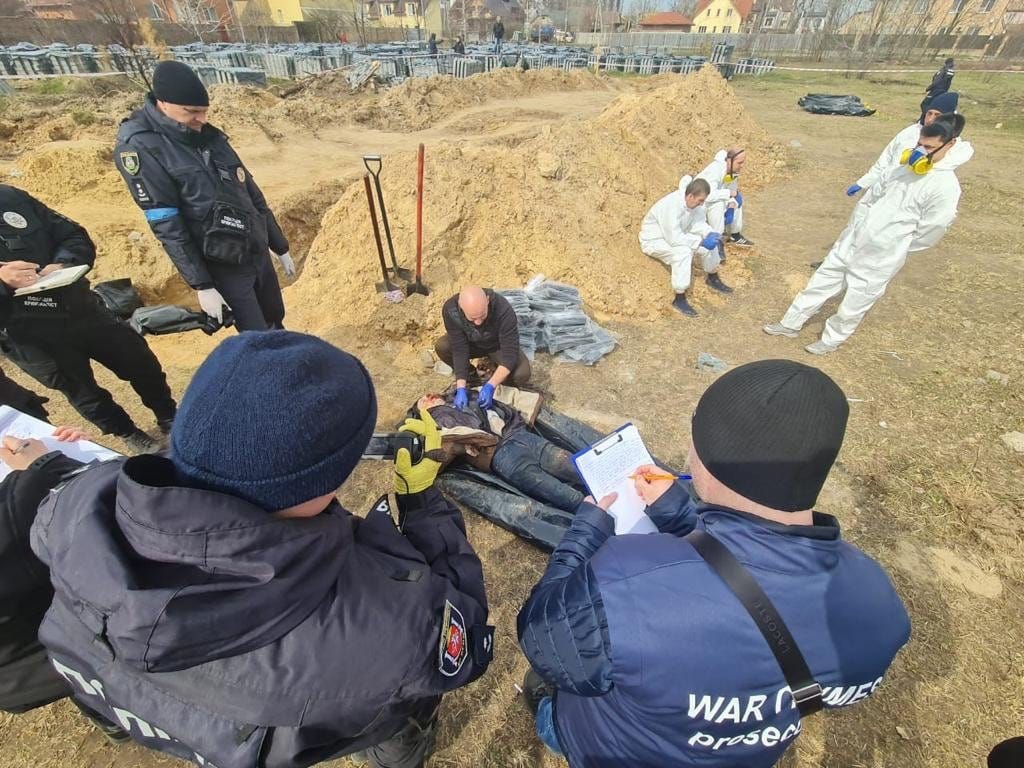
Dr. Elena Davlikanova: I believe Ukraine’s greatest strength is historical memory. First of all, we know Russians in a way that other, not all, but many Western countries decide not to look at. So they are trying to stay in denial, and I remember very well the change of heart that came with the liberation of Bucha, Irpin, and all the Kyiv Oblast areas after the first weeks of the full-scale invasion, and when European leaders were brought to those areas, and they saw for themselves the mass graves of people who were tortured, who were killed. Whether you know, they were all civilians. There were kids. There were women.
Exhumation of victims of a Bucha mass grave, 8 April 2022, image National Police of Ukraine, courtesy Wikipedia
So we know very well that Russian culture is not Dostoevsky. It’s not Tchaikovsky. It’s not everything that Russia is trying to sell. It’s a very, very thin veil of a ‘cultured something’ that doesn’t exist, because you know under that veil, you will see the true face of Russia, and it is barbaric. It is very, very. heartless. It is very aggressive, and Ukrainians knew what was going to happen to them because this aggression started not in 2022. It started in 2014, and those who were tracking the situation, those who were gathering information from the occupied territories, from the prison, where the information about torture that happened there, we knew...
I knew exactly. I was going around saying that what is going to happen would be horrific. It will be the ugliest phase the war can have. They do not care about any kind of Geneva Conventions.
I knew this will be medieval barbarism, and this is what Russians actually were doing. So, in my opinion, many families in Ukraine, they still remember the first half of the 20th century, when women suffered from the communist terror, and the stories in 2022, a group of authors, including me, we gathered 100 stories of women and girls from this war. But many of these women, or some of them, they were saying that this exactly happened with my grandmother, and there were stories like this: ‘grandmother had to carry the dead body of her husband, who was killed by a communist, at night, from the mass grave somewhere where she could actually bury him, and because it was not allowed to bury these people, and she was pregnant at the time,’ so all these horrific stories they are a part of that memory.
So we know this ‘culture,’ even after the Soviet Union collapsed. The overall Russian culture is very disrespectful to other nations, and they were always disrespectful to Ukrainians, dehumanizing, and dehumanizing other nations. And Ukrainians were all the time portrayed as a little bit stupid, incapable. There was this narrative again, coming back to the cognitive war, the narrative that Ukraine is a failed state that cannot govern itself without Russia, the older brother. There is a publication called “The War of Narratives: The View of Ukraine Since 1991 till 2022” and we looked into how Russian media portrayed Ukraine, how Western media portrayed Ukraine, and how Ukraine portrayed itself, and these are very different countries at the end of the day.
In addition to perception, for many European states, it was beneficial economically to ignore all these things about Russia, because Russia used energy as a weapon against them, and then against us as well. So it’s very complex, and I am very happy that finally Ukrainian experts are being heard, even though still Ukrainians very often, behind the stage, are talked about as a little bit crazy, somewhat not objective. We know that, and it’s okay because we have the track record of being right for too many times, and in many cases, when we were trying to say something, then our European partners were ready to understand it, to comprehend it, in two years. Usually, it takes them about two years to completely understand.
Existential for the Democratic World
Dr. Elena Davlikanova: The outcome of the war in Ukraine will show how impactful, how strong, how united the democratic world is, and when this disunity, which is already being seen by all the adversaries very clearly, is sending a very strong message that the age of dominance of democratic nations is over, that the redistribution of the spheres of influence is full-fledged. There will be more and more regional alliances, you know, all over the world. We will already see the recent development with Turkey, Saudi Arabia, and Pakistan. So what I’m trying to say that the if Ukraine wins, and by winning again there was a lack of understanding or vision what Ukrainian victory could look like. This war is existential for the democratic world.
Europe’s Upcoming Elections
Dr. Elena Davlikanova: We look very cautiously to European elections, because the number of populist parties that are coming to power may shift or change the balance of power in Europe.
Defend Imperfect Democracies
Dr. Elena Davlikanova: I do not think there is one specific technique that will save you from the information war, particularly as it becomes more and more elaborate. More artificial intelligence is involved, and then algorithms help to tailor it for you specifically, understanding who you are, and so on. And it’s very hard to keep your guard on all the time. However, I would say that if you deeply understand what the alternative to your imperfect democratic regimes are, you will probably be way more skeptical when it comes to criticism towards democracy.
With all the imperfections, the alternative is something that you will not be able to handle easily, because it’s the lack of so many things that are being taken for granted and by default. That I think at some point democracies will need those Democrats that will be able to stand up for it.
****
More about Dr. Elena Davlikanova’s work here:
Dr. Elena Davlikanova is an expert in democratic governance, security policy, and strategic foresight, with a focus on domestic developments in Ukraine and Russia. In September, she is heading to King's College London War Studies Department as a research fellow.
Currently, she serves as an Associate Senior Fellow at the Sahaidachny Security Center and a Senior Fellow at the Center for European Policy Analysis (CEPA). In addition, she is the Program Manager for the Friedrich Ebert Foundation in Ukraine. Dr. Davlikanova co-authored CEPA report Containing Russia, Securing Europe, and facilitated strategic foresight projects including Scenarios: Ukraine 2032 and Scenarios: Russia 2032. In 2022, she led the group of experts to compile a book “100 Stories of Women and Girls from Russia’s War against Ukraine” and “Understanding Ukraine: The Battle of Narratives.”
A private link to an annual membership discount for older adults, those on fixed incomes or drawing disability, as well as activists and members of the media is available upon request at bettedangerous/gmail. 🥹
More info about Bette Dangerous - This magazine is written by Heidi Siegmund Cuda, an Emmy-award winning investigative reporter/producer, author, and veteran music and nightlife columnist. She is the cohost of RADICALIZED Truth Survives, an investigative show about disinformation and is part of the Byline Media team. Thank you for your support of independent investigative journalism.
It is so important to remember the past, especially the stories our parents and grandparents told us. My stories are about the time before you could be vaccinated against diseases like whooping cough, when my mother's baby brother almost died from whooping cough. When my sister-in-law thought the vaccine would be too dangerous (this in the mid-eighties) my mother told me she'd take her granddaughter to the doctor herself to get her vaccinated. She remembered her baby brother turning blue and hardly being able to breathe. I myself remember when polio was a living disease and we saw the victims all around us. I pass on the stories of Berkeley in the Sixties, so people will know what governors like Reagan can and will do.


It is so important to remember the past, especially the stories our parents and grandparents told us. My stories are about the time before you could be vaccinated against diseases like whooping cough, when my mother's baby brother almost died from whooping cough. When my sister-in-law thought the vaccine would be too dangerous (this in the mid-eighties) my mother told me she'd take her granddaughter to the doctor herself to get her vaccinated. She remembered her baby brother turning blue and hardly being able to breathe. I myself remember when polio was a living disease and we saw the victims all around us. I pass on the stories of Berkeley in the Sixties, so people will know what governors like Reagan can and will do.