

***Please take out a membership to support the light of truth.***
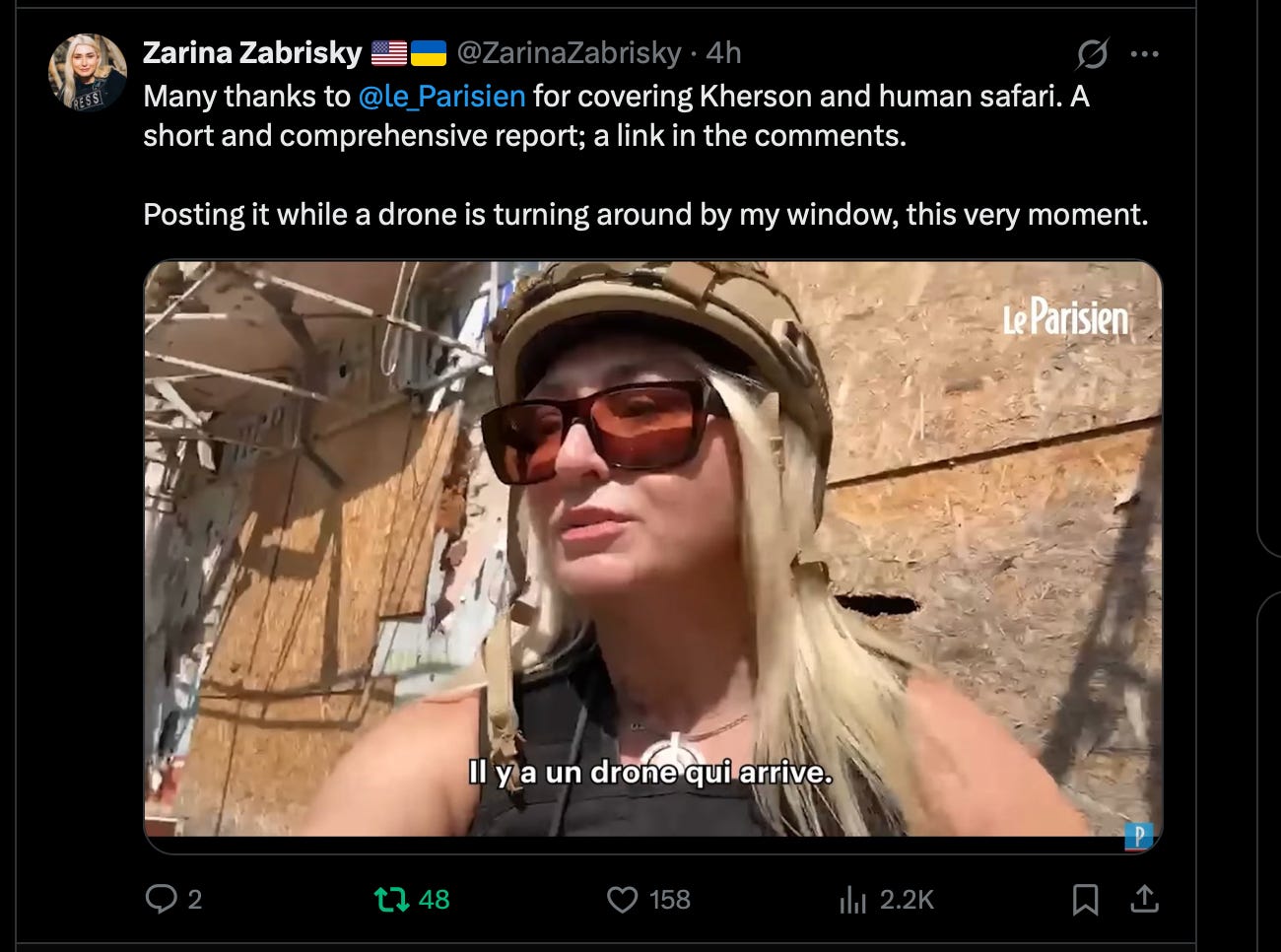
Author’s note: I felt the need to check in with Zarina Zabriksy, the director of Kherson: Human Safari and a war correspondent living in the southern port city of Kherson, Ukraine. Her reporting on how Russia is hunting civilians with drones helped inform multiple UN reports and a Human Rights Watch report on Russia’s war crimes and crimes against humanity occurring in Kherson. In recent days, Atlantic reporter Anne Applebaum cited Zabrisky’s interview with Yuri, a 52-year-old Ukrainian who runs a market stall in Kherson. Yuri was attacked by a Russian drone when he had “nothing more than a couple of garlic bulbs in his hands.” President Zelensky also drew attention to Yuri’s attack this week. Zabrisky’s recent video reports from Kherson can be found at United 24, her own Instagram account; and here is an interview she did with Le Parisien.
I asked her for an update for the Bette community, and she sent updates in two parts. The first is a personal reflection — a snapshot of a day in the life in a war zone, as seen through the tragedy of the death of birds. The second is a breaking news alert — a call to change mentality on how the war crimes in Kherson are reported.—hsc
Invisible War
by Zarina Zabrisky
‘Hitchcock has nothing on Kherson’
Today, after all my devices slowly died as we had no power, I headed to a place that has a generator and lets you charge whatever you need. You can’t edit a film without your computer.
As I step outside, the first thing I see underneath my feet are dead birds. They are everywhere. Hitchcock has nothing on Kherson. They are stuck in the fishnets of the anti-drone tunnels like miniature crucifixes, fiber optic threads glistening around. Their wings are mixed with the shards of artillery and parts of Molniya drones. We are in the midst of a heatwave, so the smell is bad.
As I walk, I hear the crunching glass from the remaining windows underneath my feet and buzzing above. We have had lots of KABs (bombs) lately, so the shock waves reach far. Luckily, I have very little glass left in my windows; it is all plywood. A bit dark but safer. Strange that there is still so much glass on the ground and so little in the windows.
I walk past a makeshift bombshelter. Tomatoes grow on top. A man who plants them used to have a garden in a suburb, but his house and garden are gone, and he has a piece of shrapnel lodged in his skull, but he likes to plant tomatoes and sunflowers.
I see a new hole in the wall where a Molniya drone hit again and want to take a picture with my 2% battery left, but another drone appears, so I have to run underneath the tree. I hide under trees about five times as I reach the street with some stores still working. There is no metro in Kherson, and shelters are spread out.
Here it becomes harder as the generators are loud, so you cannot hear the drones. A taxi flies by at a crazy speed; that’s a rare sight here these days.
I charge my computer and head back. It is very hot, and we have no water. As I return home and see a huge puddle by my fridge, I get messages about two big bombs heading my way.I sit in the dark hallway and wait.


Changing Mentality
by Zarina Zabrisky
“This is an invisible war, visible only to those who are suffering from it.”
Alert: Kherson is under a massive attack on a daily basis. The scale of it is not reported properly. Why?
1. Most people do not understand the difference between an FPV drone and Shahid (Geran, Gerber, etc) drones. Both are drones. Well, a sparrow and an eagle are both birds.
FPV drones are operated by pilots who choose targets. They are small. They either drop explosives or fall and explode on impact. They set homes and blocks on fire and fly inside windows. They fly up to 50 to 60 km these days.
Shahid drones are the size of a person. They fly long distances and can fly all the way from Russia. They have 50 kg bombs. If they explode, they can destroy a building.
Example: last night, 15 Shahid drones destroyed a lot of houses. It was a massive Shahid drone attack. Today, FPV drones hunted cars and civilians; one fatality, several casualties.
2. Russian attacks in Kherson are not singular strikes once a week or once a day or even an hour. Every few minutes, there are explosions caused by various types of weapons. The above-mentioned FPV drones, Shahid drones, artillery, mortar, tanks (the latter are rare these days), and, importantly, KABs (also known as guided aerial bombs or glide bombs.)
KABs could be 500 kg to 3,000 kg. They raise this familiar mushroom cloud you saw in movies and leave craters. Whole blocks turn into rubble.
Russians do a double-tap move: meaning FPV drones come to the site of destruction and attack first responders, survivors and journalists. Or it could be artillery.
Example of all of the above: today, as my colleagues were filming at the site of Shahid drone attacks, drones appeared. By the time I got there, 9 KABs flew over and struck a suburb nearby. As I was getting home, I had to hide from small FPV drones and filmed one flying by. It was later shot at by the mobile fire units.
3. Reporting from the site here is a challenge because moving around the city is a challenge. Very few taxis are driving at this point; they would not reach some districts at all; all cars have been damaged by drones by now. Few buses are still running but they are a frequent target, too. You have to walk under drones. You cannot wear protective gear visibly, as the drone pilots see you. Often, nobody makes it to the site. It is just not possible.
Getting the video reports out is also tricky as power and internet are sketchy. Russians keep hitting critical infrastructure. So some reports are delayed and the news cycle moves on. Or, photos appear days after the attacks.
4. My colleagues, Khersonian journalists, are working really hard on covering daily tragedies for five years. Like everyone else here, each one has lost a lot. They are professionals, doing an amazing job, and they are heroes.
My colleagues from outside Kherson are courageous professionals who overcome many obstacles to report from here. But being here for a few hours or even days is not enough to grasp this very different reality.
So, Kherson continues to stay mainly invisible because of misreporting. And so do Sumy, Chernihiv, Nikopol, and all the cities and villages close to the frontline.
This is an invisible war, visible only to those who are suffering from it.
I call for all journalists, bloggers, editors, and audience to make a mental adjustment. This is an entirely different type of warfare.
We need new methods of reporting on systematic attacks. We need to change the way we show and tell stories. And we, as humans everywhere, need to change the way we see and hear, too.
PS. As I finish this long post with a hope of being heard on this important matter, I am listening to drones buzzing and guns firing, with a few explosions booming underground.
****
If you would like to support the work of Zarina Zabrisky, who is in the process of editing the second film in her Kherson trilogy, please reach out to her directly at: khersonhumansafari (at) gmail dot com.
****
****
Bette Dangerous is a reader-funded magazine. Thank you to all monthly, annual, and founding members.
I expose the corruption of billionaire fascists, while relying on memberships for support.
Thank you in advance for considering the following:
Share my reporting with allies
Buying my ebooks
A private link to an annual membership discount for older adults, those on fixed incomes or drawing disability, as well as activists and members of the media is available upon request at bettedangerous/gmail. 🥹
More info about Bette Dangerous - This magazine is written by Heidi Siegmund Cuda, an Emmy-award winning investigative reporter/producer, author, and veteran music and nightlife columnist. She is the cohost of RADICALIZED Truth Survives, an investigative show about disinformation and is part of the Byline Media team. Thank you for your support of independent investigative journalism.
🤍
Begin each day with a grateful heart.
🤍
Fck russia. Glory to Ukraine.
💔💩🇷🇺💩🤬🤯💔🔥🌻🔥🇺🇦🔥🌻🔥🍉💗🇬🇧💝💝💝💝