

***Paid Bette members will find the registration link below the paywall. To join our community events and to help support independent investigative journalism in a time of grave peril, please upgrade to a paid membership here:
When Mark Carney was elected the 24th Prime Minister of Canada in April 2025, I breathed a sigh of relief. The former head of both the Bank of Canada and the Bank of England — an economist and an MP — was the right leader at the right time. As I watched him settle into the role with grace and confidence, I began referring to him as the Leader of the Free World.
His speech at Davos on 20 January 2026, proved me right.
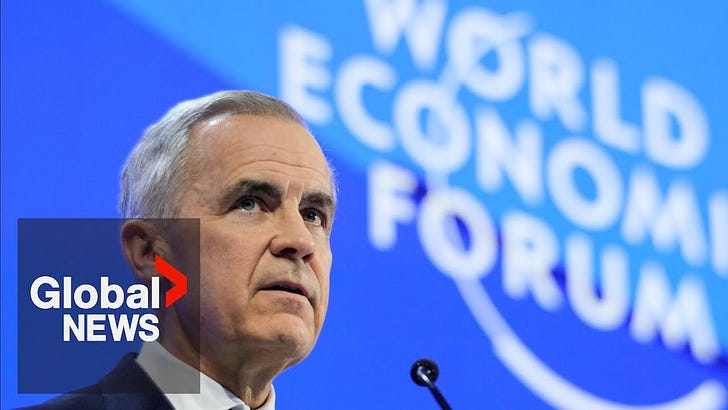
In that speech, he said “the rules-based order is fading,” and he acknowledged that we are “are in the midst of a rupture, not a transition.”
He quoted Václav Havel, whose words were already familiar to the Bette community. I have written multiple reports on Havel’s “The Power of the Powerless,” which Carney cited in his speech.


Carney went on to say:
“We know the old order is not coming back. We shouldn’t mourn it. Nostalgia is not a strategy, but we believe that from the fracture we can build something bigger, better, stronger, more just. This is the task of the middle powers, the countries that have the most to lose from a world of fortresses and the most to gain from genuine cooperation. The powerful have their power. But we have something too: the capacity to stop pretending, to name realities, to build our strength at home, and to act together.”
I have so much grief over US aggression toward Canada, which I wrote about in this report which includes the thoughts of Marci Shore and Michael Mackay, two of the great thinkers of our time.

And I was so elated by the historic developments of Canada becoming an associate member of the EU, that I invited MacKay to dash off this brief.

Carney’s statement about the union reads like poetry:
“The alliance between Canada and Europe is not defined by what we oppose, but by what we uphold: freedom, solidarity, prosperity, and sustainable development. An alliance strong enough that no one can dictate our choices to us. Individually, Europe and Canada are strong. Together, they are even stronger.”—Mark Carney, Prime Minister, Canada

Bette’s Sunday Speakeasy with Monique Camarra — ‘A Road Map For the Future’
I am thrilled that Monique Camarra will be our guest this Sunday at 11 am Pacific to discuss this groundbreaking alliance.
The exact moment Carney was elected, the geopolitical analyst, who grew up in Canada and now lives in Siena, Italy, told the Bette community that with Carney’s win, Canada and the EU would be forming a bridge, a union. And that gave me great comfort.
To prepare for our conversation, I asked Monique to offer us her insights and here is what she wrote:
Canada’s associate membership with the EU has been a long time coming, and most likely something that was being discussed even during the Trudeau premiership, in terms of cooperation in countering international terrorism and organised crime, as well as the CETA trade agreement that didn’t go as far as both parties wanted for political reasons. Let’s just say it was the icebreaker.
Prime Minister Carney is moving fast on an idea that emerged after the Cold War: what would happen to American economic and defence allies if the US pulled out as security guarantor? What should the response be? What does the “US pulling out” look like? This issue was heavily debated in American and European national security circles after the publication of Zbigniew Brzezinski’s The Choice (2005), although many others took the issue up less systematically.
So, Carney is following what Brzezinski and many advisors in the Obama administration were advocating: like-minded countries — mostly liberal democratic in nature — could coalesce together on transnational issues (climate change, transnational crime, space security, peace-keeping and mitigation, critical mineral supplies, etc.), allowing everyone to share the burden and not just a select few.
The nature of these issues is so taxing that not one country has the wherewithal to play leader. The UN framework was supposed to be revamped, but then Russia and China began influencing much of its workings, so that road was closed. So, this idea of how to respond to a possible US retreat from the global stage as leader of the free world popped up much earlier than we think. The international arena has changed since then, pressures are starting to mount, and the same question is now front and centre.
What we are seeing now is an acceleration of the trend under the Trump administration. Canada, Carney and the EU are responding by reaching out to like-minded partners to increase their strength and mitigate weaknesses. There’s too much volatility in American circles right now, and there’s no indication it will subside within the next decade, although many hope that its worst characteristics can be mitigated from within the US.
The EU and Canada cannot bank on the end of Trumpism coming any time soon, and quite frankly, it’s also an opportunity for the EU and Canada to diversify their resource base and alliances. Carney described Canada as a ‘middling nation’, so not in the league with the U.S., China, or Russia; therefore, it must seek stable, reliable, and opportune partners if it is to grow and thrive.
Canada and the EU share the same outlook, so it’s much easier to agree (within limits) on how to tackle all sorts of issues, and team up if too much pressure begins to build in any given shared sector.
Teaming up with the EU is also a question of stability: how is anyone going to do long-term business deals or agreements or even think of investing in another country if that country presents too many points of friction, like interference in the general economic and financial workings of the state? Businesses and investors need stability, or relative stability, and they need to decrease or mitigate risks as much as possible. Logically and strategically, Carney is looking toward Europe, Australia, and New Zealand, and other nations that can provide the possibility for authentic growth, as well as administrative and policy environments that won’t turn on a dime.
It’s also easier to counter international economic pressure or economic and political warfare. A group of partners can respond to various kinds of pressures in a coordinated way instead of going it alone. For example, if the Trump administration begins really hurting a coalition partner? Some can team up to put overt or covert economic pressure on the administration. China decides to cut critical mineral supplies to the EU? Well, Canada and some EU states have them, although they would need to be refined. Let’s remember that today’s financial markets are globalised and threats can come from both state and non-state players working together; international criminal organisations and combines are highly organised in terms of finances, logistics and personal networks, so there is no way a single nation has the human, financial, administrative and defensive resources to counter these organisations: they need to be in a coalition to do so effectively.
In the end, the Trump administration, with its constant public offending, its interference in Canadian politics (the Alberta referendum), the constant threat of an increase in tariffs or product embargos, and the overall unreliability of the American administration at this moment, gave Carney the green light to begin his quest for multilateral partners, which he had mentioned during his speech in Davos in January 2026. The US is trying to assert dominance, or at least the American administration is (I try to distinguish between the two), by putting everyone on the same political and moral level, as the administration set out in the National Security Strategy 2025.
This made all the difference for Carney and the EU. Culturally, the EU is a good fit for Canada. Both EU Commission President Ursula von der Leyen and Prime Minister Carney made direct references to the liberal democratic values we all embrace and emphasized their deep transatlantic roots; during WWI and WWII, Canada and many European soldiers fought shoulder to shoulder, losing precious lives together and liberating the entire continent together. Canadians have really applauded the associate membership because those roots are there, and the relationship makes sense, especially in these uncertain times. It’s no wonder Carney’s approval rating is now at over 70%, the highest ever registered for a Canadian prime minister. The EU is all about stability. It will enjoy many advantages in terms of business ventures, logistics, technological growth, cultural projects, and defence, which the EU member states need at home and in the Arctic.
Getting back to Canada, Carney and his team have given Canadians a road map for the future, but it’s more than just a mix of transatlantic economic, defence, and social agreements: it’s a vision. And right now, we are in such need of leadership with concrete, actionable plans set firmly within a liberal democratic fabric.—Monique Camarra for Bette Dangerous
****
With that bit of uplifting news, I look forward to seeing many of you on Sunday, as we continue to think our way to solutions for these trouble times. If you would like to join our vibrant pro-democracy community, please take out a membership here:
Lastly, a heartfelt thank you to those of you who are renewing your memberships and are new to the Bette community. Your support means everything to me. It’s been a devastating time to be a member of independent media, and I am so grateful for your continued support.
Keep scrolling to find the registration link.
****
****
Bette Dangerous is a reader-funded magazine. Thank you to all monthly, annual, and founding members.
I expose the corruption of billionaire fascists, while relying on memberships for support.
Thank you in advance for considering the following:
Share my reporting with allies
Buying my ebooks
A private link to an annual membership discount for older adults, those on fixed incomes or drawing disability, as well as activists and members of the media is available upon request at bettedangerous/gmail. 🥹
More info about Bette Dangerous - This magazine is written by Heidi Siegmund Cuda, an Emmy-award winning investigative reporter/producer, author, and veteran music and nightlife columnist. She is the cohost of RADICALIZED Truth Survives, an investigative show about disinformation and is part of the Byline Media team. Thank you for your support of independent investigative journalism.
🤍
Begin each day with a grateful heart.
🤍
REGISTRATION LINK FOUND HERE